
Properties of a Kite by David T
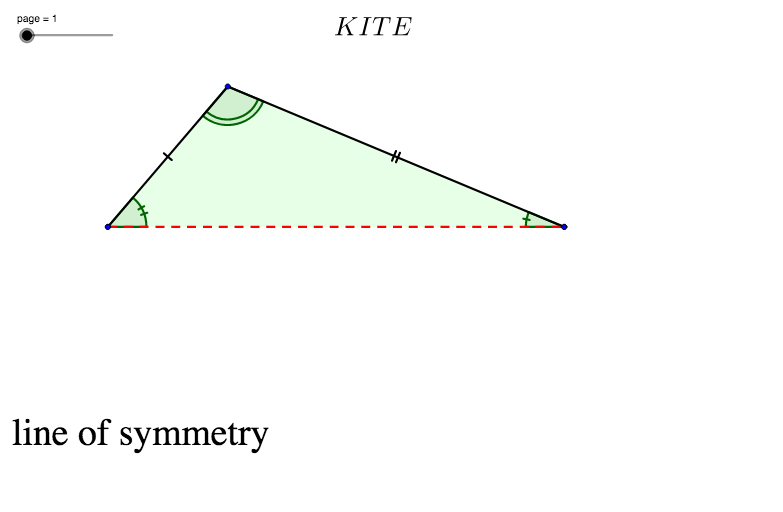
Loading the math board and drawing, please wait…
This example illustrates the properties of a kite. Key mathematical concepts include the definition of a kite, properties of its diagonals, and symmetry. Using GeoGebra commands such as Line, Polygon, Angle, and Segment, the construction process is dynamically demonstrated. Suitable for middle school and above students to learn geometric construction and related properties.
GeoGebra Commands & Parameters
Line(A, B) → aPolygon(A, B, C) → poly1, c, a_1, bAngle(B, A, C) → αAngle(A, C, B) → βAngle(C, B, A) → γSegment(A, B) → dMirror(A, d) → A'Mirror(B, d) → B'Mirror(C, d) → C'Polygon(A', B', C') → poly1', c', a', b'Angle(B, C', A) → δAngle(A, B, C') → εAngle(C', A, B) → ζSegment(C, C') → eIntersect(e, a) → DSegment(C, D) → fSegment(C', D) → gAngle(A, C, C') → ηAngle(C, C', A) → θAngle(C', A, C) → ιAngle(C, B, C') → κAngle(C', C, B) → λAngle(B, C', C) → μAngle(B, D, C) → νSegment(D, A) → h
AI Drawing Prompt Reference
Draw a kite ABCD and connect its diagonals AC and BD to find their intersection point O. Then mirror points B and C about point A to form points A' and C', creating a new kite A'B'C'D'. Measure and analyze the relationships between angles and segments, especially the properties of the diagonals and symmetry.
The prompt above was compiled from the original drawing commands and is for reference only.