
Proof without words: Sum of odd numbers equals square numbers
Loading the math board and drawing, please wait…
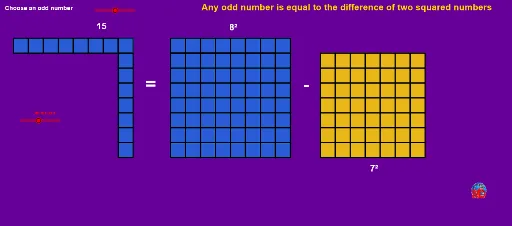
① This example demonstrates a classic proof without words: the sum of the first n consecutive odd numbers (1+3+5+…+(2n-1)) equals n², visualized dynamically. ② Core mathematical concepts include arithmetic sequences of odd numbers, square numbers, and geometric area equivalence, along with centroid and polygon transformations. ③ Construction highlights: using GeoGebra commands such as Intersect, Point, Polygon, Sequence, Element, Take, Centroid, Rotate, Translate, Vertex, Segment, Midpoint, and Vector, the applet builds multiple polygons (p1, p2, p3) and point lists (liste1, liste2, etc.), then rotates and translates them to assemble the odd-numbered unit squares into a larger square, with a slider (Animation) controlling n to reveal the pattern. ④ Suitable for middle and high school mathematics, especially for teaching sequence summation, square numbers, geometric proofs, and dynamic exploration, as well as for math enrichment activities.
GeoGebra Commands & Parameters
Intersect(xAxis, yAxis) → APoint(xAxis) → BPolygon(A, B, C, D) → p1, a, b, c, dSequence(Polygon[Translate[A, (i, 0)], Translate[B, (i, 0)], Translate[C, (i, 0)], Translate[D, (i, 0)]], i, 0, n - 1) → liste1Element(liste1, floor(n / 2) + 1) → p2Take(liste1, 1, floor(n / 2)) → liste2Take(liste1, floor(n / 2) + 2, n) → liste3Centroid(p2) → ERotate(liste3, ((-Animation) * π / 2), E) → liste3'Rotate(liste3, -1.5707963267948966, E) → liste3'_1Polygon(F, G, H, I) → p3, f, g, h, iSequence(Polygon[Translate[F, (i, 0)], Translate[G, (i, 0)], Translate[H, (i, 0)], Translate[I, (i, 0)]], i, 0, floor(n / 2)) → liste4Sequence(Translate[liste4, (0, (-i))], i, 0, floor(n / 2)) → liste5Translate(F, (floor(n / 2) + 3.5, -1)) → F'Translate(G, (floor(n / 2) + 3.5, -1)) → G'Translate(H, (floor(n / 2) + 3.5, -1)) → H'Translate(I, (floor(n / 2) + 3.5, -1)) → I'Translate(F, (floor(n / 2) + 3, -1)) → F'_1Translate(G, (floor(n / 2) + 3, -1)) → G'_1Translate(H, (floor(n / 2) + 3, -1)) → H'_1Translate(I, (floor(n / 2) + 3, -1)) → I'_1Polygon(F'_1, G'_1, H'_1, I'_1) → p3', f'_1, g'_1, h'_1, i'_1Sequence(Polygon[Translate[F'_1, (i, 0)], Translate[G'_1, (i, 0)], Translate[H'_1, (i, 0)], Translate[I'_1, (i, 0)]], i, 0, floor(n / 2) - 1) → liste6Sequence(Translate[liste6, (0, (-i))], i, 0, floor(n / 2) - 1) → liste7Translate(liste7, Vector[((2 - Animation) * (floor(n / 2) + 3, 0))]) → liste7'Translate(liste7, Vector[((2 - 3) * (floor(n / 2) + 3, 0))]) → liste7'_1Vertex(Element[liste4, 1], 4) → JVertex(Element[liste4, floor(n / 2) + 1], 4) → KVertex(Element[Element[liste5, floor(n / 2) + 1], floor(n / 2) + 1], 4) → LSegment(J, K) → eSegment(L, K) → jSequence(Translate[liste4, (0, (-i))], i, 0, floor(n / 2)) → liste5bSequence(Translate[liste6, (0, (-i))], i, 0, floor(n / 2) - 1) → liste7bTranslate(liste7b, Vector[((2 - Animation) * (floor(n / 2) + 3, 0))]) → liste7b'Take(liste1, 1, floor(n / 2)) → liste2bElement(liste1, floor(n / 2) + 1) → p2bTake(liste1, floor(n / 2) + 2, n) → liste3bRotate(liste3, ((-Animation) * π / 2), E) → liste3b'Rotate(liste3, -1.5708, E) → liste3b'_1Translate(liste7, Vector[((2 - 3) * (floor(n / 2) + 3, 0))]) → liste7b'_1Midpoint(G, M) → NMidpoint(P, O) → QMidpoint(R, S) → TVector(Q, T) → uTranslate(Q, Vector[(If[Animation < 2, 0, If[Animation < 3, Animation - 2, 1]] * u)]) → Q'Midpoint(A, U) → W
AI Drawing Prompt Reference
Create a dynamic geometric illustration showing that the sum of the first n odd numbers equals n squared. The figure consists of unit squares arranged in a staircase pattern, with some squares rotated about their centroid and others translated to assemble into a larger square. A slider controls the value of n, revealing how the odd-numbered squares combine to form a perfect square, demonstrating the area equivalence.
The prompt above was compiled from the original drawing commands and is for reference only.