
Proof of Angle Equality: Similarity Transformation Exploration
Loading the math board and drawing, please wait…
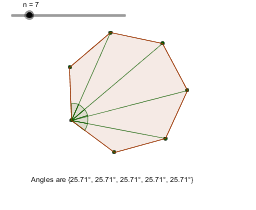
This example demonstrates how to prove that a set of angles are equal through geometric construction. The core mathematical concepts involve similar triangles, similarity transformations, and geometric mean applications. Construction details: Using the Polygon command to create polygon object poly1, the Sequence command to generate multiple angle variables (a through t with subscripts), and a slider parameter n to control iterative construction. Suitable for high school students and competition math learners, serving as an intuitive demonstration for triangle similarity criteria and angle relationship proofs.
GeoGebra Commands & Parameters
Polygon(A, B, n) → poly1, a, j, k, l, m, p, q, r, s, t, a_1, b, b_1, c_1, d_1, e_1, f_1, g_1, h_1, i_1, j_1, k_1, c, l_1, C, D, E, F, G, H, I, J, K, d, L, M, N, O, P, Q, R, S, T, U, e, V, W, Z, A_1, B_1, C_1, D_1, E_1, F_1, f, g, h, iSequence(Angle[Element[list1, i], A, Element[list1, i + 1]], i, 2, n - 1) → list2Sequence(Segment[A, Element[list1, i]], i, 3, n - 1) → list3
AI Drawing Prompt Reference
Draw a regular polygon with vertices arranged in order. From one fixed vertex, draw line segments to all other vertices, creating multiple triangles. Using the fixed vertex as the common vertex, measure and label the angles between consecutive segments. Include a slider to adjust the number of sides, dynamically showing how these angles change, thereby illustrating the equality of corresponding angles in similar triangles.
The prompt above was compiled from the original drawing commands and is for reference only.