
Blancmange (Fancurve) Fractal via Series Summation
Loading the math board and drawing, please wait…
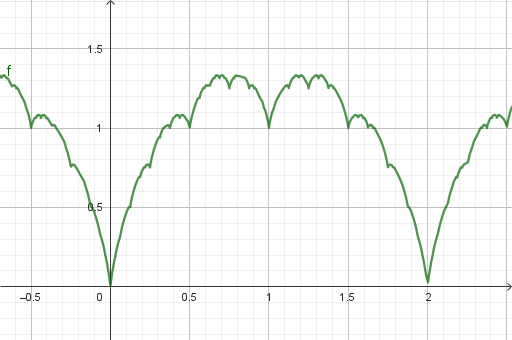
This example demonstrates how the Blancmange curve—a classic fractal—can be generated by iteratively adding simple periodic “triangle-wave” components. It highlights key ideas from fractal geometry (self-similarity), constructing a function using piecewise/periodic waveform behavior, and using sequences with summation to refine the curve layer by layer. The construction follows the GeoGebra command plan from the summary: it uses Sequence and Sum to organize parameters and iteration levels (objects such as T, a, n, l1, and the function f). In practice, each term in the Sequence is mapped through the function f, and the curve is obtained by taking the running total with Sum over n. Suitable for advanced secondary students and early university learners for exploring function graphs, sequences, and visually building fractal structure from elementary rules.
GeoGebra Commands & Parameters
Sequence((a^(N) * T((2^(N) * x))), N, 0, n) → l1Sum(l1) → f
AI Drawing Prompt Reference
Draw a fractal curve to illustrate how the Blancmange curve, a classic fractal, is generated by iteratively adding simple periodic triangle-wave components. Start by constructing successive layers of curves based on a power function and a trigonometric function, where each layer's amplitude and frequency are exponentially scaled. Finally, sum all the layers to form a continuous, self-similar fractal structure, visually demonstrating the principles of self-similarity in fractal geometry and the accumulation process of function graphs through sequences.
The prompt above was compiled from the original drawing commands and is for reference only.