
Problem in a Parallelogram
Loading the math board and drawing, please wait…
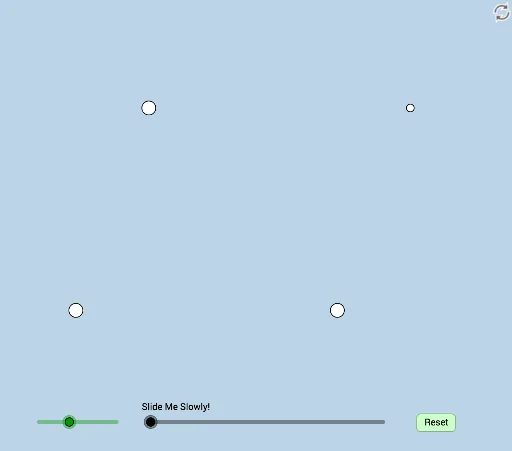
This is a dynamic and modifiable illustration of a problem within a parallelogram. Using transformations like rotation and translation, various geometric relationships within the parallelogram can be explored. Commands used include Line, Ray, Rotate, Point, Midpoint, Intersect, Segment, Angle, Min, Circle, Dilate, CircleSector, Vector, Translate, Polygon, LineBisector, Distance. Suitable for middle school and above students to learn about geometric transformations and explore the properties of parallelograms.
GeoGebra Commands & Parameters
Line(A, B) → s_1Ray(A, B) → fRotate(B, a°, A) → B'Ray(A, B') → gPoint(g) → CMidpoint(B, C) → WLine(W, s_1) → t_1Line(C, f) → iLine(B, g) → hIntersect(h, i) → DSegment(D, B) → k_1Intersect(t_1, k_1) → F_1Segment(D, F_1) → k_2Angle(B, A, B') → αSegment(C, D) → jSegment(A, B) → kSegment(B, D) → lSegment(A, C) → mMin(m, k) → bCircle(C, (0.2 * b)) → dCircle(A, (0.15 * b)) → eCircle(B, (0.2 * b)) → pCircle(D, (0.2 * b)) → cIntersect(e, k, 1) → EIntersect(e, m, 1) → FIntersect(p, k, 1) → GIntersect(p, l, 1) → HIntersect(d, g, 2) → IRay(C, I) → qIntersect(c, h, 2) → JRay(D, J) → rIntersect(c, i, 2) → KRay(D, K) → sDilate(A, If[0 < o ≤ 1, 1 - o, 0], B) → A'Segment(A, A') → tRotate(E, If[1 < o ≤ 2, ((o - 1) * α), α], A) → E'CircleSector(A, E, E') → c_1Dilate(A, If[2 < o ≤ 3, 3 - o, 0], C) → A'_1Vector(A, A'_1) → uTranslate(c_1, u) → d_1Segment(A, A'_1) → f_1Dilate(C, If[3 < o ≤ 4, 4 - o, 0], D) → C'Vector(C, C') → vTranslate(d_1, v) → e_1Segment(C, C') → g_1Dilate(D, If[4 < o ≤ 5, 5 - o, 0], B) → D'Segment(D, D') → h_1Polygon(A, B, D, C) → poly1, a_1, b_1, d_2, c_2Dilate(A, If[5.5 < o ≤ 6.5, 6.5 - o, 0], C) → A'_2Vector(A, A'_2) → wTranslate(A, w) → A'_3Translate(A', w) → A''Dilate(A, If[6.5 < o ≤ 7.5, 7.5 - o, 0], B) → A'_4Vector(A, A'_4) → u_1Translate(A, u_1) → A'_5Translate(A'_1, u_1) → LIntersect(d, i) → M, NIntersect(d, g) → O, PAngle(A, C, N) → βRotate(N, If[6.5 < o ≤ 7.5, ((-(o - 6.5)) * β), (-β)], C) → N'Dilate(C, If[7.5 < o ≤ 8.5, 8.5 - o, 0], B) → C'_1Vector(C, C'_1) → v_1Ray(A, B) → q_1LineBisector(B, A) → r_1Distance(C, B) → distanceCBSegment(C, D) → i_1Line(A, D) → j_1Line(C, A) → m_1Intersect(e, j_1) → S, TIntersect(e, m_1) → U, VAngle(D, A, C) → γRotate(T, If[10 < o ≤ 11, ((o - 10) * γ), γ], A) → T'Midpoint(A, D) → A_1Midpoint(C, D) → QMidpoint(A, B) → RPoint(k_2) → ZRay(Z, Q) → l_1Ray(B, C) → n_1Intersect(n_1, l_1) → B_1Ray(R, B_1) → p_1Intersect(t_1, p_1) → C_1Line(C_1, Q) → f_2Line(R, Z) → g_2Line(C, A) → h_2Intersect(h_2, t_1) → D_1Intersect(n_1, l_1) → E_1Segment(R, C_1) → i_2Dilate(A, If[6 < o ≤ 7, 7 - o, 0], R) → A'_6Segment(A, A'_6) → l_2Rotate(A, If[7 < o ≤ 8, ((-(o - 7)) * π), (-π)], R) → A'_7Rotate(A'_6, If[7 < o ≤ 8, ((-(o - 7)) * π), (-π)], R) → G_1Segment(A'_7, G_1) → m_2Dilate(A, If[8 < o ≤ 9, 9 - o, 0], C) → A'_8Vector(A, A'_8) → w_1Translate(A, w_1) → A'_9Translate(A'_6, w_1) → H_1Segment(A'_9, H_1) → n_2Translate(A'_7, w_1) → L_1Translate(G_1, w_1) → M_1Segment(L_1, M_1) → p_2Dilate(B, If[9 < o ≤ 10, 10 - o, 0], W) → B'_1Segment(B, B'_1) → j_2Dilate(W, If[10 < o ≤ 11, 11 - o, 0], C) → W'Segment(W, W') → q_2Rotate(B, If[11 < o ≤ 12, ((-(o - 11)) * π), (-π)], W) → B'_2Rotate(B'_1, If[11 < o ≤ 12, ((-(o - 11)) * π), (-π)], W) → I_1Segment(B'_2, I_1) → r_2Dilate(Z, If[13 < o ≤ 14, 14 - o, 0], Q) → Z'Segment(Z, Z') → s_2Dilate(Q, If[14 < o ≤ 15, 15 - o, 0], B_1) → Q'Segment(Q, Q') → t_2Dilate(C, If[14 < o ≤ 15, 15 - o, 0], B_1) → C'_2Segment(C, C'_2) → a_2Dilate(W, If[15 < o ≤ 16, 16 - o, 0], D_1) → W'_1Segment(W, W'_1) → b_2Line(W, D_1) → e_2Circle(D_1, 2) → c_3Intersect(c_3, e_2) → J_1, K_1Ray(D_1, K_1) → f_3Rotate(d_1, If[16 < o ≤ 17, ((o - 16) * π), π], C) → d_3Dilate(C, If[17 < o ≤ 18, 18 - o, 0], D_1) → C'_3Vector(C, C'_3) → u_2Translate(d_3, u_2) → e_3Intersect(g_2, j_2) → N_1Segment(R, N_1) → g_3Min(i_2, g_3) → o_1Circle(R, (0.35 * o_1)) → h_3Intersect(h_3, g_2) → O_1, P_1Angle(N_1, R, C_1) → δDilate(B_1, If[18 < o ≤ 19, 19 - o, 0], C_1) → Q_1Segment(B_1, Q_1) → i_3Dilate(C_1, If[19 < o ≤ 20, 20 - o, 0], R) → R_1Segment(C_1, R_1) → j_3Dilate(R, If[20 < o ≤ 21, 21 - o, 0], Z) → R'Segment(R, R') → k_3Dilate(C_1, If[21 < o ≤ 22, 22 - o, 0], Q) → S_1Segment(C_1, S_1) → l_3Rotate(P_1, If[22 < o ≤ 23, ((o - 22) * δ), δ], R) → T_1CircleSector(R, P_1, T_1) → p_3Dilate(R, If[23 < o ≤ 24, 24 - o, 0], C_1) → R'_1Vector(R, R'_1) → v_2Translate(p_3, v_2) → q_3
AI Drawing Prompt Reference
Draw a parallelogram ABCD with points A, B, C, and D as vertices. First, draw the line segment AB and the ray BC, then find the midpoint W of BC and draw a line t1 through W parallel to AB. Next, draw a line i from C to f, intersecting h at D. Connect BD and find point F1 on BD such that DF1 is parallel to t1. Then, draw angle BAC with degree α, and draw circles with centers at C, D, and radii 0.2 times BD, intersecting with corresponding lines to get points E, F, G, and H. Draw a circle with center at A and radius 0.15 times BD, intersecting with corresponding lines to get E', and draw a sector with center at A and radius E'E. Draw a circle with center at C and radius 0.2 times BD, intersecting with corresponding lines to get C', and draw a circle with center at C and radius C'C. Finally, draw a circle with center at D and radius 0.2 times BD, intersecting with corresponding lines to get D', and draw a circle with center at D and radius D'D.
The prompt above was compiled from the original drawing commands and is for reference only.