
Prism Volume by Ashar_Arabi
Loading the math board and drawing, please wait…
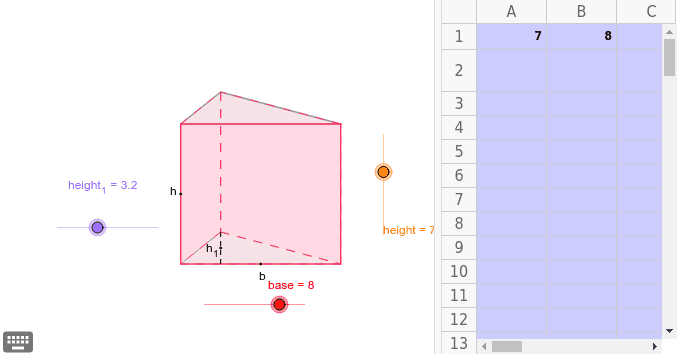
This example demonstrates how to calculate the volume of a prism using geometric transformations and measurements. Key mathematical concepts include the volume calculation methods for prisms in solid geometry. Using GeoGebra commands such as Dilate, Vector, and Intersect, the construction process of the prism is dynamically shown. Suitable for middle school and above students or teachers.
GeoGebra Commands & Parameters
Dilate(F, height, E) → GVector(E, G) → uDilate(I, base, H) → LVector(H, L) → vCircle(J, height_1) → gLine(J, K) → hIntersect(g, h, 1) → MVector(J, M) → wTranslate(A, v) → BCircle(J, 1) → dMidpoint(A, B) → CMidpoint(C, A) → DTranslate(D, Vector[w / 2]) → NPolygon(A, N, B) → P, b, a, nTranslate(A, u) → A'Translate(N, u) → N'Translate(B, u) → B'Polygon(A', N', B') → P', b', a', n'Polygon(A', N', N, A) → Q, a'_1, n'_1, n_1, a_1Polygon(N', N, B, B') → R, n'_2, n_2, b_1, b'_1Polygon(B', B, A, A') → S, b'_2, b_2, a_2, a'_2Segment(N, D) → cMidpoint(A, A') → OMidpoint(N, D) → TIf(VolumeFormula ≟ 1, U) → ZIf(VolumeSolution ≟ 1, V) → A_1AngularBisector(A, N, B) → eAngularBisector(B, A, N) → fIntersect(f, e) → WTranslate(W, u) → Y
AI Drawing Prompt Reference
Draw a prism by geometric transformations and measurements to calculate its volume. Start with a base, then stretch it vertically to form the prism. Use vector tools to determine the height and direction, and assist construction with circles and lines. Finally, draw the lateral and base faces of the prism using polygon tools, labeling key points and segments to show the volume calculation process.
The prompt above was compiled from the original drawing commands and is for reference only.