
Cone Volume by Ashar_Arabi
Loading the math board and drawing, please wait…
In collections
Investigating Volume
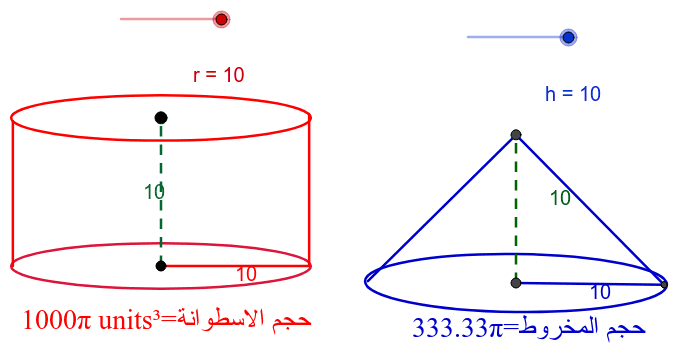
This example demonstrates the calculation of a cone's volume. Key mathematical concepts include the geometric properties of a cone and the volume formula. Using GeoGebra commands such as Circle, Point, Line, Intersect, etc., a cone is constructed and its volume is calculated. Suitable for high school mathematics education and learning.
GeoGebra Commands & Parameters
Circle(A, r) → cPoint(c) → BLine(B, A) → aIntersect(c, a) → C, DPoint(c) → ELine(E, A) → bPoint(b) → FPoint(b) → GEllipse(B, D, G) → dPoint(Circle[A, h]) → HSegment(A, H) → eRotate(A, 90*°, A) → A'Rotate(H, 90*°, A) → H'Segment(A', H') → e'Vector(A, H') → uTranslate(d, u) → d'OrthogonalLine(B, e) → fOrthogonalLine(H, e) → gIntersect(d', f) → I, JIntersect(d', g) → K, LSegment(B, I) → iSegment(H, K) → jSegment(A, D) → kOrthogonalLine(D, k) → lIntersect(d', l) → N, OSegment(O, D) → mCircle(P, r) → pPoint(p) → QLine(P, Q) → nOrthogonalLine(P, n) → qRotate(P, 30*°, Q) → P'Angle(P, Q, P') → αLine(Q, P') → sRotate(P, 330*°, Q) → P'_1Angle(P'_1, Q, P) → βLine(Q, P'_1) → tIntersect(t, s) → RIntersect(q, t) → SIntersect(s, q) → TLine(P, Q) → a_1OrthogonalLine(P, a_1) → b_1Rotate(P, 15*°, Q) → P'_2Angle(P, Q, P'_2) → γRotate(P, 345*°, Q) → P'_3Angle(P'_3, Q, P) → δLine(Q, P) → c_1Line(Q, P) → d_1Intersect(p, d_1) → U, VEllipse(V, Q, W) → e_1Segment(P, Q) → f_1Point(e_1) → A_1Point(Circle[P, h]) → ZSegment(P, Z) → g_1Rotate(Z, 90*°, P) → Z'Segment(P, Z') → h_1Segment(V, Z') → i_1Segment(Z', Q) → j_1
AI Drawing Prompt Reference
Draw a cone with a circular base centered at a point with a given radius. Pick a point on the base circle and connect it to the center to form a radius line intersecting the circle at two opposite points. Choose another point on the circle, draw a second radius line, and place two points on it; use these three points to construct an ellipse representing the cone's lateral surface. From the center, draw a vertical segment upward to a top point, and translate the base ellipse along this height to create the top ellipse. Connect the diameter endpoints on the base to corresponding points on the top to form the cone's slant edges. Additionally, draw an auxiliary circle, pick points on it, and create rotated lines and angles to form intersecting points, illustrating geometric relations for volume calculation.
The prompt above was compiled from the original drawing commands and is for reference only.