
Types of Angles by Ashar_Arabi
Loading the math board and drawing, please wait…
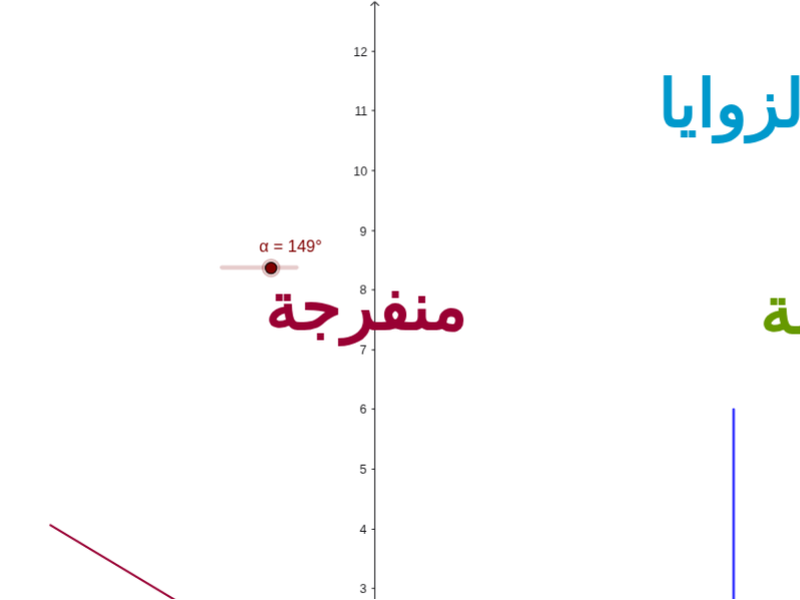
This example demonstrates the geometric representation and classification of different types of angles, including acute, right, obtuse, and reflex angles. It involves core mathematical concepts such as angle measurement, angle sum in triangles, and central angles in circles. The construction uses GeoGebra commands like Rotate, Angle, Segment, and LaTeX, along with objects like I, J, β, D, E, γ_1, etc. It is suitable for middle school students and above for learning angle classifications and properties, or for mathematical teaching demonstrations.
GeoGebra Commands & Parameters
Rotate(D, β, E) → D'Angle(D, E, D') → γ_1Segment(D, E) → aSegment(D', E) → bRotate(A, α, B) → A'Angle(A, B, A') → δSegment(A, B) → cSegment(B, A') → dSegment(C, F) → eSegment(F, G) → fAngle(G, F, C) → γLaTeX(β, true, true) → text2LaTeX(γ, true, true) → text3LaTeX(α, true, true) → text4
AI Drawing Prompt Reference
Draw a geometric diagram showing acute, right, obtuse, and reflex angles. Include a triangle and a circle, labeling each angle with different colors and their measures. Start by drawing a side of the triangle, then rotate it to form various angles. Next, draw central angles in the circle, and finally label the angle sizes with formulas.
The prompt above was compiled from the original drawing commands and is for reference only.