
Rhombicosidodecahedron and Its Dual Deltoidal Hexecontahedron: Edge/Face Colorin
Loading the math board and drawing, please wait…
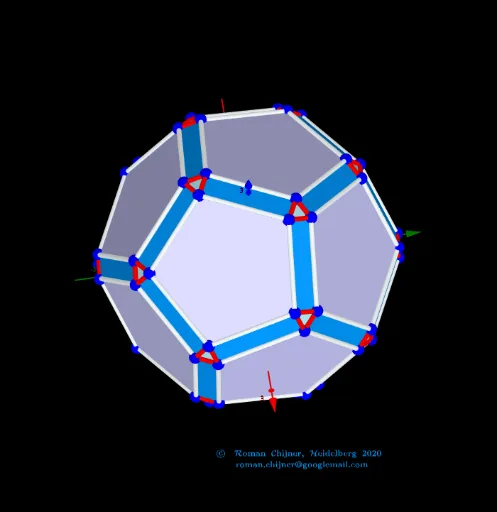
This GeoGebra example visualizes the geometry of a Rhombicosidodecahedron-c (V=60) together with its dual, the Deltoidal Hexecontahedron (V=62), and highlights their structural symmetry by systematically coloring edges and faces in 3D. Key mathematical ideas include dual polyhedra, solid geometry, and quantitative measures referenced to a sphere (e.g., volume computations using Sphere as a scale). Construction-wise, it uses Sequence to generate collections of geometric objects, Sphere and volume-related objects (Vol, Vold, Vol_{sphere}, Vol_r, Vold_r) to set the metric context, PointIn and Angle to support spatial selection and angular relationships, and Segment for edge creation. Objects are filtered and organized with If, Sort, First, and KeepIf so that only selected edges/faces are included in the coloring scheme. Finally, Textfield, TableText, UnicodeToLetter, and multiple text objects label and display parameters/results. Suitable for advanced high school through university-level geometry visualization, symmetry/adversarial duality learning, and math-software demonstrations.
GeoGebra Commands & Parameters
Sequence(((zoom * Element[Element[A00d, i], 1]), (zoom * Element[Element[A00d, i], 2]), (zoom * Element[Element[A00d, i], 3])), i, 1, Length[A00d]) → A0dSequence(((zoom * Element[Element[A00, i], 1]), (zoom * Element[Element[A00, i], 2]), (zoom * Element[Element[A00, i], 3])), i, 1, Length[A00]) → A0Sphere(O, r_o) → sp02dTextfield(R1sphere) → InputBox5Sphere(O, R1sphere) → sp01Textfield(r_o) → InputBox6Textfield(jarc) → InputBox8Textfield(jarc_d) → InputBox9Textfield(f_{Poly}) → InputBox11Textfield(k) → InputBox15Textfield(k_d) → InputBox14TableText({Append["i", 1…Length[mm5a]], Append["\fgcolor{orange}{n}", mm5a], Append["\fgcolor{orange}{N}", mm7a], Append["\fgcolor{#007FFF}{n/dual}", mm5ad], Append["\fgcolor{#007FFF}{N}", mm7ad]}, "hr") → text24Textfield(iseg) → InputBox17Textfield(f_{Poly}d) → InputBox18Textfield(isegd) → InputBox19UnicodeToLetter(34) → u34TableText({Append["i", 1…Max[Length[Segn], Length[Segnd]]], Append["\fgcolor{orange}{s_i}", Segn / Segments_o1], Append["\fgcolor{orange}{N}", lLength], Append["\fgcolor{#007FFF}{s_id}", Segnd / Segments_o1d], Append["\fgcolor{#007FFF}{N}", lLengthd]}, "hr") → text23Textfield(n_3) → InputBox20If(n_3 ≟ 0, "", Text["" + n_3]) → txt_3Textfield(nd_3) → InputBox21If(nd_3 ≟ 0, "", Text["" + nd_3]) → txtd_3Circle(A_{farbe}, rfabe) → farbekreisPointIn(farbekreis) → AAngle(A) → αSegment(C, D) → hSort(Sequence[Segment[Element[A0, Element[Element[nom, i], 1]], Element[A0, Element[Element[nom, i], 2]]], i, 1, Length[nom]]) → SegmentsFirst(Segments, i_s) → Segments_oSort(Sequence[Segment[Element[A0d, Element[Element[nomd, i], 1]], Element[A0d, Element[Element[nomd, i], 2]]], i, 1, Length[nomd]]) → SegmentsdFirst(Segmentsd, id_s) → Segmentsd_oKeepIf(round((x * 10^(k))) / 10^(k) ≟ Element[Segn, 1], Segments) → la1KeepIf(round((x * 10^(k))) / 10^(k) ≟ Element[Segn, 2], Segments) → la2KeepIf(round((x * 10^(k))) / 10^(k) ≟ Element[Segn, 3], Segments) → la3KeepIf(round((x * 10^(k))) / 10^(k) ≟ Element[Segn, 4], Segments) → la4Sequence(Polygon[Element[A0, Element[Element[mm1, f], 1]], Element[A0, Element[Element[mm1, f], 2]], Element[A0, Element[Element[mm1, f], 3]]], f, 1, Length[mm1]) → poly_{3}KeepIf(round((x * 10^(k))) / 10^(k) ≟ Element[poly_{3}S, 1], poly_{3}) → poly_{3}1Sequence(Polygon[Sequence[A0(mm6(1, f, k)), k, 1, Length[mm6(1, 1)]]], f, 1, Length[mm6(1)]) → poly_{4}Sequence(Polygon[Sequence[A0(mm6(2, f, k)), k, 1, Length[mm6(2, 1)]]], f, 1, Length[mm6(2)]) → poly_{5}KeepIf(round((x * 10^(k))) / 10^(k) ≟ Element[Segnd, 1], Segmentsd) → lad1KeepIf(round((x * 10^(k))) / 10^(k) ≟ Element[Segnd, 2], Segmentsd) → lad2KeepIf(round((x * 10^(k))) / 10^(k) ≟ Element[Segnd, 3], Segmentsd) → lad3Sequence(Polygon[Element[A0d, Element[Element[mm1d, f], 1]], Element[A0d, Element[Element[mm1d, f], 2]], Element[A0d, Element[Element[mm1d, f], 3]]], f, 1, Length[mm1d]) → polyd_{3}KeepIf(round((x * 10^(k))) / 10^(k) ≟ Element[poly_{3}Sd, 1], polyd_{3}) → polyd_{3}1
AI Drawing Prompt Reference
Draw a rhombicosidodecahedron and its dual deltoidal hexecontahedron, both sharing a common circumsphere. Color the original solid's edges and faces in orange, and the dual's in blue. Use input boxes to adjust scale, radius, and color parameters, and display tables of volumes and edge lengths. Construct edges as segments between vertices, fill faces as polygons, and filter specific edges/faces by length for coloring. Include a circular color wheel with an angle indicator for interactive color selection. Show the symmetry and quantitative measures of the two dual polyhedra.
The prompt above was compiled from the original drawing commands and is for reference only.