
Place Value Practice: Visualizing Digits with Polygons and Random Points
Loading the math board and drawing, please wait…
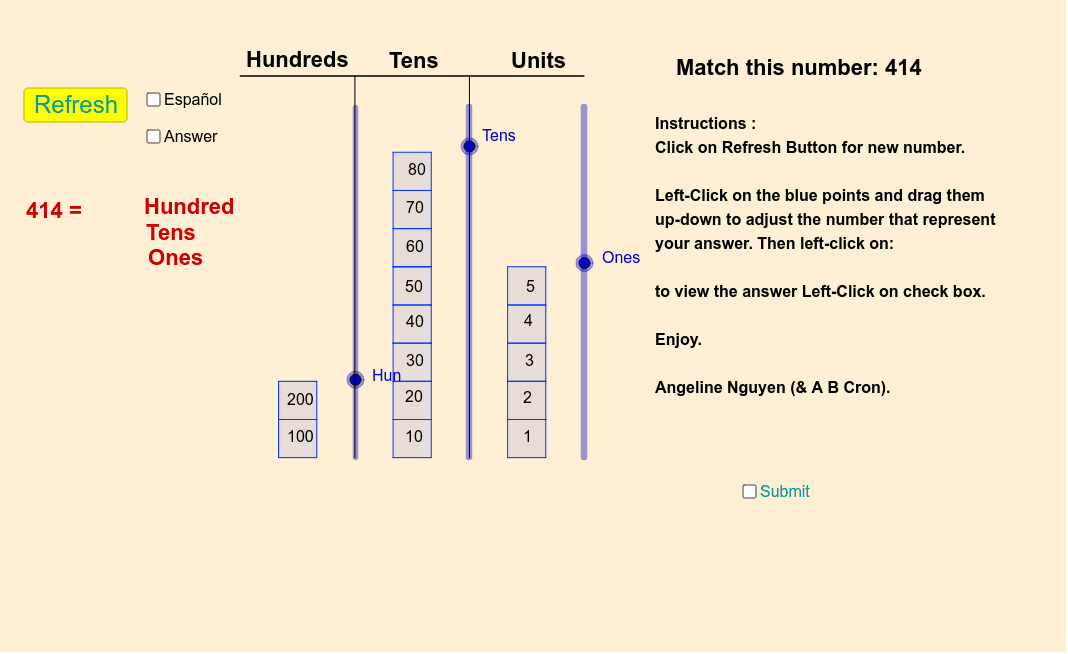
This GeoGebra example dynamically illustrates the concept of place value (ones, tens, hundreds, etc.) by using randomly generated polygons and points to represent digits in different positions. It helps learners intuitively grasp the decimal system and the relationship between digit position and numerical value. Core mathematical concepts include decimal notation, place value, and the use of modulo arithmetic (Mod) to extract individual digits. Construction highlights: the Polygon command creates rectangular regions for each place, Segment draws separators, Random generates random digits, Intersect and Point locate key positions, and Mod computes the digit values. Suitable for early elementary math classes or beginners reinforcing place value, and useful for teachers creating interactive practice materials.
GeoGebra Commands & Parameters
Polygon(A, B, C, D) → polyU9b_1, seg9b, seg9c, seg9d, seg9aPolygon(E, F, G, H) → polyU7b, seg7b, seg7c, seg7d, seg7aPolygon(I, J, K, L) → polyU5B, seg5b, seg5c, seg5d, seg5aPolygon(M, N, O, P) → polyU3b, seg3b, seg3c, seg3d, seg3aPolygon(Q, R, S, T) → polyU1B, seg1b, seg1c, seg1d, seg1aPolygon(U, V, W, Z) → polyT9b, seg90b, seg90c, seg90d, seg90aPolygon(A_1, B_1, C_1, D_1) → polyT7b, seg70b, seg70c, seg70d, seg70aPolygon(E_1, F_1, G_1, H_1) → polyT5b, seg50b, seg50c, seg50d, seg50aPolygon(I_1, J_1, K_1, L_1) → polyT3b, seg30b, seg30c, seg30d, seg30aPolygon(M_1, N_1, O_1, P_1) → polyT1b, seg10b, seg10c, seg10d, seg10aPolygon(Q_1, R_1, S_1, T_1) → polyC9b, seg900b, seg900a, seg900d, seg900cPolygon(U_1, V_1, W_1, Z_1) → polyC7b, seg700b, seg700c, seg700d, seg700aPolygon(A_2, B_2, C_2, D_2) → polyC5b, seg500b, seg500c, seg500d, seg500aPolygon(E_2, F_2, G_2, H_2) → polyC3b, seg300b, seg300c, seg300d, seg300aPolygon(I_2, J_2, K_2, L_2) → polyC1b, seg100b, seg100c, seg100d, seg100aSegment(M_2, N_2) → dividerUnitSegment(O_2, P_2) → dividerTensRandom(0, 999) → num_ASegment(Q_2, R_2) → dividerUpIntersect(seg9a, seg9d) → S_2Intersect(seg9d, seg9c) → T_2Intersect(seg7c, seg7b) → U_2Intersect(seg7a, seg7b) → V_2Polygon(S_2, T_2, U_2, V_2) → polyU8b, seg8b, seg8c, seg8d, seg8aIntersect(seg7a, seg7d) → W_2Intersect(seg7d, seg7c) → Z_2Intersect(seg5c, seg5b) → A_3Intersect(seg5a, seg5b) → B_3Polygon(W_2, Z_2, A_3, B_3) → polyU6b, seg6b, seg6c, seg6d, seg6aPoint(seg5d) → C_3Intersect(seg5d, seg5c) → D_3Intersect(seg3c, seg3b) → E_3Intersect(seg3a, seg3b) → F_3Polygon(C_3, D_3, E_3, F_3) → polyU4b, seg4b, seg4c, seg4d, seg4aIntersect(seg3a, seg3d) → G_3Intersect(seg1c, seg1b) → I_3Intersect(seg1a, seg1b) → J_3Polygon(G_3, H_3, I_3, J_3) → polyU2b, seg2b, seg2c, seg2d, seg2aIntersect(seg30d, seg30c) → K_3Intersect(seg10c, seg10b) → L_3Intersect(seg10a, seg10b) → M_3Intersect(seg30a, seg30d) → N_3Polygon(K_3, L_3, M_3, N_3) → polyT2b, seg20c, seg20d, seg20a, seg20bIntersect(seg30c, seg30b) → O_3Intersect(seg30a, seg30b) → P_3Point(seg50a) → Q_3Intersect(seg50d, seg50c) → R_3Polygon(O_3, P_3, Q_3, R_3) → polyT4b, seg40d, seg40a, seg40b, seg40cPoint(seg50b) → S_3Intersect(seg70a, seg70d) → T_3Intersect(seg50c, seg50b) → V_3Polygon(S_3, T_3, U_3, V_3) → polyT6b, seg60a, seg60b, seg60c, seg60dIntersect(seg90a, seg90d) → W_3Intersect(seg90d, seg90c) → Z_3Intersect(seg70c, seg70b) → A_4Polygon(W_3, Z_3, A_4, B_4) → polyT8b, seg80b, seg80c, seg80d, seg80aPoint(seg900d) → C_4Intersect(seg900c, seg900d) → D_4Intersect(seg700c, seg700b) → E_4Intersect(seg700a, seg700b) → F_4Polygon(C_4, D_4, E_4, F_4) → polyC8b, seg800b, seg800c, seg800d, seg800aPoint(seg700d) → G_4Intersect(seg700d, seg700c) → H_4Intersect(seg500c, seg500b) → I_4Intersect(seg500a, seg500b) → J_4Polygon(G_4, H_4, I_4, J_4) → polyC6b, seg600b, seg600c, seg600d, seg600aIntersect(seg500a, seg500d) → K_4Intersect(seg500d, seg500c) → L_4Point(seg300c) → M_4Intersect(seg300a, seg300b) → N_4Polygon(K_4, L_4, M_4, N_4) → polyC4b, seg400b, seg400c, seg400d, seg400aPoint(seg300a) → O_4Intersect(seg300d, seg300c) → P_4Intersect(seg100c, seg100b) → Q_4Intersect(seg100a, seg100b) → R_4Polygon(O_4, P_4, Q_4, R_4) → polyC2b, seg200b, seg200c, seg200d, seg200aMod(num_A, 10) → numUMod(num_A, 100) → numTT
AI Drawing Prompt Reference
Create a practice diagram for place value: arrange three vertical rectangular sections on the canvas, representing ones, tens, and hundreds, each composed of two smaller rectangles separated by a horizontal line. Inside each section, place random points to represent the digit value, with the number of points matching the digit. Draw vertical dividers between the sectionshol, and add a random three-digit number label at the top. The layout should be clear for comparing point counts with digit positions.
The prompt above was compiled from the original drawing commands and is for reference only.