
Exploring the Sum of Exterior Angles of a Polygon
Loading the math board and drawing, please wait…
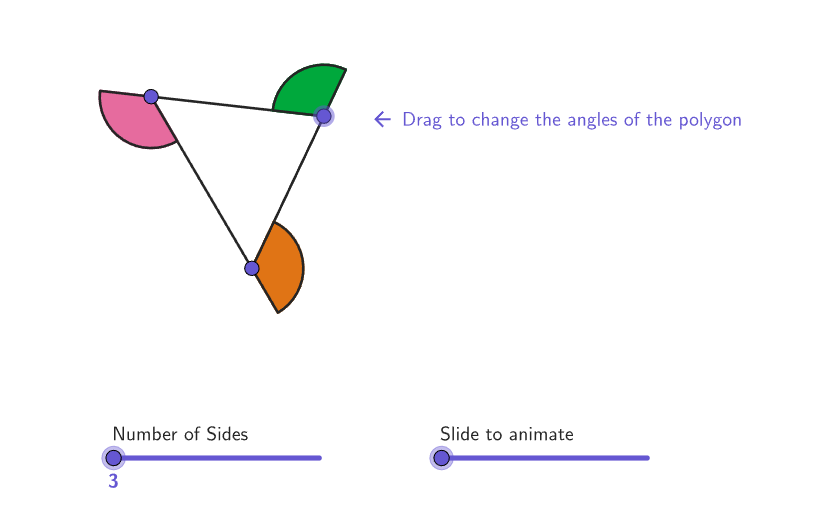
This example dynamically demonstrates the exterior angles of a polygon to help students understand the sum of exterior angles. Key mathematical concepts include the exterior angle sum theorem. GeoGebra commands used include Polygon, DynamicCoordinates, PointToPixels, etc. Suitable for middle school grades 6-8 to explore problems related to the interior and exterior angles of convex polygons.
GeoGebra Commands & Parameters
Polygon({(left, bottom), (left, top), (right, top), (right, bottom)}) → viewboxDynamicCoordinates(A71, If[D71, x(A71), x(C71)], If[D71, y(A71), y(C71)]) → B71PointToPixels(Corner[1], Corner[3], Corner[5], B71) → StartPointPixelsDynamicCoordinates(A31, If[D31, x(A31), x(C31)], If[D31, y(A31), y(C31)]) → B31DynamicCoordinates(A32, If[D32, x(A32), x(C32)], If[D32, y(A32), y(C32)]) → B32DynamicCoordinates(A33, If[D33, x(A33), x(C33)], If[D33, y(A33), y(C33)]) → B33DynamicCoordinates(A29, If[D29, x(A29), x(C29)], If[D29, y(A29), y(C29)]) → B29DynamicCoordinates(A30, If[D30, x(A30), x(C30)], If[D30, y(A30), y(C30)]) → B30DynamicCoordinates(A34, If[D34, x(A34), x(C34)], If[D34, y(A34), y(C34)]) → B34DynamicCoordinates(A35, If[D35, x(A35), x(C35)], If[D35, y(A35), y(C35)]) → B35DynamicCoordinates(A36, If[D36, x(A36), x(C36)], If[D36, y(A36), y(C36)]) → B36DynamicCoordinates(A39, If[D39, x(A39), x(C39)], If[D39, y(A39), y(C39)]) → B39DynamicCoordinates(A40, If[D40, x(A40), x(C40)], If[D40, y(A40), y(C40)]) → B40DynamicCoordinates(A41, If[D41, x(A41), x(C41)], If[D41, y(A41), y(C41)]) → B41DynamicCoordinates(A42, If[D42, x(A42), x(C42)], If[D42, y(A42), y(C42)]) → B42DynamicCoordinates(A43, If[D43, x(A43), x(C43)], If[D43, y(A43), y(C43)]) → B43DynamicCoordinates(A44, If[D44, x(A44), x(C44)], If[D44, y(A44), y(C44)]) → B44DynamicCoordinates(A45, If[D45, x(A45), x(C45)], If[D45, y(A45), y(C45)]) → B45DynamicCoordinates(A49, If[D49, x(A49), x(C49)], If[D49, y(A49), y(C49)]) → B49DynamicCoordinates(A50, If[D50, x(A50), x(C50)], If[D50, y(A50), y(C50)]) → B50DynamicCoordinates(A51, If[D51, x(A51), x(C51)], If[D51, y(A51), y(C51)]) → B51DynamicCoordinates(A52, If[D52, x(A52), x(C52)], If[D52, y(A52), y(C52)]) → B52DynamicCoordinates(A53, If[D53, x(A53), x(C53)], If[D53, y(A53), y(C53)]) → B53DynamicCoordinates(A57, If[D57, x(A57), x(C57)], If[D57, y(A57), y(C57)]) → B57DynamicCoordinates(A58, If[D58, x(A58), x(C58)], If[D58, y(A58), y(C58)]) → B58DynamicCoordinates(A59, If[D59, x(A59), x(C59)], If[D59, y(A59), y(C59)]) → B59DynamicCoordinates(A60, If[D60, x(A60), x(C60)], If[D60, y(A60), y(C60)]) → B60DynamicCoordinates(A61, If[D61, x(A61), x(C61)], If[D61, y(A61), y(C61)]) → B61DynamicCoordinates(A64, If[D64, x(A64), x(C64)], If[D64, y(A64), y(C64)]) → B64DynamicCoordinates(A65, If[D65, x(A65), x(C65)], If[D65, y(A65), y(C65)]) → B65DynamicCoordinates(A66, If[D66, x(A66), x(C66)], If[D66, y(A66), y(C66)]) → B66DynamicCoordinates(A67, If[D67, x(A67), x(C67)], If[D67, y(A67), y(C67)]) → B67DynamicCoordinates(A54, If[D54, x(A54), x(C54)], If[D54, y(A54), y(C54)]) → B54Polygon(C29:C36) → B28Polygon(C39:C45) → B38Sum(H29:H34) → testPolygon(C49:C54) → B48Polygon(C57:C61) → B56Polygon(C64:C67) → B63Zip(CircleSector[A, B, C], A, {B64, B65, B66, B67}, B, {E64, E65, E66, E67}, C, {B65, B66, B67, B64}) → SectorsQuadZip(CircleSector[A, B, C], A, B57:B61, B, E57:E61, C, Append[E58:E61, E57]) → SectorsPentagonZip(CircleSector[A, B, C], A, B49:B54, B, E49:E54, C, Append[E50:E54, E49]) → SectorsHexagonZip(CircleSector[A, B, C], A, B39:B45, B, E39:E45, C, Append[E40:E45, E39]) → SectorsHeptagonZip(CircleSector[A, B, C], A, B29:B36, B, E29:E36, C, Append[E30:E36, E29]) → SectorsOctagonDynamicCoordinates(A70, If[D70, x(A70), x(C70)], If[D70, y(A70), y(C70)]) → B70DynamicCoordinates(A72, If[D72, x(A72), x(C72)], If[D72, y(A72), y(C72)]) → B72Zip(CircleSector[A, B, C], A, B70:B72, B, E70:E72, C, {B71, B72, B70}) → SectorsTriangleElement({SectorsTriangle, SectorsQuad, SectorsPentagon, SectorsHexagon, SectorsHeptagon, SectorsOctagon}, numSides - 2) → currentSectorsElement({B70:B72, B64:B67, B57:B61, B49:B54, B39:B45, B29:B36}, numSides - 2) → currentVerticesPolygon(C70:C72) → B69Zip(Translate[A, Vector[(slider2 * Vector[B, CircCenter])]], A, currentSectors, B, currentVertices) → moveSectorsJoin({B29:B36, B39:B45, B49:B54, B57:B61, B64:B67, B70:B72, {numSides, slider2}}) → tabOrderSaveForLateronboardingTextOffset(Corner[onboardingText, 1], Corner[onboardingText, 3], 1, Corner[1], Corner[3], Corner[5]) → OnboardingTextOffsetcirclePixels(B71, 7 + (7 * pulsing), Corner[1], Corner[3], Corner[5]) → pulsingObject
AI Drawing Prompt Reference
Draw a polygon and dynamically demonstrate the sum of its exterior angles. Start by sketching a quadrilateral, then add vertices to increase the number of sides up to an octagon. At each vertex, draw the corresponding exterior angle with distinct colors. Use a slider to adjust the number of sides, updating the angles and their sum in real-time. Label each exterior angle and display the total sum next to it to verify the exterior angle sum theorem.
The prompt above was compiled from the original drawing commands and is for reference only.