
Phase E: Heptagon
Loading the math board and drawing, please wait…
In collections
Polygon Angles: Interactive Exploration
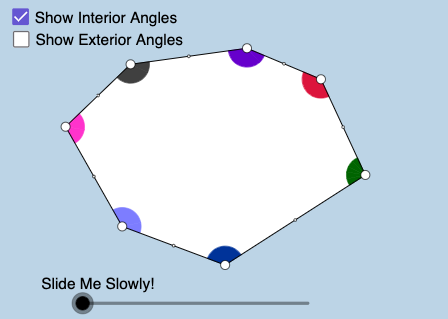
This example demonstrates constructing a heptagon using GeoGebra and highlighting its geometric properties. Key mathematical concepts include polygons, angles, vectors, and transformations. Construction involves commands like Ray, Circle, Intersect, and Polygon, along with objects such as Point and Midpoint. Suitable for middle school students learning geometric constructions and parametric equations.
GeoGebra Commands & Parameters
Ray(N_1, D) → l_4Circle(D, 3) → kIntersect(k, l_4) → W_1, Z_1Ray(D, A_1) → a_3Intersect(k, a_3, 1) → D_1Segment(C, A_1) → i_3Circle(C, 3) → hIntersect(h, i_3) → L,Ray(C, D) → cIntersect(h, c, 1) → PRay(A, B) → aRay(B, C) → bRay(E, A) → eCircle(A, 3) → fCircle(B, 3) → gCircle(E, 3) → pSegment(C, A) → iSegment(C, E) → jIntersect(f, a, 1) → FIntersect(f, i, 1) → GIntersect(f, e, 1) → HIntersect(f, e, 2) → IIntersect(p, e) → J,Intersect(p, j) → K,Intersect(k, c, 2) → OIntersect(h, j, 1) → QIntersect(h, i, 1) → RIntersect(h, b, 1) → SIntersect(g, a, 2) → TIntersect(g, b, 1) → UIntersect(g, a, 1) → VCircleSector(A, F, G) → qCircleSector(A, G, H) → rCircleSector(B, U, V) → sCircleSector(C, Q, R) → c_1CircleSector(C, R, S) → d_1Intersect(k, c, 1) → WCircleSector(E, J, K) → h_1CircleSector(A, I, F) → p_1CircleSector(B, T, U) → q_1Intersect(h, b, 2) → ZVector(A, B) → uVector(C, B) → vVector(E, D) → wVector(C, D) → u_1Vector(C, E) → v_1Vector(A, E) → w_1Translate(d_1, v) → s_1Dilate(A, If[0 < l ≤ 1, 1 - l, 0], B) → A'Dilate(C, If[0 < l ≤ 1, 1 - l, 0], B) → C'Dilate(A, If[1 < l ≤ 2, 2 - l, 0], E) → A'_1Dilate(C, If[1 < l ≤ 2, 2 - l, 0], E) → C'_1Dilate(C, If[2 < l ≤ 3, 3 - l, 0], D) → C'_2Dilate(E, If[2 < l ≤ 3, 3 - l, 0], D) → E'Vector(A, B) → a_1Vector(C, C') → b_1Vector(A, A'_1) → i_1Vector(E, E') → j_1Vector(C, C'_2) → l_1Vector(C, C'_1) → m_1Translate(d_1, b_1) → c_2Translate(r, i_1) → r'_1Translate(r, w_1) → r'_2Translate(c_1, v_1) → f_2Translate(c_1, m_1) → g_2CircleSector(C, P, L) → tTranslate(t, u_1) → t'Translate(t, l_1) → t'_1Translate(q, a_1) → r'Translate(d_1, b_1) → h_2Vector(A, A') → n_1Ray(C, E) → i_2Vector(D, C) → u_2Vector(E, C) → v_2Vector(A, C) → w_2Vector(B, C) → l_2Dilate(B, If[0 < o < 1, 1 - o, 0], C) → B'Dilate(A, If[1 < o < 2, 2 - o, 0], C) → A'_2Dilate(E, If[2 < o < 3, 3 - o, 0], C) → E'_1Dilate(D, If[3 < o < 4, 4 - o, 0], C) → D'Vector(B, B') → m_2Vector(A, A'_2) → n_2Vector(E, E'_1) → s_2Vector(D, D') → t_2Translate(q_1, m_2) → c_3Translate(q_1, l_2) → d_3Translate(p_1, w_2) → e_3If(1 < o < 2, Translate[p_1, n_2]) → h_3Ray(A_1, E) → b_3Circle(A_1, 3) → q_3Intersect(q_3, i_3) → M,Intersect(q_3, b_3, 1) → NIntersect(q_3, a_3, 2) → B_1Intersect(k, c, 2) → C_1Intersect(k, c, 1) → E_1CircleSector(C, L, Q) → dIntersect(p, b_3, 1) → F_1Intersect(p, i_2) → G_1, H_2CircleSector(E, G_1, N) → e_1Dilate(E, If[2 < l < 3, 3 - l, 0], A_1) → E'_2Dilate(C, If[2 < l < 3, 3 - l, 0], A_1) → C'_3Dilate(C, If[3 < l < 4, 4 - l, 0], D) → C'_4Dilate(A_1, If[3 < l < 4, 4 - l, 0], D) → H_1Vector(E, A_1) → f_1Vector(C, A_1) → g_1Translate(e_1, f_1) → k_1Translate(d, g_1) → d'Vector(E, E'_2) → a_2Vector(C, C'_3) → b_2Translate(e_1, a_2) → d_2Translate(d, b_2) → d'_1CircleSector(A_1, N, M) → f_3Intersect(q_3, a_3, 1) → I_1CircleSector(A_1, M, I_1) → g_3CircleSector(D, D_1, E_1) → k_3Vector(C, D) → j_2Vector(A_1, D) → u_3Translate(g_3, u_3) → p_3Translate(t, j_2) → t'_2Vector(A_1, H_1) → v_3Vector(C, C'_4) → w_3Translate(g_3, v_3) → s_3Translate(t, w_3) → t'_3Intersect(p, b_3, 2) → J_1Polygon(A, B, C) → poly1, c_4, a_4, b_4Polygon(A, C, E) → poly2, e_4, a_5, c_5Polygon(E, C, A_1) → poly3, a_6, e_5, c_6Polygon(A_1, C, D) → poly4, d_4, a_7, c_7Intersect(p, e, 1) → L_1CircleSector(E, J_1, L_1) → f_4CircleSector(A_1, B_1, N) → g_4Vector(E, C) → j_3Vector(A_1, C) → l_3Vector(D, C) → m_3Translate(f_4, j_3) → k_4Translate(g_4, l_3) → p_4CircleSector(D, Z_1, D_1) → h_4Translate(h_4, m_3) → q_4Dilate(E, If[2 < o < 3, 3 - o, 0], C) → E'_3Dilate(A_1, If[3 < o < 4, 4 - o, 0], C) → M_1Dilate(D, If[4 < o < 5, 5 - o, 0], C) → D'_1Vector(E, E'_3) → n_3Vector(A_1, M_1) → u_4Vector(D, D'_1) → v_4If(2 < o < 3, Translate[f_4, n_3]) → r_4If(3 < o < 4, Translate[g_4, u_4]) → s_4If(4 < o < 5, Translate[h_4, v_4]) → t_4Ray(C, N_1) → i_4Circle(N_1, 3) → d_5Intersect(d_5, i_4, 2) → K_1Intersect(d_5, l_4, 1) → O_1Intersect(d_5, i_4, 1) → P_1Intersect(h, i_4, 1) → Q_1CircleSector(C, Q_1, P) → f_5CircleSector(N_1, O_1, P_1) → g_5Intersect(k, l_4, 1) → R_1CircleSector(D, E_1, R_1) → h_5Dilate(D, If[4 < l < 5, 5 - l, 0], N_1) → D'_2Dilate(C, If[4 < l < 5, 5 - l, 0], N_1) → C'_5Vector(C, N_1) → w_4Vector(D, N_1) → j_4Translate(h_5, j_4) → p_5Vector(D, D'_2) → m_4Vector(C, C'_5) → n_4Translate(h_5, m_4) → r_5Polygon(D, C, N_1) → poly5, n_5, d_6, c_8Segment(D, C) → b_5Ray(C, E) → i_5Ray(C, A_1) → j_5Ray(C, D) → l_5Point(j_5) → T_1Point(l_5) → U_1Ray(A_1, T_1) → m_5Ray(D, U_1) → b_6Polygon(A_1, E, A, B, C, N_1, D) → poly6, a_8, e_6, a_9, b_7, c_9, n_6, d_7Intersect(d_5, l_4, 1) → S_1Intersect(d_5, i_4, 2) → V_1CircleSector(N_1, V_1, S_1) → f_6CircleSector(C, Z, Q_1) → r_1Vector(N_1, C) → u_5Translate(f_6, u_5) → g_6Dilate(N_1, If[5 < o < 6, 6 - o, 0], C) → A_2Vector(N_1, A_2) → v_5Translate(f_6, v_5) → h_6Vector(D, C) → w_5Translate(h_4, w_5) → k_6Segment(E, A) → i_6Segment(A, B) → j_6Segment(B, C) → l_6Segment(C, N_1) → m_6Segment(N_1, D) → p_6Segment(D, A_1) → q_6Segment(A_1, E) → r_6Midpoint(i_6) → B_2Midpoint(j_6) → C_2Midpoint(l_6) → D_2Midpoint(m_6) → E_2Midpoint(p_6) → F_2Midpoint(q_6) → G_2Midpoint(r_6) → I_2Rotate(d_1, If[0 < l ≤ 1, ((-l) * 180°), -180°], D_2) → t_1Rotate(C, If[0 < l ≤ 1, ((-l) * 180°), -180°], D_2) → C'_6Segment(D_2, C'_6) → k_2Rotate(A, If[0 < l ≤ 1, (l * 180°), 180°], C_2) → A'_3Segment(C_2, A'_3) → s_6Rotate(q, If[0 < l ≤ 1, (l * 180°), 180°], C_2) → q'Rotate(R, 180°, C_2) → R'Rotate(R, 180°, D_2) → R'_1Line(B, R'_1) → t_6Rotate(A, If[1 < l ≤ 2, ((-(l - 1)) * 180°), 180°], B_2) → A'_4Rotate(r, If[1 < l ≤ 2, ((-(l - 1)) * 180°), 180°], B_2) → r'_3Segment(B_2, A'_4) → q_2Ray(E, H_2) → e_7Rotate(e_1, If[2 < l ≤ 3, ((-(l - 2)) * 180°), 180°], I_2) → e_2Rotate(E, If[2 < l ≤ 3, ((-(l - 2)) * 180°), 180°], I_2) → E'_4Segment(I_2, E'_4) → f_7Rotate(g_3, If[3 < l ≤ 4, ((-(l - 3)) * 180°), 180°], G_2) → t_3Rotate(A_1, If[3 < l ≤ 4, ((-(l - 3)) * 180°), 180°], G_2) → J_2Segment(G_2, J_2) → g_7Rotate(h_5, If[4 < l ≤ 5, ((-(l - 4)) * 180°), 180°], F_2) → t_5Rotate(D, If[4 < l ≤ 5, ((-(l - 4)) * 180°), 180°], F_2) → D'_3Segment(F_2, D'_3) → h_7Rotate(f_5, If[4 < l ≤ 5, ((l - 4) * 180°), 180°], E_2) → s_5Rotate(C, If[4 < l ≤ 5, ((l - 4) * 180°), 180°], E_2) → C'_7Segment(E_2, C'_7) → i_7Rotate(W, 180°, F_2) → W'Line(N_1, W') → k_5
AI Drawing Prompt Reference
Create a geometric construction of a heptagon in the plane by using several congruent circles centered at existing key points. Start with a base circle centered at D, and use rays from D through given directions to get intersection points on that circle. Introduce additional auxiliary circles centered at C and at other provided points (such as A, B, and E) and compute their intersections with rays or segments to obtain the required vertices. Mark the construction’s crucial angles by drawing several circle-sector regions: use sectors around A, B, and C formed by specific intersection points, and also around E to emphasize the intended angle partition and rotational relationships. Connect the resulting key points on the relevant circles to form the heptagon boundary, and apply a translation to one marked sector to visually reinforce the symmetry/shift between configurations.
The prompt above was compiled from the original drawing commands and is for reference only.