
Penrose Triangle
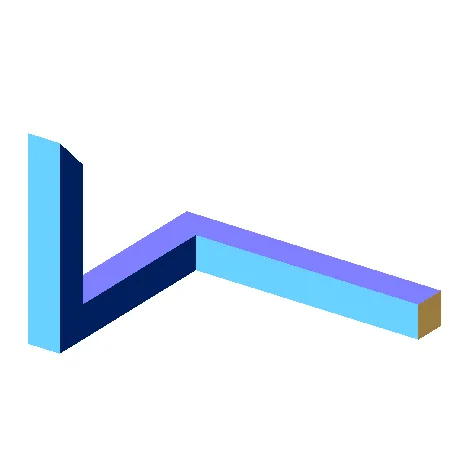
Loading the math board and drawing, please wait…
This example demonstrates the construction and properties of the Penrose triangle, a famous visual paradox consisting of three mutually connected but non-interlocking triangles that cannot form a three-dimensional space. The core mathematical concepts involved include polygon construction, solid geometry, vector operations, and spatial geometric relationships. The construction highlights commands and objects in GeoGebra such as Polygon, Prism, Vector, Plane, IntersectPath, and Segment. It is suitable for high school students and above to explore spatial geometry, visualization skills, and geometric construction techniques, as well as for mathematical competitions or enrichment purposes.
GeoGebra Commands & Parameters
Polygon(A, B, C, D) → poly1, a, b, c, dPrism(poly1, l) → e, E, edgeAE, edgeBF, edgeCG, edgeDH, edgeEF, edgeFG, edgeGH, edgeEH, F, G, H, faceABFE, faceBCGF, faceCDHG, faceADHE, faceEFGHPolygon(I, H, G, J) → poly2, i, h, g, jPrism(poly2, l - 1) → f, K, edge1, edge2, edge3, edge4, edge5, edge6, edge7, edge8, L, M, N, face1, face2, face3, face4, face5Polygon(C, O, P, B) → poly3, c_1, o, p, b_1Prism(poly3, l) → k, Q, edgeCQ, edgeOR, edgePS, edgeBT, edgeQR, edgeRS, edgeST, edgeQT, R, S, T, faceCORQ, faceOPSR, faceBPST, faceBCQT, faceQRSTVector(N, Q) → uPlane(N, edgeCQ) → mPlane(S, m) → nIntersectPath(n, f) → poly4, U, V, W, Z, q, r, s, tPolygon(A, E, V, U, I, D) → poly5, a_1, e_1, v, u_1, i_1, d_1Polygon(E, F, W, V) → poly6, e_2, f_1, w, v_1Polygon(Q, D, I, J, O, R) → poly7, q_1, d_2, i_2, j_1, o_1, r_1Polygon(O, P, S, R) → poly8, o_2, p_1, s_1, r_2Polygon(W, Z, J, O, P, F) → poly9, w_1, z_1, j_2, o_3, p_2, f_2Polygon(R, S, T, Q) → poly10, r_3, s_2, t_1, q_2Polygon(T, A, D, Q) → poly11, t_2, a_2, d_3, q_3Polygon(E, A, T, S, P, F) → poly12, e_3, a_3, t_3, s_3, p_3, f_3Polygon(J, I, U, Z) → poly13, j_3, i_3, u_2, z_2Polygon(Q, R, O, D) → poly14, q_4, r_4, o_4, d_4Polygon(D, I, J, O) → poly15, d_5, i_4, j_4, o_5Polygon(A, E, I, D) → poly16, a_4, e_4, i_5, d_6Polygon(I, E, V, U) → poly17, i_6, e_5, v_2, u_3Polygon(W, Z, J, F) → poly18, w_2, z_3, j_5, f_4Polygon(J, O, P, F) → poly19, j_6, o_6, p_4, f_5Polygon(F, E, A, P) → poly20, f_6, e_6, a_5, p_5Polygon(P, A, T, S) → poly21, p_6, a_6, t_4, s_4Segment(P, A_1) → g_1