
Geometric Construction of Gaudi's Sagrada Familia Columns
Loading the math board and drawing, please wait…
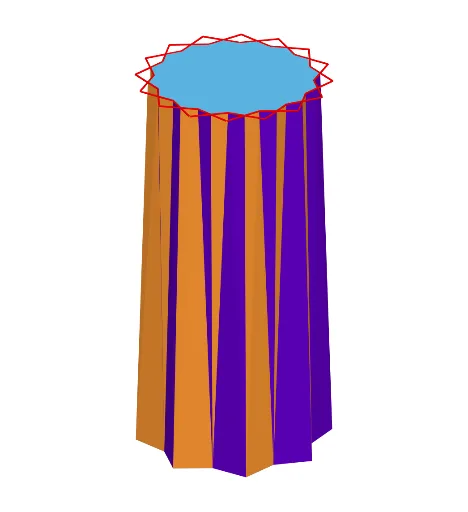
① This GeoGebra example dynamically simulates the geometric construction of the columns of Gaudi's Sagrada Familia, demonstrating how complex column structures with intricate cross-sections can be generated through rotations, translations, and dilations. ② Core mathematical concepts include solid geometry (cylinders and rotational solids), transformations (rotation, translation, dilation), and the combination of polygons, segments, and intersection points via sequences. ③ Construction highlights: from the command summary, it uses Rotate, Dilate, Translate, Join, Polygon, Segment, Intersect, and Sequence commands, with objects such as dOut, dIn, poly1–poly5, newOut, newN, and interactive controls like InputBox1 and sliders (n, k, height) to adjust parameters dynamically, enabling nested and rotated cross-sections. ④ Suitable for high school and above students studying solid geometry, transformation geometry, or mathematical modeling, as well as for architectural mathematics or artistic geometry enrichment, fostering parametric thinking and spatial visualization.
GeoGebra Commands & Parameters
Rotate(A, π / ((2 * n))) → A'_1Dilate(A'_1, dIn / dOut) → BJoin(Sequence[Rotate[l1, (i * π / n)], i, 0, (2 * n) - 1]) → l2Polygon(l2) → poly2Translate(Rotate[l1, ((k * π)) / ((4 * n))], Vector[((k * height) * vz)]) → l3Translate(Rotate[{l1(2), l2(3)}, (((-k) * π)) / ((4 * n))], Vector[((k * height) * vz)]) → l8Segment(l3(1), l3(2)) → jSegment(l8(1), l8(2)) → lIntersect(j, l) → EJoin(Sequence[Rotate[l9, (i * π / ((2 * n)))], i, 0, (4 * n) - 1]) → l10Polygon(l10) → poly5Join(Sequence[Rotate[l1, (i * π / n)], i, 0, (2 * n)]) → l5Translate(Rotate[poly2, (k * π / ((4 * n)))], Vector[((k * height) * vz)]) → poly1Translate(Rotate[poly2, ((-k) * π / ((4 * n)))], Vector[((k * height) * vz)]) → poly3Join(Sequence[Rotate[l9, (i * π / ((2 * n)))], i, 0, (4 * n)]) → l12Translate(Rotate[l1, (((-k) * π) + (4 * π)) / ((4 * n))], Vector[((k * height) * vz)]) → l15Translate(Rotate[{l1(2), l2(3)}, ((k * π)) / ((4 * n))], Vector[((k * height) * vz)]) → l16Intersect(Segment[l15(1), l15(2)], Segment[l16(1), l16(2)]) → CJoin(Sequence[Rotate[l17, (i * π / n)], i, 0, (2 * n) - 1]) → l18Polygon(l18) → poly4Join(Sequence[Rotate[l17, (i * π / n)], i, 0, (2 * n)]) → l19Sequence(Polygon[l5((2 * i) + 2), l19((4 * i) + 2), l19((4 * i) + 3)], i, 0, (2 * n) - 1) → l4Sequence(Polygon[l5((2 * i) + 2), l19((4 * i) + 1), l19((4 * i) + 2)], i, 0, (2 * n) - 1) → l6Sequence(Polygon[l5((2 * i) + 2), l5((2 * i) + 3), l19((4 * i) + 3)], i, 0, (2 * n) - 1) → l14Sequence(Polygon[l5((2 * i) + 1), l5((2 * i) + 2), l19((4 * i) + 1)], i, 0, (2 * n) - 1) → l13Sequence(Polygon[l5((2 * i) + 3), l19((4 * i) + 4), l19((4 * i) + 5)], i, 0, (2 * n) - 1) → l11Sequence(Polygon[l5((2 * i) + 3), l19((4 * i) + 3), l19((4 * i) + 4)], i, 0, (2 * n) - 1) → l7Textfield(height) → InputBox1Textfield(dIn) → InputBox2Translate(poly2, Vector[(((1 - kN) * height) * vz)]) → poly2'
AI Drawing Prompt Reference
Create a complex column structure inspired by Gaudi's Sagrada Familia, built from stacked polygonal cross-sections that rotate and translate vertically. Each layer is generated by rotating the base polygon by an angle proportional to the layer index and shifting it upward, with inner and outer profiles scaled differently. Use sliders to adjust the number of sides, rotation step, and total height, revealing nested and interlocking polygonal meshes. Include intersecting line segments and their intersection points to emphasize the geometric framework, suitable for studying parametric transformations and spatial visualization.
The prompt above was compiled from the original drawing commands and is for reference only.