
Connecting Cone and Cylinder Volumes with Visual Models
Loading the math board and drawing, please wait…
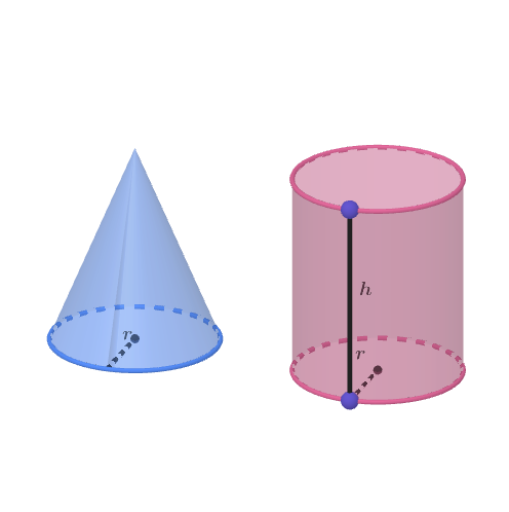
This GeoGebra activity uses visual 3D models to explore the relationship between the volume of a cone and the volume of a cylinder when they share the same base area and height. It also supports the analogous comparison between a pyramid and a prism. Students investigate what stays the same versus what changes as the base and height vary, then reason about the result of dividing the cone’s volume by the cylinder’s volume and whether multiple cones can fit into an identical cylinder. The construction builds cone and cylinder solids with controlled parameters (radius and height), generates key points and parameter sequences (via Sequence and Point), uses geometric primitives such as Segment, Ray, Vector, and Circle, applies transformations like Translate, and creates the 3D objects through Cylinder and Cone. It is designed for grades 6–8 and is suitable for inquiry-based instruction on measurement and solid geometry.
GeoGebra Commands & Parameters
Sequence((t, 3), t, 0.1, 1.5, 0.1) → radPointsPoint(radPoints) → CSequence((x(C), y(C), t), t, 0.1, 4.5, 0.1) → hPointsPoint(hPoints) → HPoint(yAxis) → CCILSegment(CCIL, C) → rCilSegment(C, H) → hCilSegment((-1.5, 3), (1.5, 3)) → segmCSegment(C + (0, 0, 0.1), HM) → hPriVector(A, CCIL) → uSequence(Rotate[C, ((t * 2) * pi / n), CCIL], t, 1, n) → vertTranslate(vert, Vector[(-u)]) → vertCoRay(C + (0, 0, 0.1), (x(C), y(C), 40)) → hCircle(vert(1), vert(2), vert(3)) → bCilCylinder(bCil, Segment[C, H]) → c, d, eTranslate(bCil, Vector[(tra * u)]) → bConTranslate(CCIL, Vector[(tra * u)]) → CCOPoint(bCon) → PSegment(P, CCO) → rCoCone(bCon, Segment[C, H]) → a, g, b
AI Drawing Prompt Reference
Draw a 3D model showing a cylinder and a cone with the same base area and height. The model should illustrate the volume relationship between the two shapes and how volume changes when the base radius and height vary. Construct by first drawing the outlines, then adding key points, and finally generating the 3D model through transformations.
The prompt above was compiled from the original drawing commands and is for reference only.