
Pyramid Section: Exploring Cross-Sections and Geometric Relations
Loading the math board and drawing, please wait…
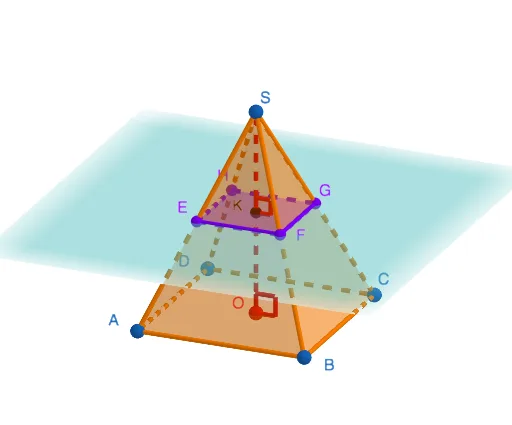
① This example demonstrates a right square pyramid cut by a plane, showing the resulting cross-section polygon (EFGH) and its spatial relationships with the base and lateral faces. ② Core mathematical concepts include solid geometry of pyramids, cross-section properties, symmetry, midpoints, parallelism/perpendicularity, and measurements of lengths and angles; the original tags also mention conditional probability and volume, suggesting possible applications to random points or volume ratios. ③ Construction details: uses GeoGebra commands such as Pyramid to build the pyramid, Plane to define the cutting plane, IntersectPath to generate the section edges, Midpoint for midpoints, Angle for angle measures, Segment for edges, and Distance for lengths; key objects include apex S, base ABCD, center O, section vertices E/F/G/H, auxiliary points J/K, and parameters a, b, α, β, k. ④ Suitable for high-school solid geometry lessons or university-level geometric visualization, helping students understand how the cross-section changes with the plane's orientation and reinforcing symmetry and metric calculations.
GeoGebra Commands & Parameters
Pyramid(A, B, C, D, S) → a, ABCD, edgeAS, edgeBS, edgeCS, edgeDS, faceABS, faceBCS, faceCDS, faceADS, edgeAB, edgeBC, edgeCD, edgeADPlane(K, xOyPlane) → bIntersectPath(b, a) → EFGH, E, F, G, H, f, g, i, jMidpoint(B, C) → JMidpoint(F, G) → K_1Angle(J, O, S) → αAngle(K_1, K, S) → βSegment(S, O) → kDistance(S, O) → SO
AI Drawing Prompt Reference
Draw a right square pyramid with a square base, showing the cross-section created by a plane. The cross-section is a quadrilateral with spatial relationships to the base and lateral faces. Include vertices, base vertices, center point, cross-section vertices, and key angles and distances.
The prompt above was compiled from the original drawing commands and is for reference only.