
Partial Derivatives: Tangent Planes and Directional Derivatives on a Surface
Loading the math board and drawing, please wait…
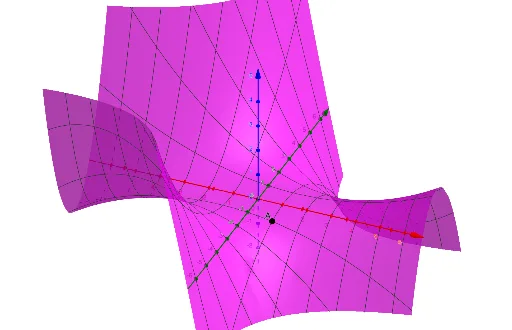
① This example visualizes the geometric meaning of partial derivatives and directional derivatives of a multivariable function at a point on a 3D surface, using tangent planes and direction vectors. ② Core mathematical concepts include partial derivatives, directional derivatives, tangent planes, gradient vectors, and unit vectors, forming a foundation for multivariable calculus. ③ Construction highlights: CurveCartesian creates a parametric surface, Derivative computes partial derivatives, Tangent generates tangent lines, Vector and UnitVector build direction vectors, and Plane draws the tangent plane; sliders a and b control the point of interest, with objects yc, f, p, a, xc, A, g, b, fx, h, fy, B, u, v, n, r, q. ④ Suitable for university-level calculus or multivariable calculus courses, ideal for classroom demonstrations or student exploration to understand local linear approximation and the role of the gradient direction.
GeoGebra Commands & Parameters
CurveCartesian(t, yc, f(t, yc), t, -100, 100) → aTangent(A, a) → gCurveCartesian(xc, t, f(xc, t), t, -100, 100) → bDerivative(f, x) → fxTangent(A, b) → hDerivative(f, y) → fyVector(B) → uVector(A, A + B) → vUnitVector(v) → nPlane(g, h) → r
AI Drawing Prompt Reference
Visualize a point on a 3D surface with its tangent plane, illustrating the geometric meaning of partial and directional derivatives. Start by creating a parametric surface, then draw tangent lines at the point along the x and y axes to represent partial derivatives. Construct vectors for these derivatives, then create direction and unit vectors. Finally, generate the tangent plane using the tangent lines and direction vectors.
The prompt above was compiled from the original drawing commands and is for reference only.