
Parametric Derivatives: Visualizing Tangent Vectors
Loading the math board and drawing, please wait…
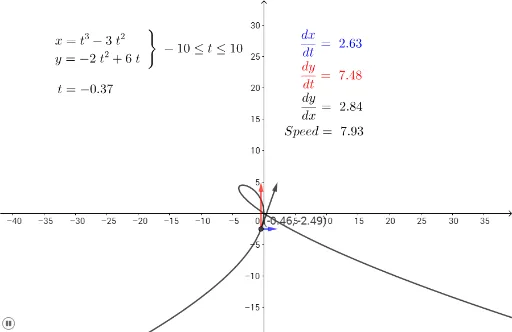
① This example demonstrates the geometric meaning of derivatives for parametric curves by showing a dynamic point and its tangent vector. ② Core math concepts include parametric equations, derivatives (dy/dx in terms of dx/dt and dy/dt), vectors, and tangent directions. ③ Construction highlights: uses GeoGebra commands CurveCartesian to plot the parametric curve, defines parameter t and functions f, g; uses Vector to construct tangent vectors u, v, w, with points A, B, C, D and slider a for dynamic control; text objects text1 to text6 display derivative expressions and values. ④ Suitable for high school to early college calculus or analytic geometry courses, helping students grasp the computation and visual intuition of parametric differentiation, and useful for classroom demonstrations or self-study.
GeoGebra Commands & Parameters
CurveCartesian(f(t), g(t), t, -10, 10) → aVector(A, B) → uVector(A, D) → vVector(A, C) → w
AI Drawing Prompt Reference
Draw a parametric curve in the plane, with x and y coordinates defined by two functions of a parameter ranging from -10 to 10. Place a dynamic point on the curve that moves as a slider changes the parameter value. From this point, draw three vectors: one representing the tangent direction to the curve at that point, another showing the horizontal and vertical components of change due to the parameter, and a third vector that is the resultant displacement combining these components. Also include text labels displaying the derivative expression for the slope in terms of the parameter derivatives, along with the numerical value at the current parameter, to illustrate the geometric meaning of parametric differentiation.
The prompt above was compiled from the original drawing commands and is for reference only.