
Equidistant Curve from Two Parabolas
Loading the math board and drawing, please wait…
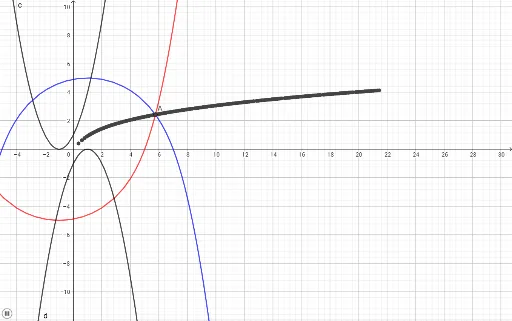
This example demonstrates constructing a curve that is equidistant from two parabolas. Key mathematical concepts include parabolas, distance, and slope. Using GeoGebra commands CurveCartesian and Intersect, the equidistant curve is constructed. Suitable for high school mathematics education, particularly in coordinate geometry and function graphing courses.
GeoGebra Commands & Parameters
CurveCartesian((f_{x}(t), f_{y}(t)), t, -10, 10) → cCurveCartesian((f_{1}(t), f_{2}(t)), t, -10, 10) → f_{3}CurveCartesian((g_{x}(t), g_{y}(t)), t, -10, 10) → dCurveCartesian((g_{1}(t), g_{2}(t)), t, -10, 10) → g_{3}Intersect(f_{3}, g_{3}, 1.7566421387897608, 1.5538790391507038) → A
AI Drawing Prompt Reference
Draw two parabolas and then construct a curve that is equidistant from these two parabolas. First, draw the parabolas f and g, then generate their parametric equations as curves f3 and g3. Finally, find the intersection of f3 and g3, which represents a point on the equidistant curve.
The prompt above was compiled from the original drawing commands and is for reference only.