
Tangent, Normal, and Binormal Vectors at a Point on a Curve
Loading the math board and drawing, please wait…
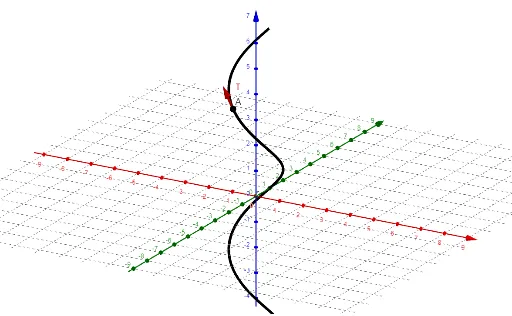
① This example visualizes a 3D parametric curve with its tangent, normal, and binormal vectors drawn at a movable point, forming the Frenet frame that shows local bending and twisting. ② Core math concepts include parametric space curves, unit tangent vector, principal normal, binormal (cross product), and the orthogonal Frenet-Serret frame. ③ Construction uses GeoGebra commands: CurveCartesian defines the curve a, Vector creates vectors, and UnitVector normalizes the tangent; objects include curve a, point A, vectors T (tangent), N (normal), B (binormal), plus auxiliary objects r, m, unittangent, b₂, C, v, u, etc., with dynamic updates via slider or moving point A. ④ Suitable for university calculus or differential geometry courses explaining space curve properties, and also for advanced high school math or teacher demonstrations of vectors and derivatives in 3D.
GeoGebra Commands & Parameters
CurveCartesian(sin(t), cos(t), t, t, (-2 * π), (2 * π)) → rCurveCartesian(x(r'(t)) / m(t), y(r'(t)) / m(t), z(r'(t)) / m(t), t, -10, 10) → unittangentVector(A, A + b_{2}) → nUnitVector(n) → NVector(A, A + C) → vUnitVector(v) → TVector(A, A + u) → B
AI Drawing Prompt Reference
Draw a 3D parametric curve and at a movable point on the curve, draw its tangent, normal, and binormal vectors, which together form the Frenet frame to show local bending and twisting. The curve is defined using sine and cosine functions, the tangent vector is obtained by calculating the derivative of the curve and normalizing it, while the normal and binormal vectors are derived through vector operations and normalization, all dynamically updating as the point moves.
The prompt above was compiled from the original drawing commands and is for reference only.