
Parametrizing Solutions 1: General Solution of a Linear System
Loading the math board and drawing, please wait…
In collections
Exploring Systems
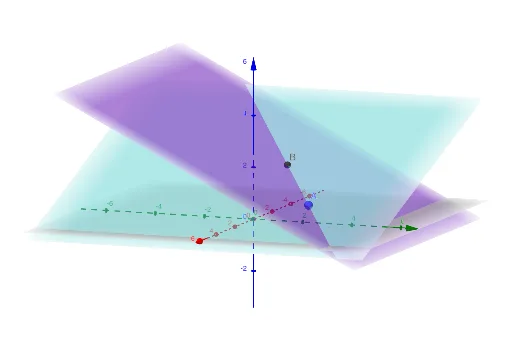
This example demonstrates how to express the solution set of a linear system in parametric form, using free variables to represent infinitely many solutions. Core mathematical concepts include linear equations, free variables, parametric representation, and the geometric interpretation of solution sets. Construction highlights: using GeoGebra objects A, eq1, eq2 to define the system, parameters u and s, point B and text1 to display the parametrized solution, with eq3 and eq4 further detailing the expressions. Suitable for senior high school or early university students learning linear algebra basics, and for teachers demonstrating parametrization methods in class. The example clearly shows the transition from equations to parametric solutions, helping students understand the dimension of solution spaces and the role of parameter choices.
GeoGebra Commands & Parameters
(2, 3, 1)x + (3 * z) = 5y + (2 * z) = 5(-3, -2, 1)Numeric s(1)A + (s * u)x + (3 * z) = 0y + (2 * z) = 0
AI Drawing Prompt Reference
Draw the solution set of a linear system consisting of two lines: x + 3z = 5 and y + 2z = 5. Use parameters s and free variable z to represent infinitely many solutions in the solution set. First, draw these two lines, then use a linear combination of s and z to represent the solution set, and finally show the range of parameter s.
The prompt above was compiled from the original drawing commands and is for reference only.