
Parallelogram Properties Exploration by Grace Piol
Loading the math board and drawing, please wait…
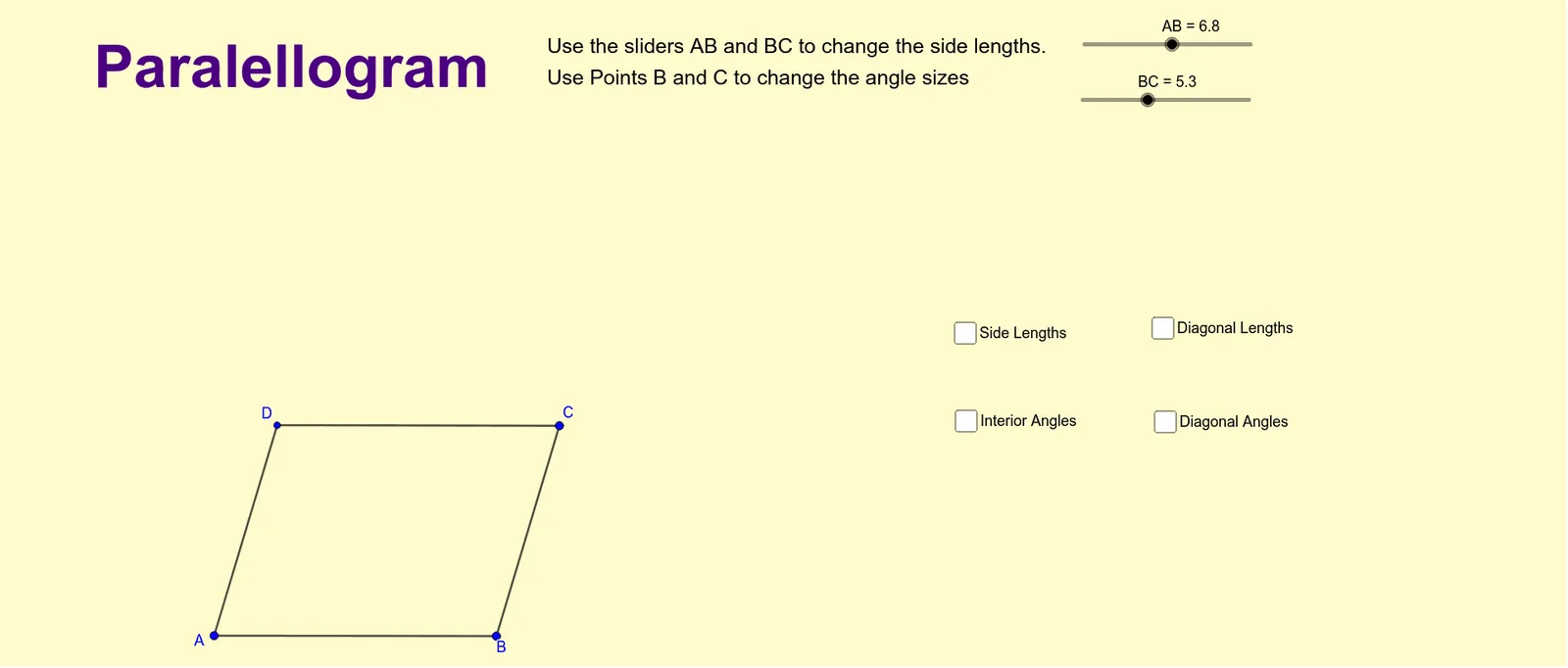
This GeoGebra example dynamically demonstrates the fundamental properties of parallelograms, including opposite sides being parallel and equal, opposite angles being equal, and adjacent angles being supplementary. The core mathematical concepts involved include parallel line criteria, angle relationships, and quadrilateral classification. Construction details: Using Point command to create vertices A, B, C, D; Segment command to construct adjacent sides AB, BC, etc.; Line command to draw lines containing opposite sides; Intersect command to find key intersection points; Angle command to measure and label interior angles α, β, γ, δ, etc.; with text1 and text2 for explanations. Suitable for middle school geometry teaching, ideal for直观演示 and validating parallelogram property theorems, helping students develop geometric intuition.
GeoGebra Commands & Parameters
Point(Circle[A, AB]) → BSegment(A, B) → fPoint(Circle[B, BC]) → CSegment(B, C) → gLine(C, f) → hLine(A, g) → iIntersect(h, i) → DSegment(D, C) → jSegment(D, A) → kSegment(D, B) → lSegment(A, C) → mIntersect(l, m) → ESegment(D, E) → nSegment(E, B) → pSegment(E, C) → qSegment(E, A) → rAngle(A, D, C) → αAngle(D, C, B) → βAngle(B, A, D) → γAngle(C, B, A) → δAngle(D, E, A) → εAngle(B, E, C) → ζAngle(C, E, D) → ηAngle(A, E, B) → θSegment(D, C) → sSegment(C, B) → tSegment(B, A) → bSegment(A, D) → c