
Trapezium Properties and Geometric Construction
Loading the math board and drawing, please wait…
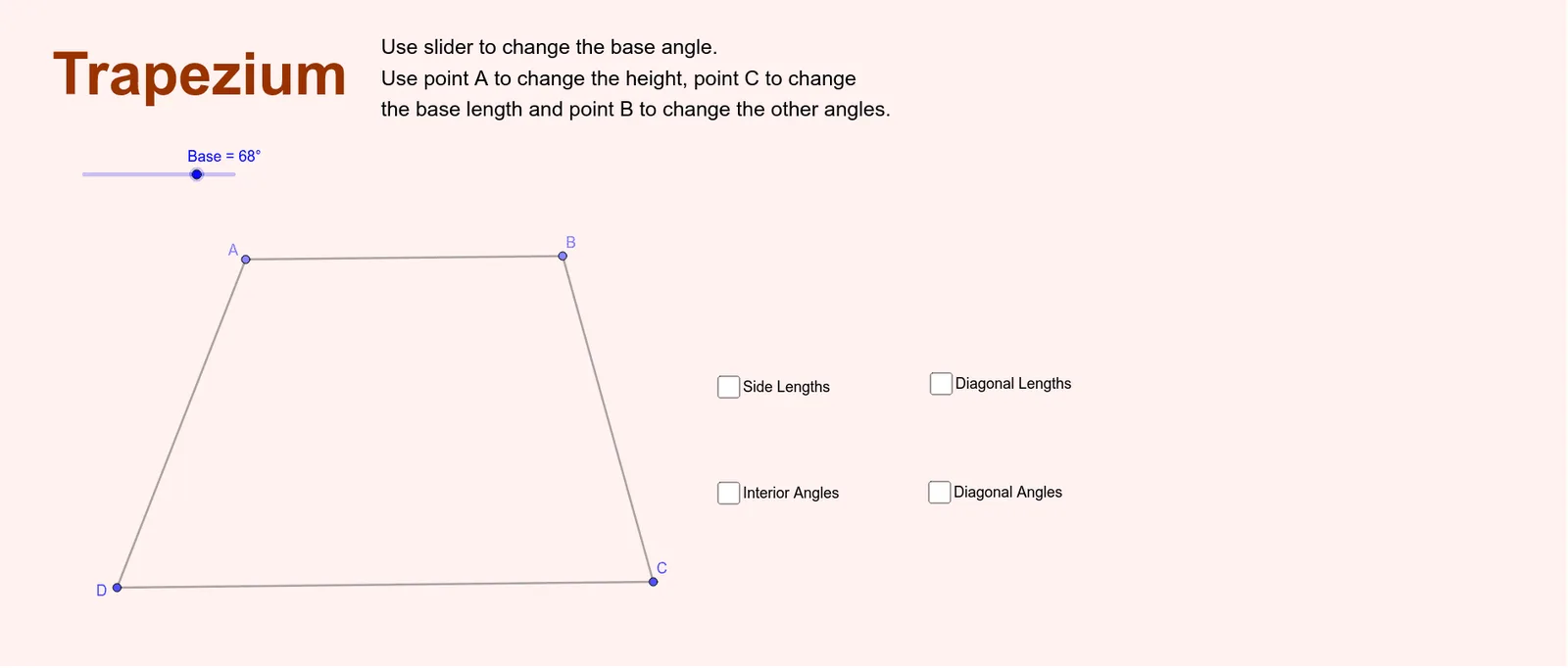
This example demonstrates the properties of trapeziums and their application in geometric construction. Key mathematical concepts include trapezium definition, properties of parallel lines, and geometric transformations. Construction involves using GeoGebra commands such as Segment, Rotate, Angle to build trapezium shapes. Suitable for middle school students learning geometry fundamentals or for mathematical teaching support.
GeoGebra Commands & Parameters
Segment(D, C) → pRotate(C, Base, D) → F'Angle(C, D, F') → ζRay(D, F') → qPoint(q) → ALine(A, p) → rPoint(r) → BSegment(D, A) → sSegment(A, B) → tSegment(C, B) → aSegment(A, B) → fSegment(B, C) → gSegment(C, D) → hSegment(D, A) → iLine(A, C) → jLine(B, D) → kIntersect(j, k) → ESegment(A, E) → lSegment(E, C) → mSegment(B, E) → nSegment(E, D) → bAngle(A, E, D) → αAngle(C, E, B) → βAngle(B, E, A) → γAngle(D, E, C) → δSegment(A, C) → eSegment(B, D) → f_1Angle(D, A, B) → εAngle(A, B, C) → ηAngle(B, C, D) → θ