
Astroid: Geometric Construction and Perimeter Exploration
Loading the math board and drawing, please wait…
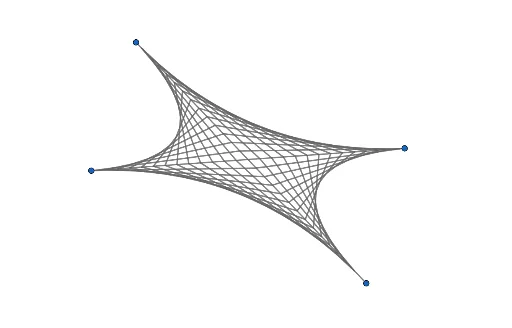
This example demonstrates the geometric construction of the astroid, a classic hypocycloid curve formed by the path of a point on a small circle rolling inside a larger circle with radius four times as large. The astroid has a distinctive four-cusped star shape. Core mathematical concepts include parametric equations, hypocycloids, tangents, midpoints, perpendiculars, and arc length (perimeter) calculation. Construction highlights: using GeoGebra commands such as Segment, Midpoint, Line, Circle, Intersect, and Point, the construction builds base elements and then generates key features of the astroid through multiple auxiliary points (A, B, C, D, etc.) and auxiliary circles (c_1, e_1). This example is suitable for high school or early college students to understand the geometric generation of parametric curves and to explore the relationship between curve perimeter and parameters, serving as a visual aid for arc length integration in calculus.
GeoGebra Commands & Parameters
Segment(A, B) → fMidpoint(f) → CLine(C, D) → gCircle(C, 1) → cCircle(C, 2) → dCircle(C, 3) → eCircle(C, 4) → hCircle(C, 5) → kIntersect(k, g, 2) → EIntersect(c, f, 1) → FIntersect(h, g, 2) → GIntersect(d, f, 1) → HIntersect(e, g, 2) → IIntersect(e, f, 1) → JIntersect(d, g, 2) → KIntersect(h, f, 1) → LIntersect(c, g, 2) → MIntersect(k, f, 1) → NIntersect(k, f, 2) → OIntersect(h, f, 2) → PIntersect(e, f, 2) → QIntersect(d, f, 2) → RIntersect(c, f, 2) → SIntersect(c, g, 1) → TIntersect(d, g, 1) → UIntersect(e, g, 1) → VIntersect(h, g, 1) → WIntersect(k, g, 1) → ZCircle(C, 0.5) → c_1Circle(C, 2.5) → e_1Circle(C, 3.5) → p_1Circle(C, 4.5) → q_1Circle(C, 5.5) → r_1Circle(C, 6) → s_1Circle(C, 6.5) → t_1Intersect(t_1, g, 2) → A_1Intersect(c_1, f, 1) → B_1Intersect(t_1, f, 1) → C_1Intersect(s_1, f, 1) → D_1Intersect(r_1, f, 1) → E_1Intersect(q_1, f, 1) → F_1Intersect(p_1, f, 1) → G_1Intersect(e_1, f, 1) → H_1Intersect(c_1, f, 2) → J_1Circle(C, 1.5) → pIntersect(p, f, 1) → I_1Intersect(p, f, 2) → K_1Intersect(e_1, f, 2) → L_1Intersect(p_1, f, 2) → M_1Intersect(q_1, f, 2) → N_1Intersect(r_1, f, 2) → O_1Intersect(s_1, f, 2) → P_1Intersect(s_1, g, 2) → R_1Intersect(r_1, g, 2) → S_1Intersect(q_1, g, 2) → T_1Intersect(p_1, g, 2) → U_1Intersect(e_1, g, 2) → V_1Intersect(p, g, 2) → W_1Intersect(c_1, g, 2) → Z_1Intersect(c_1, g, 1) → A_2Intersect(p, g, 1) → B_2Intersect(e_1, g, 1) → C_2Intersect(p_1, g, 1) → D_2Intersect(q_1, g, 1) → E_2Intersect(r_1, g, 1) → F_2Intersect(s_1, g, 1) → G_2Intersect(t_1, g, 1) → H_2Segment(A_1, B_1) → iSegment(R_1, F) → jSegment(S_1, I_1) → lSegment(E, H) → mSegment(T_1, H_1) → nSegment(G, J) → qSegment(U_1, G_1) → rSegment(I, L) → sSegment(V_1, F_1) → tSegment(K, N) → aSegment(W_1, E_1) → bSegment(M, D_1) → f_1Segment(Z_1, C_1) → g_1Segment(A_1, J_1) → h_1Segment(R_1, S) → i_1Segment(S_1, K_1) → j_1Segment(E, R) → k_1Segment(T_1, L_1) → l_1Segment(G, Q) → m_1Intersect(t_1, f, 2) → Q_1Segment(U_1, M_1) → n_1Segment(I, P) → a_1Segment(V_1, N_1) → b_1Segment(K, O) → d_1Segment(W_1, O_1) → f_2Segment(M, P_1) → g_2Segment(Z_1, Q_1) → h_2Segment(A_2, C_1) → i_2Segment(T, D_1) → j_2Segment(B_2, E_1) → k_2Segment(U, N) → l_2Segment(C_2, F_1) → m_2Segment(V, L) → n_2Segment(D_2, G_1) → p_2Segment(W, J) → q_2Segment(E_2, H_1) → r_2Segment(Z, H) → s_2Segment(F_2, I_1) → t_2Segment(G_2, F) → a_2Segment(H_2, B_1) → b_2Segment(A_2, Q_1) → c_2Segment(T, P_1) → d_2Segment(B_2, O_1) → e_2Segment(U, O) → f_3Segment(C_2, N_1) → g_3Segment(V, P) → h_3Segment(D_2, M_1) → i_3Segment(W, Q) → j_3Segment(E_2, L_1) → k_3Segment(Z, R) → l_3Segment(F_2, K_1) → m_3Segment(G_2, S) → n_3Segment(H_2, J_1) → p_3Point(g) → I_2Segment(D, I_2) → q_3