
Parabolic Segment: Archimedes Insight
Loading the math board and drawing, please wait…
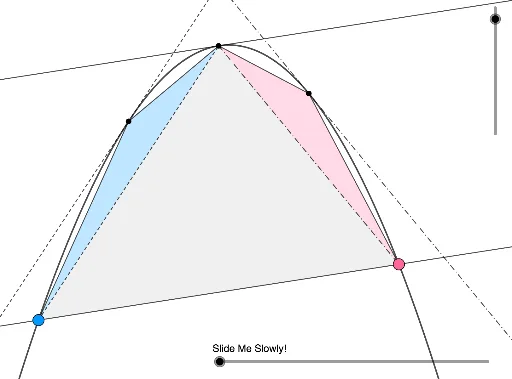
This example dynamically illustrates the formation of a parabolic segment and its relationship with tangent lines and angles. It involves core mathematical concepts such as parabola, tangent, angle, straight line, and vector. Construction highlights include commands like Line, Segment, Slope, Intersect, Polygon, OrthogonalLine, Circle, Dilate, Vector, Translate, Point, Angle, Rotate, and Midpoint from GeoGebra. Suitable for high school students and math enthusiasts to understand parabolic properties and geometric constructions.
GeoGebra Commands & Parameters
Line(A, B) → gSegment(A, B) → jSlope(g) → dIntersect(f', h, 1) → CPolygon(A, D, B) → t1, b_1, a_1, d_1OrthogonalLine(D, g) → lIntersect(g, l) → ESlope(b_1) → mSlope(a_1) → m_1Intersect(f', n) → FIntersect(f', p) → HPolygon(A, I, D) → t2, d_2, a_2, i_1Polygon(D, G, B) → t3, b_2, d_3, g_1Segment(A, D) → qSegment(D, B) → rSegment(B, G) → sSegment(G, D) → tSegment(A, I) → eSegment(I, D) → f_1Line(A, B) → h_1Circle(A, t) → c_1Intersect(c_1, j_1, 2) → JCircle(A, r) → e_1Circle(J, s) → p_1Intersect(e_1, p_1, 2) → KDilate(I, If[0 < o ≤ 1, 1 - o, 0], J) → I'Polygon(A, I', D) → t4, d_4, a_3, i'Segment(A, I') → l_1Segment(I', D) → n_1Line(D, l_1) → q_1Dilate(D, If[3 < o ≤ 4, 4 - o, 0], K) → D'Polygon(A, I', D') → t5, d', a_4, i'_1Segment(I', D') → r_1Segment(D', A) → s_1Dilate(I', If[5 < o ≤ 6, 6 - o, 0], G) → I''Vector(I', I'') → uTranslate(A, u) → A'Translate(I', u) → I''_1Translate(D', u) → D''Polygon(A', I''_1, D'') → t5', d'', a', i''_1Line(I', t) → t_1Point(t_1) → LAngle(L, I', A) → αRotate(A', If[5 < o ≤ 6, ((-(o - 5)) * α), (-α)], I''_1) → A''Rotate(I''_1, If[5 < o ≤ 6, ((-(o - 5)) * α), (-α)], I''_1) → MRotate(D'', If[5 < o ≤ 6, ((-(o - 5)) * α), (-α)], I''_1) → D'''Polygon(A'', M, D''') → t5'', d''', a'', m_2Midpoint(A, B) → NMidpoint(N, B) → OMidpoint(A, N) → PMidpoint(A, P) → QMidpoint(P, N) → RMidpoint(N, O) → SMidpoint(O, B) → TDilate(A, If[7 < o ≤ 8, 8 - o, 0], Q) → A'_1Segment(A, A'_1) → f_2Rotate(A, If[8 < o ≤ 9, ((o - 8) * π), π], Q) → A'_2Rotate(A'_1, If[8 < o ≤ 9, ((o - 8) * π), π], Q) → USegment(A'_2, U) → g_2Rotate(A'_2, If[9 < o ≤ 10, ((o - 9) * π), π], A'_2) → VRotate(U, If[9 < o ≤ 10, ((o - 9) * π), π], A'_2) → U'Segment(V, U') → h_2Rotate(V, If[10 < o ≤ 11, ((o - 10) * π), π], U') → V'Rotate(U', If[10 < o ≤ 11, ((o - 10) * π), π], U') → U''Segment(V', U'') → i_2Rotate(V', If[11 < o ≤ 12, ((o - 11) * π), π], V') → V''Rotate(U'', If[11 < o ≤ 12, ((o - 11) * π), π], V') → U'''Segment(V'', U''') → j_2Rotate(V'', If[12 < o ≤ 13, ((o - 12) * π), π], U''') → V'''Rotate(U''', If[12 < o ≤ 13, ((o - 12) * π), π], U''') → WSegment(V''', W) → k_2Rotate(V''', If[13 < o ≤ 14, ((o - 13) * π), π], V''') → ZRotate(W, If[13 < o ≤ 14, ((o - 13) * π), π], V''') → W'Segment(Z, W') → l_2Rotate(Z, If[14 < o ≤ 15, ((o - 14) * π), π], W') → Z'Rotate(W', If[14 < o ≤ 15, ((o - 14) * π), π], W') → W''Segment(Z', W'') → n_2Circle(D, n_2) → c_2Intersect(c_2, k_1) → A_1, B_1Dilate(M, If[16 < o ≤ 17, 17 - o, 0], B_1) → M'Polygon(D, M', B) → t6, b_3, d_5, m'Segment(D, M') → p_2Segment(M', B) → q_2Midpoint(M', W') → C_1Line(A, B) → r_2Circle(A, (7 / 8 * Distance[A, B])) → e_2Intersect(e_2, r_2) → D_1, E_1Polygon(A, E_1, D) → t7, d_6, a_5, e_3Polygon(E_1, B, D) → t8, d_7, e_4, b_4Midpoint(M', E_1) → F_1Dilate(D, If[17 < o ≤ 18, 18 - o, 0], E_1) → D'_1Segment(D, D'_1) → s_2Rotate(D, If[19 < o ≤ 20, ((-(o - 19)) * π), (-π)], F_1) → D'_2Rotate(M', If[19 < o ≤ 20, ((-(o - 19)) * π), (-π)], F_1) → M''Rotate(B, If[19 < o ≤ 20, ((-(o - 19)) * π), (-π)], F_1) → B'Polygon(D'_2, M'', B') → t6', b', d'_2, m''