
Pappus Area-2
Loading the math board and drawing, please wait…
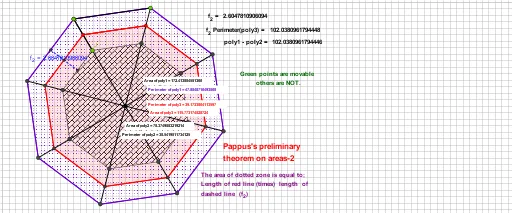
This example demonstrates the area calculation of Pappus theorem. Key concepts include area, centroid, circle, circumcircle, general quadrilateral, geometric distribution, plane figures, polygons, quadrilaterals, symmetry, geometric transformations, logarithm, step functions, vectors, square, and exponential functions. Using GeoGebra commands such as Polygon, Centroid, Segment, Intersect, Point, Line, Midpoint, OrthogonalLine, Perimeter, and PointIn, a geometric figure is constructed, suitable for high school mathematics education.
GeoGebra Commands & Parameters
Polygon(A, B, 8) → poly1, f, D, E, F, G, H, g, h, i, j, k, l, m, CCentroid(poly1) → ISegment(B, I) → nSegment(A, I) → pSegment(H, I) → qSegment(G, I) → rSegment(F, I) → sSegment(E, I) → tSegment(D, I) → aSegment(C, I) → bIntersect(n, poly1) → LPoint(n) → JSegment(B, A) → cLine(J, f) → dIntersect(d, p) → KIntersect(d, p) → MPolygon(M, J, 8) → poly2, e, O, P, Q, R, S, f_1, g_1, h_1, i_1, j_1, k_1, l_1, NMidpoint(B, J) → TLine(T, d) → m_1Intersect(m_1, p) → USegment(U, T) → n_1Polygon(U, T, 8) → poly3, p_1, W, Z, A_1, B_1, C_1, q_1, r_1, s_1, t_1, a_1, b_1, c_1, VSegment(B, J) → e_1OrthogonalLine(I, g) → d_1Intersect(d_1, g) → D_1Intersect(d_1, f_1) → E_1Segment(D_1, E_1) → f_2Perimeter(poly3) → perimeterpoly3PointIn(poly3) → Pointpoly3_{1}PointIn(poly3) → Pointpoly3_{2}Perimeter(poly3) → uPointIn(poly3) → Pointpoly3_{3}Perimeter(poly1) → perimeterpoly1PointIn(poly1) → Pointpoly1_{1}Perimeter(poly1) → vPointIn(poly1) → Pointpoly1_{2}Perimeter(poly2) → perimeterpoly2PointIn(poly2) → Pointpoly2_{1}Intersect(q_1, f_2) → F_1PointIn(poly1) → Pointpoly1PointIn(poly3) → Pointpoly3PointIn(poly2) → Pointpoly2
AI Drawing Prompt Reference
Draw a regular octagon with its center marked. Connect the center to each vertex with line segments, creating eight radial lines. Pick a point on one radial line, draw a line through it parallel to one side of the octagon, intersecting an adjacent radial line. Use this intersection and the point to form a second regular octagon. Take the midpoint of the segment between the original point and the intersection, draw a parallel line through it, and construct a third regular octagon. Finally, place a random point inside each of the three octagons and display their perimeters.
The prompt above was compiled from the original drawing commands and is for reference only.