
Obvious Corollary: Dynamic Illustration of Triangle Exterior Angle Theorem
Loading the math board and drawing, please wait…
In collections
Congruence (CO) Cluster
Congruence (Vol 2)
CCSS High School: Geometry (Congruence) Volume 2
CCSS High School: Geometry (Congruence) Volume 2
CCSS High School: Geometry (Congruence) Volume 2
Geometry (Congruence) Volume 2
CCSS High School: Geometry (Congruence) Volume 2
CCSS High School: Geometry (Congruence) Volume 2
CCSS High School: Geometry (Congruence) Volume 2
CCSS High School: Geometry (Congruence) Volume 2
CCSS High School: Geometry (Congruence) Volume 2
CCSS High School: Geometry (Congruence) Volume 2
Gail LeBlancCCSS High School: Geometry (Congruence) Volume 2
CCSS High School: Geometry (Congruence) Volume 2
CCSS High School: Geometry (Congruence) Volume 2
Triangle Theorems
Unit 7: Polygons and Quadrilaterals
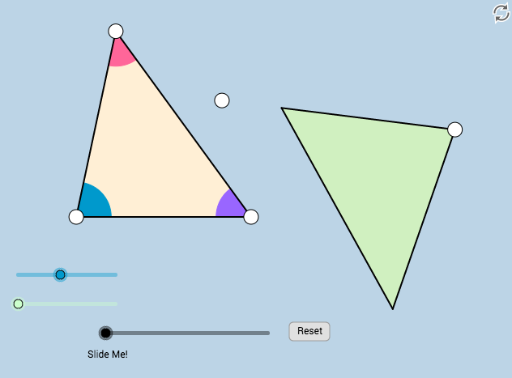
This GeoGebra example dynamically illustrates an obvious corollary to the Triangle-Angle-Sum Theorem: the measure of an exterior angle of a triangle equals the sum of the measures of the two non-adjacent interior angles. The interactive construction allows learners to drag points and observe how angle relationships remain invariant. Core mathematical concepts include triangle angle sum, exterior angle theorem, angle measurement, and rotation. The construction uses GeoGebra commands such as Ray, Point, Rotate, Segment, Angle, Polygon, Circle, Intersect, Dilate, Min, CircleSector, Vector, Translate, Line, and CircleArc to build multiple triangles, auxiliary circles, angle markers, and dynamic points. Suitable for middle school or high school geometry classes, this resource is ideal for classroom demonstration or self-paced exploration, reinforcing the connection between the triangle angle sum and its corollaries.
GeoGebra Commands & Parameters
Ray(E, L) → lPoint(l) → MRotate(M, α, E) → M'Ray(E, M') → mPoint(y = 0) → ASegment(A, C) → jRotate(C, α, A) → C'Ray(A, C') → gPoint(g) → DSegment(A, D) → iSegment(D, C) → hRay(A, C) → fAngle(C, A, C') → βPolygon(A, C, D) → poly1, d, a, cAngle(M, E, M') → γCircle(E, i) → eCircle(E, j) → kIntersect(k, l, 1) → FIntersect(e, m, 1) → GCircle(G, 1) → pCircle(F, 1) → qCircle(G, h) → rIntersect(r, l) → H, UDilate(G, b, E) → G'Dilate(H, b, E) → H'Segment(G', H') → nPolygon(E, H', G') → poly2, g', e_1, h'Angle(poly2) → δ, ε, ζAngle(poly1) → η, θ, ιSegment(E, H') → sSegment(E, G') → tMin({j, i, h}) → oCircle(A, (0.2 * o)) → c_1Circle(D, (0.2 * o)) → d_1Circle(C, (0.2 * o)) → f_1Intersect(c_1, j, 1) → IIntersect(c_1, i, 1) → JIntersect(d_1, i, 1) → KIntersect(d_1, h, 1) → NIntersect(f_1, h, 1) → OIntersect(j, xAxis) → PIntersect(f_1, j, 1) → QCircleSector(A, I, J) → g_1CircleSector(D, K, N) → h_1CircleSector(C, O, Q) → k_1Dilate(A, If[0 < u ≤ 1, 1 - u, 0], E) → A'Vector(A, A') → vTranslate(g_1, v) → p_1Line(A, t) → i_1Point(i_1) → RAngle(D, A, R) → κRotate(p_1, If[1 < u ≤ 2, ((u - 1) * κ), κ], E) → q_1Dilate(D, If[2 < u ≤ 3, 3 - u, 0], G') → D'Vector(D, D') → wTranslate(h_1, w) → r_1Line(D, n) → j_1Point(j_1) → SAngle(N, D, S) → λRotate(r_1, If[3 < u ≤ 4, ((u - 3) * λ), λ], G') → s_1Dilate(C, If[6 < u ≤ 7, 7 - u, 0], H') → C'_1Vector(C, C'_1) → u_1Translate(k_1, u_1) → t_1Line(C, s) → l_1Point(l_1) → TAngle(A, C, T) → μRotate(t_1, If[7 < u ≤ 8, ((u - 7) * μ), μ], H') → c_2CircleArc(A, I, J) → d_2CircleArc(D, K, N) → e_2CircleArc(C, O, Q) → f_2
AI Drawing Prompt Reference
Draw a triangle with draggable vertices to dynamically show that an exterior angle equals the sum of the two opposite interior angles. Mark the exterior and interior angles with sectors and angle indicators. Include auxiliary lines, circles, and points to illustrate the relationship. Use a slider to control rotation and dynamic points for key positions. The final image should clearly demonstrate the theorem, suitable for geometry class demonstration.
The prompt above was compiled from the original drawing commands and is for reference only.