
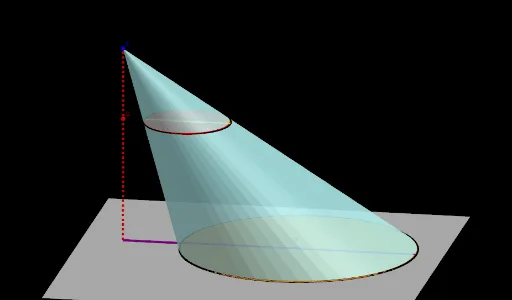
Oblique Cone
Loading the math board and drawing, please wait…
This example demonstrates the construction of an oblique cone. It involves concepts of cones, solid geometry, and vectors. Using GeoGebra commands such as Circle, Line, Intersect, Vector, etc., the dynamic generation process of the oblique cone is showcased. Suitable for high school mathematics education and students learning solid geometry.
GeoGebra Commands & Parameters
Circle(O_r, 0.5) → dLine(O_r, xAxis) → aCircle(O_r, 1) → c_1Point(c_1) → GirarIntersect(c_1, a, 2) → UAngle(U, O_r, Girar) → phiPoint(d) → B_1Intersect(d, a, 2) → M_2Angle(M_2, O_r, B_1) → thetaVector(O_ , O) → uTranslate(X_r, u) → XVector(O, X) → v_xTranslate(Y_r, u) → YVector(O, Y) → v_yTranslate(Z_r, u) → ZVector(O, Z) → v_zCircle(O, Zoom, xOyPlane) → eLine(O, yAxis) → b_1Line(Y, O) → fLine(O, X) → gLine(Z, O) → jLine(X, v_y) → hTranslate(Y, v_z) → B_2Translate(X, v_z) → C_2Point(xAxis) → BCircle(O_ , B) → cIntersect(c, yAxis, 2) → FIntersect(c, xAxis, 2) → AAngularBisector(F, O_ , A) → bIntersect(c, b, 2) → HAngularBisector(H, O_ , A) → kAngularBisector(H, O_ , F) → lIntersect(c, l, 2) → IIntersect(c, k, 2) → JTranslate((x(F) * v_x) + (y(F) * v_y), u) → B_Translate((x(A) * v_x) + (y(A) * v_y), u) → LTranslate((x(H) * v_x) + (y(H) * v_y), u) → MTranslate((x(I) * v_x) + (y(I) * v_y), u) → NTranslate((x(J) * v_x) + (y(J) * v_y), u) → PMirror(B_ , O) → A_3Mirror(I, yAxis) → WMirror(J, yAxis) → D_1Mirror(A, yAxis) → E_1Polygon(A, B, S) → P_1, l_1, g_1, e_1Dilate(B, 0.4, S) → E'_2Circle(F_1, Distance[A, B] / 2) → p_1OrthogonalLine(F_1, yAxis) → q_1OrthogonalLine(A, q_1) → r_2OrthogonalLine(S, q_1) → b_3Intersect(q_1, b_3) → Z_1Segment(Z_1, S) → c_3Translate((x(S) * v_y), u) → C_bIntersect(b_3, xAxis) → ESegment(S, E) → qPoint(q) → GLine(G, xAxis) → rIntersect(e_1, r) → KIntersect(g_1, r) → VSegment(K, V) → sOrthogonalLine(V, r) → a_1OrthogonalLine(K, r) → i_1Intersect(q_1, i_1) → A_1Intersect(q_1, a_1) → C_1Midpoint(A_1, C_1) → G_1Circle(G_1, C_1) → k_1Segment(V, C_1) → j_1Segment(A_1, K) → m_1Intersect(c, yAxis, 1) → H_1If(Distance[E, O_ ] > Distance[B, O_ ], Distance[E, O_ ], Distance[B, O_ ]) → m_pCircle(O_ , m_p) → r_1Intersect(r_1, xAxis, 2) → I_1OrthogonalLine(I_1, xAxis) → iIntersect(r_1, yAxis, 1) → K_1OrthogonalLine(K_1, yAxis) → s_1Intersect(i, s_1) → L_1Translate((x(L_1) * v_x) + (y(L_1) * v_y), u) → M_1Mirror(M_1, O) → DTranslate((x(L_1) * v_x) - (y(L_1) * v_y), u) → N_1Mirror(N_1, O) → O_1Translate(D, Vector[(Distance[G, E] * v_z)]) → D'Translate(N_1, Vector[(Distance[G, E] * v_z)]) → N_1'Translate(M_1, Vector[(Distance[G, E] * v_z)]) → M_1'Translate(O_1, Vector[(Distance[G, E] * v_z)]) → O_1'Segment(O_ , E) → t_1Segment(G, K) → b_2Segment(Z_1, G_1) → g_2Segment(Z_1, F_1) → h_2Circle(F_1, Distance[A, B] / 2) → p_2Circle(F_1, Distance[A, B] / 2) → q_2Circle(G_1, C_1) → s_2Intersect(l_1, c_3) → V_1Segment(Z_1, V_1) → l_2Circle(O, Distance[A, B] / 2, zAxis) → pVector(O, Q) → vCurveCartesian(x(O) + (Distance[A, B] / 2 * cos(i)), y(O) + (Distance[A, B] / 2 * sin(i)), z(O), i, 0, 6.283185307179586) → mSequence((x(O) + (Distance[A, B] / 2 * cos(i)), y(O) + (Distance[A, B] / 2 * sin(i)), z(O)), i, 0, 6.28319, 0.12566370614359174) → liste1Sequence(Polygon[Element[liste1, i], Element[liste1, i + 1], Q], i, 1, Length[liste1]) → liste2Plane(T, Line[O, R]) → nOrthogonalLine(Q, n) → tIntersect(t, f) → J_1Segment(Q, J_1) → d_1Segment(O, J_1) → f_1Segment(O - (Distance[A, B] / 2, 0, 0), Q) → h_1Segment(O + (Distance[A, B] / 2, 0, 0), Q) → n_1OrthogonalLine(Q, n) → a_2Line(Q_1, f) → c_2Intersect(c_2, n_1) → R_1Intersect(h_1, c_2) → S_1Point(liste2) → T_1Segment(Q, O) → d_2Intersect(d_2, c_2) → U_1Circle(U_1, Distance[U_1, R_1], zAxis) → e_2Circle(U_1, Distance[U_1, R_1], zAxis) → f_2Point(liste2) → A_2Segment(S_1, R_1) → i_2Segment(O, J_1) → j_2Segment(O, D_2) → k_2Segment(O, E_2) → m_2
AI Drawing Prompt Reference
Draw an oblique cone. Start by drawing a circle d, then draw a line a parallel to the x-axis. Next, take a point Girar on circle c1 and find its intersection U with line a. Draw a tangent line to circle d at point U. Then, draw vector u and translate point O to X using vector u. Draw vectors v_x and v_y, and translate point O to Y and Z using vectors v_x and v_y. Draw circle e on the xOy plane, then draw line b1 along the y-axis, and lines f from Y to O, g from O to X, j from Z to O, and h from X to v_y. Translate Y and X to get B_2 and C_2. Draw point B on the x-axis, and draw circle c with B as the center, intersecting with the y-axis and x-axis to get points F and A. Draw angle bisector b from F and A, then find the intersection H of circle c and b, and draw angle bisectors k and l from H, and find the intersections I and J of circle c and k and l. Translate B_2, I, and J to get B_, M, N, and P, then mirror B_, I, J, A, E_1, D_1, W, E'_2, P_1, l_1, g_1, e_1, p_1, q_1, and r_2.
The prompt above was compiled from the original drawing commands and is for reference only.