
Number Line Addition Demo by Matt Whiteway
Loading the math board and drawing, please wait…
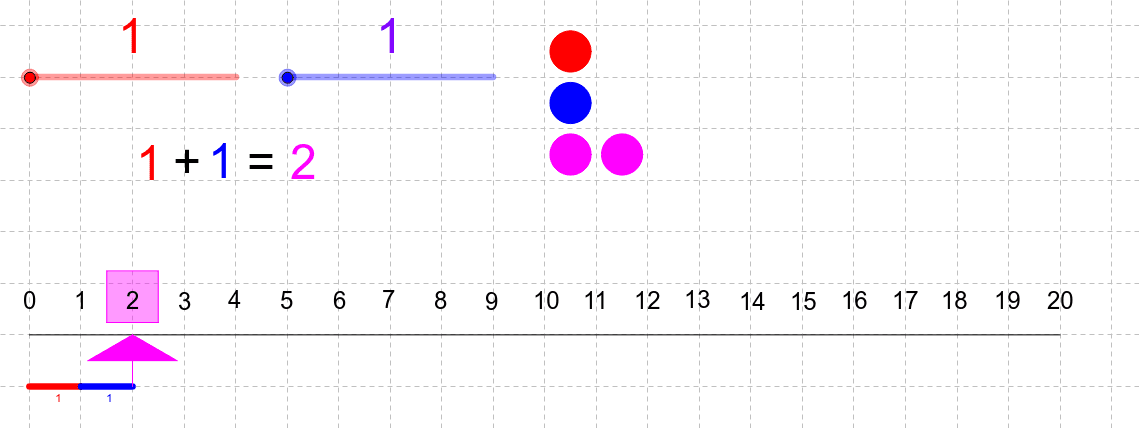
This example demonstrates single digit addition using sliders, with results visualized on a number line and counters. It involves core math concepts like natural numbers and addition, constructed using GeoGebra commands such as Intersect, Point, Segment, Circle, Polygon, and Translate. Ideal for lower elementary math education to teach addition and number line representation.
GeoGebra Commands & Parameters
Intersect(xAxis, yAxis) → APoint(Circle[A, abs(a)]) → BSegment(A, B) → cPoint(Circle[B, abs(b)]) → CSegment(B, C) → dPoint(yAxis) → DPoint(Circle[D, abs(a + b)]) → ESegment(D, E) → ePoint(Circle[D, 20]) → FSegment(D, F) → fSegment(C, E) → gCircle(E, Segment[E, C]) → hCircle(C, Segment[C, E]) → kIntersect(h, k, 2) → GIntersect(h, k, 1) → HPolygon(G, H, E) → poly1, e_1, g_1, h_1Point(Circle[I, 1]) → JSegment(I, J) → iPoint(Circle[I, 1]) → KSegment(I, K) → jPoint(Circle[K, 1]) → LSegment(K, L) → lSegment(L, J) → mPolygon(K, I, J, L) → poly2, k_1, i_1, j_1, l_1Circle(M, 0.4) → pTranslate(p, (1, 0)) → p'Translate(p, (2, 0)) → p'_1Translate(p, (3, 0)) → p'_2Translate(p, (4, 0)) → p'_3Translate(p, (5, 0)) → p'_4Translate(p, (6, 0)) → p'_5Translate(p, (7, 0)) → p'_6Translate(p, (8, 0)) → p'_7Translate(p, (0, 1)) → p'_8Translate(p, (1, 1)) → p'_9Translate(p, (2, 1)) → p'_{10}Translate(p, (3, 1)) → p'_{11}Translate(p, (4, 1)) → p'_{12}Translate(p, (5, 1)) → p'_{13}Translate(p, (6, 1)) → p'_{14}Translate(p, (7, 1)) → p'_{15}Translate(p, (8, 1)) → p'_{16}Translate(p, (0, -1)) → p'_{17}Translate(p, (1, -1)) → p'_{18}Translate(p, (2, -1)) → p'_{19}Translate(p, (3, -1)) → p'_{20}Translate(p, (4, -1)) → p'_{21}Translate(p, (5, -1)) → p'_{22}Translate(p, (6, -1)) → p'_{23}Translate(p, (7, -1)) → p'_{24}Translate(p, (8, -1)) → p'_{25}Translate(p, (9, -1)) → p'_{26}Translate(p, (0, -2)) → p'_{27}Translate(p, (1, -2)) → p'_{28}Translate(p, (2, -2)) → p'_{29}Translate(p, (3, -2)) → p'_{30}Translate(p, (4, -2)) → p'_{31}Translate(p, (5, -2)) → p'_{32}Translate(p, (6, -2)) → p'_{33}Translate(p, (7, -2)) → p'_{34}
AI Drawing Prompt Reference
Draw a number line starting from the origin, showing the addition of two single-digit numbers using sliders. Mark the result on the number line with arrows indicating the movement from the first number to the second. Draw two unit circles on the number line to represent the two numbers being added, and connect them with line segments to form a triangle. Draw multiple identical circles on the number line to show the repeated application of the addition operation.
The prompt above was compiled from the original drawing commands and is for reference only.