
Figural Numbers: Geometric Construction and Linear Regression
Loading the math board and drawing, please wait…
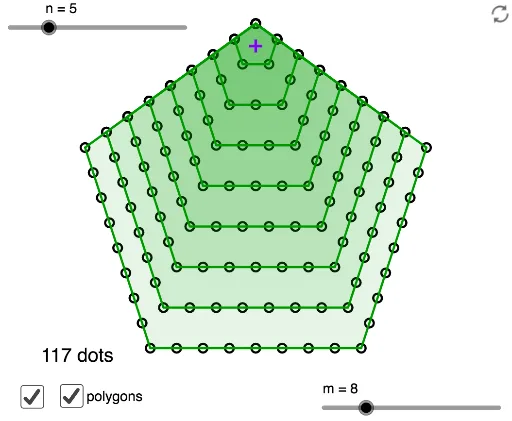
① This GeoGebra example dynamically illustrates figural numbers (such as square numbers and triangular numbers) through geometric point arrangements, using rotation and sequence commands to reveal the correspondence between numbers and shapes. ② Core mathematical concepts include figural numbers, square numbers, exponents, right triangles, ellipses, and linear regression, combining algebraic sequences with geometric forms to embody the idea of number-shape integration. ③ Construction highlights: The Rotate and Sequence commands generate point sets, involving objects m, u, A, B, n, B', L_1, L_2, a, b, c, and text1; parameter n controls the order of figural numbers, and linear regression may be used to fit the trend of point patterns. ④ Suitable for middle and high school mathematics (grades 8–12) in teaching sequences and geometry, as well as for mathematical exploration activities to help students understand the geometric meaning of sequences and the connection between algebra and geometry.
GeoGebra Commands & Parameters
Rotate(B, (360 * ° / n), A) → B'Sequence(Translate[Sequence[Rotate[kdots[A, B, n, j], ((i * 360) * ° / n), A], i, 1, n], ((j - 1) * (A - B))], j, 1, m) → L_1Sequence(Polygon[B, B' + ((i - 1) * (B' - B)), n], i, 1, m) → L_2