
Adding with Quick Tens v2
Loading the math board and drawing, please wait…
In collections
Elementary School Applets
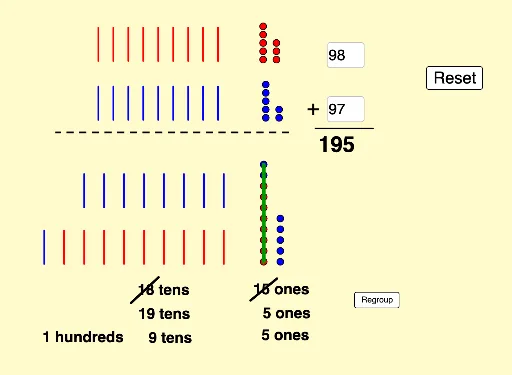
① This interactive GeoGebra example demonstrates two-digit addition with visual grouping into tens and ones, making the carrying process intuitive for learners. ② Core math concepts include place value (ones and tens), addition with regrouping, and the base-10 number system, reinforced through dot arrays and flat representations. ③ Construction highlights: uses GeoGebra commands such as Sequence, Flatten, Textfield, Mod, and Segment to build a dynamic interface with horizontal/vertical spacing, dot arrays, and flats. Input boxes (InputBox1/2) accept two addends, Mod splits them into tens and ones, and multiple arrays (destinationarraydotsbig, smallarrayfirstbig, etc.) display results. A reset button and visibility toggles (showfirstones, showsecondones) enhance interactivity. ④ Suitable for early elementary math (grades 1-2) in classrooms or self-study, helping students grasp addition with carrying through visual manipulation.
GeoGebra Commands & Parameters
Sequence(Sequence[(x(A) + (i * horizontalspacing), y(A) + (j * verticalspacing)), j, 0, verticaldots - 1], i, 0, horizontaldots - 1) → destinationarraydotsbigFlatten(destinationarraydotsbig) → destinationonesflatTextfield(firsttext) → InputBox1Textfield(secondtext) → InputBox2Mod(firstnumber, 10) → firstonesMod(secondnumber, 10) → secondonesSequence(Sequence[(x(B) + (i * smallhorizontalspacing), y(B) + (j * smallverticalspacing)), j, 0, smallverticaldots - 1], i, 0, smallhorizontaldots - 1) → smallarrayfirstbigSequence(Sequence[(x(C) + (i * smallhorizontalspacing), y(C) + (j * smallverticalspacing)), j, 0, smallverticaldots - 1], i, 0, smallhorizontaldots - 1) → smallarraysecondbigFlatten(smallarrayfirstbig) → smallonesfirstflatFlatten(smallarraysecondbig) → smallonessecondflatSequence(Element[smallonesfirstflat, i], i, 1, firstones) → showfirstonesSequence(Element[smallonessecondflat, i], i, 1, secondones) → showsecondonesSequence(Sequence[(x(D) - (i * smalltenswidth), y(D) + (j * smalltensheight)), j, 0, smalltensrows - 1], i, 0, smalltenscolumns - 1) → smalltensfirstbigSequence(Sequence[(x(E) - (i * smalltenswidth), y(E) + (j * smalltensheight)), j, 0, smalltensrows - 1], i, 0, smalltenscolumns - 1) → smalltenssecondbigFlatten(smalltensfirstbig) → smalltensfirstflatFlatten(smalltenssecondbig) → smalltenssecondflatSequence(Segment[Element[smalltensfirstflat, (2 * i) + 1], Element[smalltensfirstflat, (2 * i) + 2]], i, 0, firsttens - 1) → showfirsttensSequence(Segment[Element[smalltenssecondflat, (2 * i) + 1], Element[smalltenssecondflat, (2 * i) + 2]], i, 0, secondtens - 1) → showsecondtensFlatten(Sequence[Sequence[(x(F) - (i * destinationtenswidth), y(F) + (j * destinationtensheight)), i, 0, destinationtenscolumns - 1], j, 0, destinationtensrows - 1]) → destinationtensflatSequence(Translate[Element[showfirstones, i], Vector[(Vector[Element[smallonesfirstflat, i], Element[destinationonesflat, i]] * slideit)]], i, 1, firstones) → swooponesfirstSequence(Translate[Element[showsecondones, i], Vector[(Vector[Element[smallonessecondflat, i], Element[destinationonesflat, i + firstones]] * slideit)]], i, 1, secondones) → swooponessecondSegment(G, H) → fSegment(I, J) → gMod(total, 10) → totalonesMod(total, 10) → finalonesSegment(Element[destinationonesflat, 1], Element[destinationonesflat, (10 * regroupit)]) → hSegment(K, L) → iSegment(M, N) → jSequence(Vector[Element[smalltensfirstflat, (2 * i)], Element[destinationtensflat, i]], i, 1, firsttens) → slidefirsttensvectorsSequence(Vector[Element[smalltenssecondflat, (2 * i)], Element[destinationtensflat, i + firsttens]], i, 1, secondtens) → slidesecondtensvectorsSequence(Translate[Element[showfirsttens, i], Vector[(Element[slidefirsttensvectors, i] * slideit)]], i, 1, firsttens) → swooptensfirstSequence(Translate[Element[showsecondtens, i], Vector[(Element[slidesecondtensvectors, i] * slideit)]], i, 1, secondtens) → swooptenssecond