
Factor Sets, Prime Factors, and GCD/LCM of Two Integers
Loading the math board and drawing, please wait…
In collections
Sets
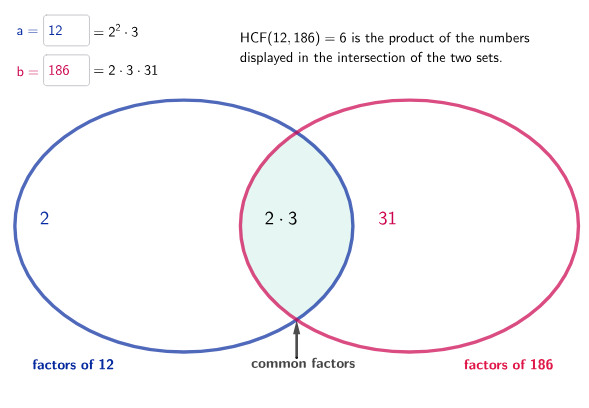
This example lets you input two integers and then visualizes their prime-factor structure by constructing factor sets and comparing shared vs. unique prime powers. It highlights how the greatest common divisor (GCD/HCF) and the least common multiple (LCM) follow from prime exponents. The core math concepts are integer factorization, set-based reasoning about factor collections, frequency/exponent counting in prime decompositions, and the GCD–LCM relationship derived from matching and combining prime powers. Construction-wise, it uses GeoGebra commands such as GCD, LCM, PrimeFactors, Frequency, and Unique to compute prime-factor lists and their exponent multiplicities; it organizes intermediate results with objects like aFact, bFact, onlyaFact, onlybFact, mcdFact, and the corresponding exponent sets (e.g., espOnlyaFact/espmcdFact). InputBox/Textfield objects (InputBox1/InputBox2 and warningText/fullText...) drive updates, while Vector and Sequence help arrange and label the computed outputs. Suitable for middle school through early university, especially for number theory basics and interactive demonstrations of GCD/LCM computation from prime factor sets.
GeoGebra Commands & Parameters
GCD(a, b) → mcdABTextfield(a) → InputBox1Textfield(b) → InputBox2Point(xAxis) → APoint(xAxis) → BEllipse(A, B, C) → dPoint(xAxis) → DPoint(xAxis) → EEllipse(D, E, F) → ePrimeFactors(a) → aFactPrimeFactors(b) → bFactFrequency(aFact) → espaFactFrequency(bFact) → espbFactUnique(aFact) → uniaUnique(bFact) → unibPrimeFactors(a / mcdAB) → onlyaFactPrimeFactors(b / mcdAB) → onlybFactPrimeFactors(mcdAB) → mcdFactFrequency(onlyaFact) → espOnlyaFactFrequency(onlybFact) → espOnlybFactFrequency(mcdFact) → espmcdFactUnique(onlyaFact) → uniOnlyaUnique(onlybFact) → uniOnlybUnique(mcdFact) → uniMcdVector(H, G) → uZip(Text[A], A, espaFact) → fullTextEspaZip(Text[A], A, espbFact) → fullTextEspbZip(Text[A], A, espOnlybFact) → fullTextEspOnlybZip(Text[A], A, espOnlyaFact) → fullTextEspOnlyaSequence(If[fullTextEspa(k) ≠ "1", fullTextEspa(k), ""], k, 1, Length[fullTextEspa]) → finalTextEspaSequence(If[fullTextEspb(k) ≠ "1", fullTextEspb(k), ""], k, 1, Length[fullTextEspb]) → finalTextEspbSequence(If[fullTextEspOnlyb(k) ≠ "1", fullTextEspOnlyb(k), ""], k, 1, Length[fullTextEspOnlyb]) → finalTextEspOnlybSequence(If[fullTextEspOnlya(k) ≠ "1", fullTextEspOnlya(k), ""], k, 1, Length[fullTextEspOnlya]) → finalTextEspOnlyaZip(Text[A], A, espmcdFact) → fullTextEspmcdSequence(If[fullTextEspmcd(k) ≠ "1", fullTextEspmcd(k), ""], k, 1, Length[fullTextEspmcd]) → finalTextEspmcdLCM(a, b) → mcmAB
AI Drawing Prompt Reference
Input two integers to visualize their prime factorization and factor sets, using ellipses for shared and unique prime power sets, and label the GCD and LCM. Dynamically display prime factor frequencies and exponents via vectors, sequences, and text boxes, emphasizing the relationship between GCD/LCM and prime factors.
The prompt above was compiled from the original drawing commands and is for reference only.