
Pizzas, Kids, Divisions and Fractions: Visual Introduction
Loading the math board and drawing, please wait…
In collections
Arithmetic and Algebra
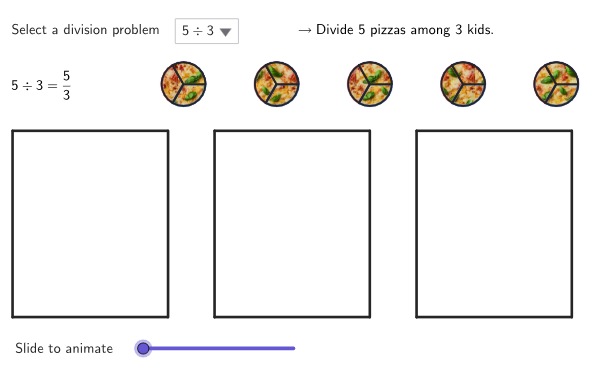
This example demonstrates how to visualize fractions and division through the engaging scenario of dividing pizzas among children. Core mathematical concepts include: the basic meaning of fractions, the relationship between fractions and division, fraction comparison, and simplification/expansion of fractions. Construction highlights: Based on the command summary, it uses Circle to draw the pizza base, CircleSector to create equal pie slices, Sequence to automatically generate multiple portions for several children, Polygon for auxiliary lines, Translate for moving pizza pieces, and RandomElement for interactive randomization. Suitable for upper elementary students learning fractions, or as a visual aid for teachers introducing fraction concepts, also great for parent-child math enlightenment.
GeoGebra Commands & Parameters
Vector(C1, C2) → cTraCorner(5) → dimsRandomElement({3, 2}) → bFiveCircle(C1, rCfr) → cCircle(C2, rCfr) → dTranslate(C2, cTra) → C3Circle(C3, rCfr) → eTranslate(C3, cTra) → C4Circle(C4, rCfr) → fTranslate(C4, cTra) → C5Circle(C5, rCfr) → gVector(R1, F) → qTraPolygon(R1, R2, R3, R4) → q1, r1, r2, r3, r4Translate(R1, qTra) → R1'Translate(R2, qTra) → R2'Translate(R3, qTra) → R3'Translate(R4, qTra) → R4'Polygon(R1', R2', R3', R4') → q2, r1', r2', r3', r4'Translate(R1', qTra) → R1''Translate(R2', qTra) → R2''Translate(R3', qTra) → R3''Translate(R4', qTra) → R4''Polygon(R1'', R2'', R3'', R4'') → q3, r1'', r2'', r3'', r4''Sequence(Rotate[A, ((2 * pi / b) * k), C1], k, 1, b) → settCfr1CircleSector(C1, A, settCfr1(1)) → settc1puCircleSector(C1, settCfr1(1), settCfr1(2)) → settc1piCircleSector(C1, settCfr1(2), settCfr1(3)) → settc1blTranslate(settc1pu, cTra) → settc2puTranslate(settc1pu, Vector[(2 * cTra)]) → settc3puTranslate(settc1pu, Vector[(3 * cTra)]) → settc4puTranslate(settc1pu, Vector[(4 * cTra)]) → settc5puTranslate(settc1pi, cTra) → settc2piTranslate(settc1pi, Vector[(2 * cTra)]) → settc3piTranslate(settc1pi, Vector[(3 * cTra)]) → settc4piTranslate(settc1pi, Vector[(4 * cTra)]) → settc5piTranslate(settc1bl, cTra) → settc2blTranslate(settc1bl, Vector[(2 * cTra)]) → settc3blTranslate(settc1bl, Vector[(3 * cTra)]) → settc4blTranslate(settc1bl, Vector[(4 * cTra)]) → settc5blTranslate(CT1, qTra) → CT1'Translate(CT2, qTra) → CT2'Translate(CT3, qTra) → CT3'Translate(CT4, qTra) → CT4'Translate(CT5, qTra) → CT5'Translate(CT1, Vector[(2 * qTra)]) → CT1'_{1}Translate(CT2, Vector[(2 * qTra)]) → CT2'_{1}Translate(CT3, Vector[(2 * qTra)]) → CT3'_{1}Translate(CT4, Vector[(2 * qTra)]) → CT4'_{1}Translate(CT5, Vector[(2 * qTra)]) → CT5'_{1}Vector(C1, CT1) → toq1c1Vector(C2, CT2) → toq1c2Vector(C3, CT3) → toq1c3Vector(C4, CT4) → toq1c4Vector(C5, CT5) → toq1c5Vector(C1, CT1') → toq2c1Vector(C2, CT2') → toq2c2Vector(C3, CT3') → toq2c3Vector(C4, CT4') → toq2c4Vector(C5, CT5') → toq2c5Vector(C1, CT1'_{1}) → toq3c1Vector(C2, CT2'_{1}) → toq3c2Vector(C3, CT3'_{1}) → toq3c3Vector(C4, CT4'_{1}) → toq3c4Vector(C5, CT5'_{1}) → toq3c5Take({settc1bl, settc2bl, settc3bl, settc4bl, settc5bl}, 1, a) → allSecBluTake({settc1pi, settc2pi, settc3pi, settc4pi, settc5pi}, 1, a) → allSecPinkTake({settc1pu, settc2pu, settc3pu, settc4pu, settc5pu}, 1, a) → allSecPuTake({CircleSector[C1, settCfr1(2), settCfr1(3)], Translate[settc1bl, cTra], Translate[settc1bl, Vector[(2 * cTra)]], Translate[settc1bl, Vector[(3 * cTra)]], Translate[settc1bl, Vector[(4 * cTra)]]}, 1, a) → allOutlinesBluTake({CircleSector[C1, settCfr1(1), settCfr1(2)], Translate[settc1pi, cTra], Translate[settc1pi, Vector[(2 * cTra)]], Translate[settc1pi, Vector[(3 * cTra)]], Translate[settc1pi, Vector[(4 * cTra)]]}, 1, a) → allOutlinesPinkTake({CircleSector[C1, A, settCfr1(1)], Translate[settc1pu, cTra], Translate[settc1pu, Vector[(2 * cTra)]], Translate[settc1pu, Vector[(3 * cTra)]], Translate[settc1pu, Vector[(4 * cTra)]]}, 1, a) → allOutlinesPuZip(Translate[p, Vector[q]], p, allSecBlu, q, If[2 ≤ aniSli ≤ 3, (allq3Vec * (aniSli - 2))]) → allTraBluZip(Translate[p, Vector[q]], p, allOutlinesBlu, q, If[2 ≤ aniSli ≤ 3, (allq3Vec * (aniSli - 2))]) → allTraOutBluZip(Translate[p, Vector[q]], p, allOutlinesPu, q, If[0 ≤ aniSli ≤ 1, (allq1Vec * aniSli), allq1Vec]) → allTraOutPuZip(Translate[p, Vector[q]], p, allSecPu, q, If[0 ≤ aniSli ≤ 1, (allq1Vec * aniSli), allq1Vec]) → allTraPuZip(Translate[p, Vector[q]], p, allSecPink, Vector[q], If[1 ≤ aniSli ≤ 2, (allq2Vec * (aniSli - 1)), 2 < aniSli ≤ 3, allq2Vec]) → allTraPinkZip(Translate[p, Vector[q]], p, allOutlinesPink, Vector[q], If[1 ≤ aniSli ≤ 2, (allq2Vec * (aniSli - 1)), 2 < aniSli ≤ 3, allq2Vec]) → allTraOutPinkSelectedIndex(ddMenu) → is
AI Drawing Prompt Reference
This is a visual introduction scene about dividing pizzas among children. The center of the scene is a circular pizza, which is divided into equal slices, each representing a portion of the pizza. Auxiliary lines are used to mark the boundaries of the slices. The pizza slices can be moved to simulate giving portions to different children. The number of slices can also be randomized to allow different division experiences. The overall scene aims to help understand the concepts of fractions and division, suitable for upper elementary students or teachers.
The prompt above was compiled from the original drawing commands and is for reference only.