
Rational Numbers Comparison & Number Line Practice
Loading the math board and drawing, please wait…
In collections
Rationale Zahlen & Arbeiten mit der Zahlengerade
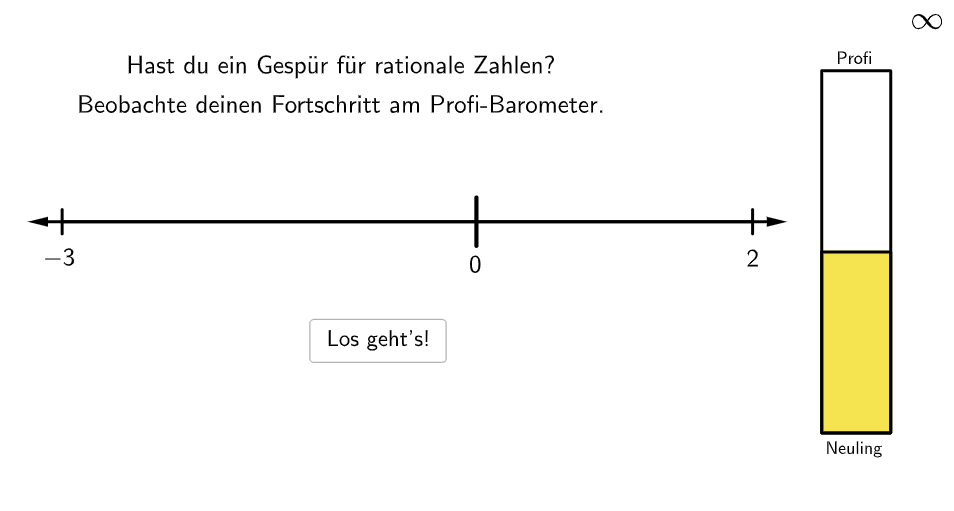
An interactive number sense training resource demonstrating how to compare and represent rational numbers on a number line. Core math concepts: comparing rational numbers (positive/negative fractions and decimals), understanding opposites and absolute values, locating points on the number line. Construction details: Uses RandomElement to randomly generate various rational numbers (negative/positive fractions and decimals), If condition to differentiate between fractions and decimals, Text commands to display problems, button1 to trigger new problems, showsolution to reveal answers, and countCorrect to track accuracy. Suitable for Grade 7-8 students to practice comparing and ordering rational numbers, developing number sense and number-visualization skills.
GeoGebra Commands & Parameters
RandomElement(minNums) → minNumRandomElement(maxNums \ {(minNum * (-1))}) → maxNumVector(A + (0.5, 0), B) → uSegment((10, b), (10, (-b))) → gJoin({{100}, Shuffle[Sequence[Random[5, 95], i, 1, 100]]}) → randomNosRemove((((minNum * 10) + 1)…0) / 10, numbersGanze) → numbers3Dezimal1NegRemove((0…((maxNum * 10) - 1)) / 10, numbersGanze) → numbers4Dezimal1PosRemove((((minNum * 100) + 1)…0) / 100, Flatten[{numbersGanze, numbers3Dezimal1Neg}]) → numbers5Dezimal2NegRemove((0…((maxNum * 100) - 1)) / 100, Flatten[{numbersGanze, numbers4Dezimal1Pos}]) → numbers6Dezimal2PosUnique(Flatten[Zip[Sequence[Sequence[j - i / a, i, 1, a - 1], j, minNum + 1, 0], a, {2, 3, 4, 5, 6, 8, 10}]]) → numbers1BruecheNegUnique(Flatten[Zip[Sequence[Sequence[j + i / a, i, 1, a - 1], j, 0, maxNum - 1], a, {2, 3, 4, 5, 6, 8, 10}]]) → numbers2BruechePosJoin(Sequence[Shuffle[{1, 1, 1, 1, 2, 2, 3, 3, 4, 5, 5, 6}], i, 1, 10]) → numbersToTakeWSKElement(numbersToTakeWSK, Mod[count, Length[numbersToTakeWSK]] + 1) → actualNumberToTakeWSKElement(numbersAll, actualNumberToTakeWSK) → numbersRandomElement(numbers) → numPolygon((Max[0, If[numPos ≥ numZero > numPos - 0.5, numZero, numPos - 0.5]], -0.3), (Min[10, If[numPos < numZero ≤ numPos + 0.5, numZero, numPos + 0.5]], -0.3), (Min[10, If[numPos < numZero ≤ numPos + 0.5, numZero, numPos + 0.5]], 0.3), (Max[0, If[numPos ≥ numZero > numPos - 0.5, numZero, numPos - 0.5]], 0.3)) → q1, h, i, j, kSegment((0, 0), (0.1, 0)) → P0Segment((0.1, 0), (0.2, 0)) → P1Segment((0.2, 0), (0.3, 0)) → P2Segment((0.3, 0), (0.4, 0)) → P3Segment((0.4, 0), (0.5, 0)) → P4Segment((0.5, 0), (0.6, 0)) → P5Segment((0.6, 0), (0.7, 0)) → P6Segment((0.7, 0), (0.8, 0)) → P7Segment((0.8, 0), (0.9, 0)) → P8Segment((0.9, 0), (1, 0)) → P9Segment((1, 0), (1.1, 0)) → P10Segment((1.1, 0), (1.2, 0)) → P11Segment((1.2, 0), (1.3, 0)) → P12Segment((1.3, 0), (1.4, 0)) → P13Segment((1.4, 0), (1.5, 0)) → P14Segment((1.5, 0), (1.6, 0)) → P15Segment((1.6, 0), (1.7, 0)) → P16Segment((1.7, 0), (1.8, 0)) → P17Segment((1.8, 0), (1.9, 0)) → P18Segment((1.9, 0), (2, 0)) → P19Segment((2, 0), (2.1, 0)) → P20Segment((2.1, 0), (2.2, 0)) → P21Segment((2.2, 0), (2.3, 0)) → P22Segment((2.3, 0), (2.4, 0)) → P23Segment((2.4, 0), (2.5, 0)) → P24Segment((2.5, 0), (2.6, 0)) → P25Segment((2.6, 0), (2.7, 0)) → P26Segment((2.7, 0), (2.8, 0)) → P27Segment((2.8, 0), (2.9, 0)) → P28Segment((2.9, 0), (3, 0)) → P29Segment((3, 0), (3.1, 0)) → P30Segment((3.1, 0), (3.2, 0)) → P31Segment((3.2, 0), (3.3, 0)) → P32Segment((3.3, 0), (3.4, 0)) → P33Segment((3.4, 0), (3.5, 0)) → P34Segment((3.5, 0), (3.6, 0)) → P35Segment((3.6, 0), (3.7, 0)) → P36Segment((3.7, 0), (3.8, 0)) → P37Segment((3.8, 0), (3.9, 0)) → P38Segment((3.9, 0), (4, 0)) → P39Segment((4, 0), (4.1, 0)) → P40Segment((4.1, 0), (4.2, 0)) → P41Segment((4.2, 0), (4.3, 0)) → P42Segment((4.3, 0), (4.4, 0)) → P43Segment((4.4, 0), (4.5, 0)) → P44Segment((4.5, 0), (4.6, 0)) → P45Segment((4.6, 0), (4.7, 0)) → P46Segment((4.7, 0), (4.8, 0)) → P47Segment((4.9, 0), (5, 0)) → P49Segment((5, 0), (5.1, 0)) → P50Segment((5.1, 0), (5.2, 0)) → P51Segment((5.2, 0), (5.3, 0)) → P52Segment((5.3, 0), (5.4, 0)) → P53Segment((5.4, 0), (5.5, 0)) → P54Segment((5.5, 0), (5.6, 0)) → P55Segment((5.6, 0), (5.7, 0)) → P56Segment((5.7, 0), (5.8, 0)) → P57Segment((5.8, 0), (5.9, 0)) → P58Segment((5.9, 0), (6, 0)) → P59Segment((6, 0), (6.1, 0)) → P60Segment((6.1, 0), (6.2, 0)) → P61Segment((6.2, 0), (6.3, 0)) → P62Segment((6.3, 0), (6.4, 0)) → P63Segment((6.4, 0), (6.5, 0)) → P64Segment((6.5, 0), (6.6, 0)) → P65Segment((6.6, 0), (6.7, 0)) → P66Segment((6.7, 0), (6.8, 0)) → P67Segment((6.8, 0), (6.9, 0)) → P68Segment((6.9, 0), (7, 0)) → P69Segment((7, 0), (7.1, 0)) → P70Segment((7.1, 0), (7.2, 0)) → P71Segment((7.2, 0), (7.3, 0)) → P72Segment((7.3, 0), (7.4, 0)) → P73Segment((7.4, 0), (7.5, 0)) → P74Segment((7.5, 0), (7.6, 0)) → P75Segment((7.6, 0), (7.7, 0)) → P76Segment((7.7, 0), (7.8, 0)) → P77Segment((7.8, 0), (7.9, 0)) → P78Segment((7.9, 0), (8, 0)) → P79Segment((8, 0), (8.1, 0)) → P80Segment((8.1, 0), (8.2, 0)) → P81Segment((8.2, 0), (8.3, 0)) → P82Segment((8.3, 0), (8.4, 0)) → P83Segment((8.4, 0), (8.5, 0)) → P84Segment((8.5, 0), (8.6, 0)) → P85Segment((8.6, 0), (8.7, 0)) → P86Segment((8.7, 0), (8.8, 0)) → P87Segment((8.8, 0), (8.9, 0)) → P88Segment((8.9, 0), (9, 0)) → P89Segment((9, 0), (9.1, 0)) → P90Segment((9.1, 0), (9.2, 0)) → P91Segment((9.2, 0), (9.3, 0)) → P92Segment((9.3, 0), (9.4, 0)) → P93Segment((9.4, 0), (9.5, 0)) → P94Segment((9.5, 0), (9.6, 0)) → P95Segment((9.6, 0), (9.7, 0)) → P96Segment((9.7, 0), (9.8, 0)) → P97Segment((9.8, 0), (9.9, 0)) → P98Segment((9.9, 0), (10, 0)) → P99Segment((10, 0), (10.1, 0)) → P100Segment((4.8, 0), (4.9, 0)) → P48If(floor(barometer / 2) + 1 ≥ 10, 10, floor(barometer / 2) + 1) → colorIndexPolygon((-1, -7), (17, -7), (17, 4), (-1, 4)) → canvas, l, m, n, pVector(B - (0.5, 0), A) → u1Segment((0, b), (0, (-b))) → g1Segment((numZero, a), (numZero, (-a))) → fVector((numPos, -0.4), (numPos, 0)) → vElement(randomNos, Mod[count, Length[randomNos]] + 1) → randomNumUnusedText("\textsf{" + numText + "}", (numPos - 0.02, -1.0), true, true, 0, 0) → text6
AI Drawing Prompt Reference
Draw a number line from 0 to 3 with tick marks every 0.1 unit, labeling integer points. Randomly select a rational number (positive or negative fraction or decimal) and highlight its position with a colored rectangle spanning the interval containing it, also marking its opposite. Include a button to generate a new problem, a toggle to reveal the answer, and a counter for correct responses. Above the line, show comparison symbols and absolute value indicators for practicing ordering and locating rational numbers.
The prompt above was compiled from the original drawing commands and is for reference only.