
Newton's Method for Equation Roots
Loading the math board and drawing, please wait…
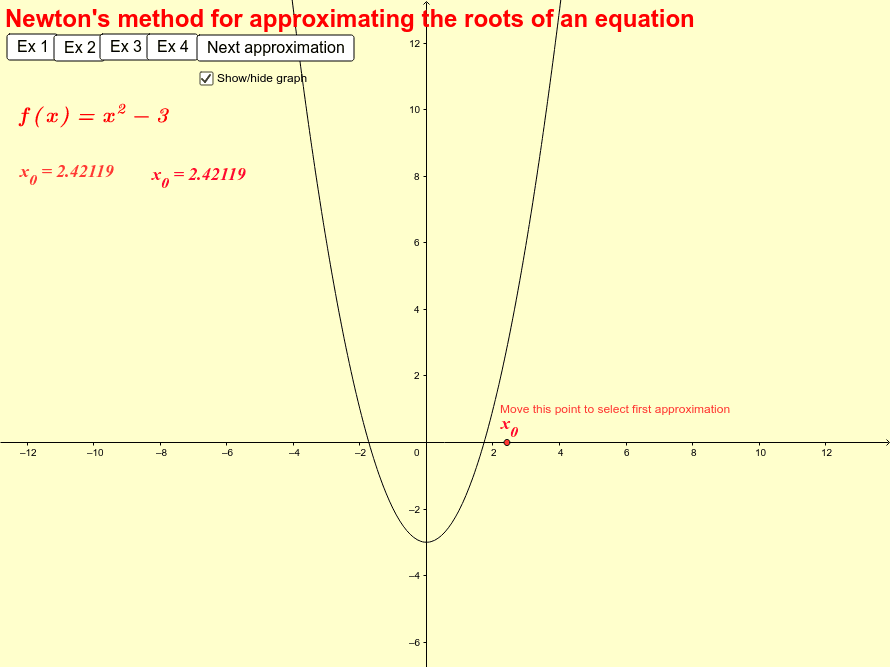
This example demonstrates the iterative process of Newton's method to approximate the roots of an equation. It involves core mathematical concepts such as functions, derivatives, iteration, and limits. Key GeoGebra commands and objects used in construction include Point, If, Derivative, IterationList, Element, Sequence, Line, and OrthogonalLine. Suitable for high school and above mathematics learners or calculus instruction.
GeoGebra Commands & Parameters
Point(xAxis) → AIf(a ≟ 1, f1, If[a ≟ 2, f2, If[a ≟ 3, f3, f]]) → gDerivative(g) → g'IterationList(h, x_0, 15) → List1Element(List1, 0) → bSequence(Vector[(Element[List1, i], 0), (Element[List1, i], g(Element[List1, i]))], i, 1, m1) → List3Sequence(Vector[(Element[List1, i], g(Element[List1, i])), (Element[List1, i + 1], 0)], i, 1, n) → List4Sequence(g(Element[List1, i]), i, 1, 15) → List2Line(B, C) → dOrthogonalLine(D, xAxis) → e
AI Drawing Prompt Reference
Draw a function and its derivative graph, using Newton's method to approximate the roots of an equation. Start by taking a point A on the x-axis, then define function g based on the chosen type (1, 2, or 3). Calculate the derivative g'. Apply Newton's method for 15 iterations to get a series of approximations, and draw line segments from the x-axis to these points to visualize the iteration process. Finally, draw the tangents and perpendicular lines at these points.
The prompt above was compiled from the original drawing commands and is for reference only.