
New Trig IDs from Similar Right Triangles (V2)
Loading the math board and drawing, please wait…
In collections
Trigonometric Identities
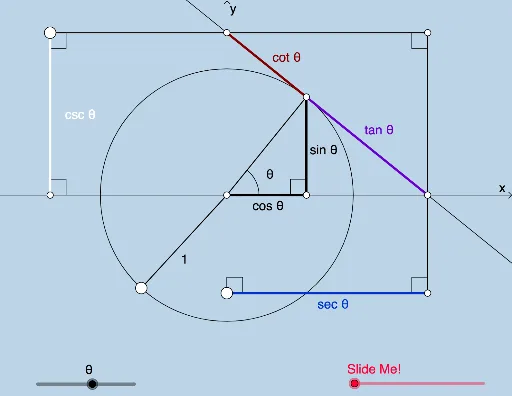
This example demonstrates how to derive new trigonometric identities using similar right triangles. Key math concepts include similarity transformations, secant lines, and trigonometric functions. GeoGebra commands and objects used in the construction are Circle, Tangent, Segment, Intersect, OrthogonalLine, Line, Point, Angle, Rotate, CircleSector, Dilate, Vector, and Translate. Suitable for high school mathematics education to understand and apply trigonometric identities.
GeoGebra Commands & Parameters
Circle(O, 1) → cTangent(A, c) → a,Segment(O, A) → eIntersect(a, b) → BIntersect(a, d) → COrthogonalLine(A, b) → fOrthogonalLine(A, d) → gIntersect(d, g) → DIntersect(b, f) → ESegment(A, B) → hSegment(O, E) → iSegment(E, A) → jSegment(A, C) → kLine(O, A) → lLine(D, A) → mLine(C, m) → nPoint(n) → FOrthogonalLine(F, n) → pIntersect(b, p) → GSegment(G, F) → qOrthogonalLine(B, m) → rPoint(d) → HOrthogonalLine(H, d) → sIntersect(r, s) → ISegment(H, I) → tAngle(A, E, O) → αIntersect(l, n) → JAngle(G, F, C) → γIntersect(c, yAxis, 2) → KSegment(O, K) → a_1Angle(t, yAxis) → δAngle(xAxis, q) → εAngle(B, I, H) → ζAngle(E, O, A) → ηAngle(E, A, B) → ιPoint(c) → LSegment(O, L) → f_1Intersect(n, r) → MIntersect(xAxis, r) → NIntersect(n, a) → PAngle(P, M, N) → κCircle(O, (0.4 * i)) → c_1Intersect(c_1, xAxis) → Q, RRotate(R, If[0 < u ≤ 1, ((o * π / 180) * u), (o * π / 180)], O) → R'CircleSector(O, R, R') → d_1Dilate(O, If[1.5 < u ≤ 2.5, 2.5 - u, 0], A) → O'Vector(O, O') → vTranslate(d_1, v) → e_1Rotate(e_1, If[2.5 < u ≤ 3.5, ((-(u - 2.5)) * π / 2), ((-π)) / 2], A) → g_1Dilate(A, If[3.5 < u ≤ 4.5, 4.5 - u, 0], P) → A'Vector(A, A') → wTranslate(g_1, w) → h_1Segment(F, M) → i_1Segment(N, M) → j_1Segment(N, I) → k_1Intersect(xAxis, q) → S
AI Drawing Prompt Reference
To describe a graph based on similar right triangles, including circles, tangents, line segments, intersection points, perpendicular lines, straight lines, points, angles, rotation, sectors, scaling, and translation. Describe the construction order of these objects.
The prompt above was compiled from the original drawing commands and is for reference only.