
Sine and Cosine Law Problem with Kite and Translation Construction
Loading the math board and drawing, please wait…
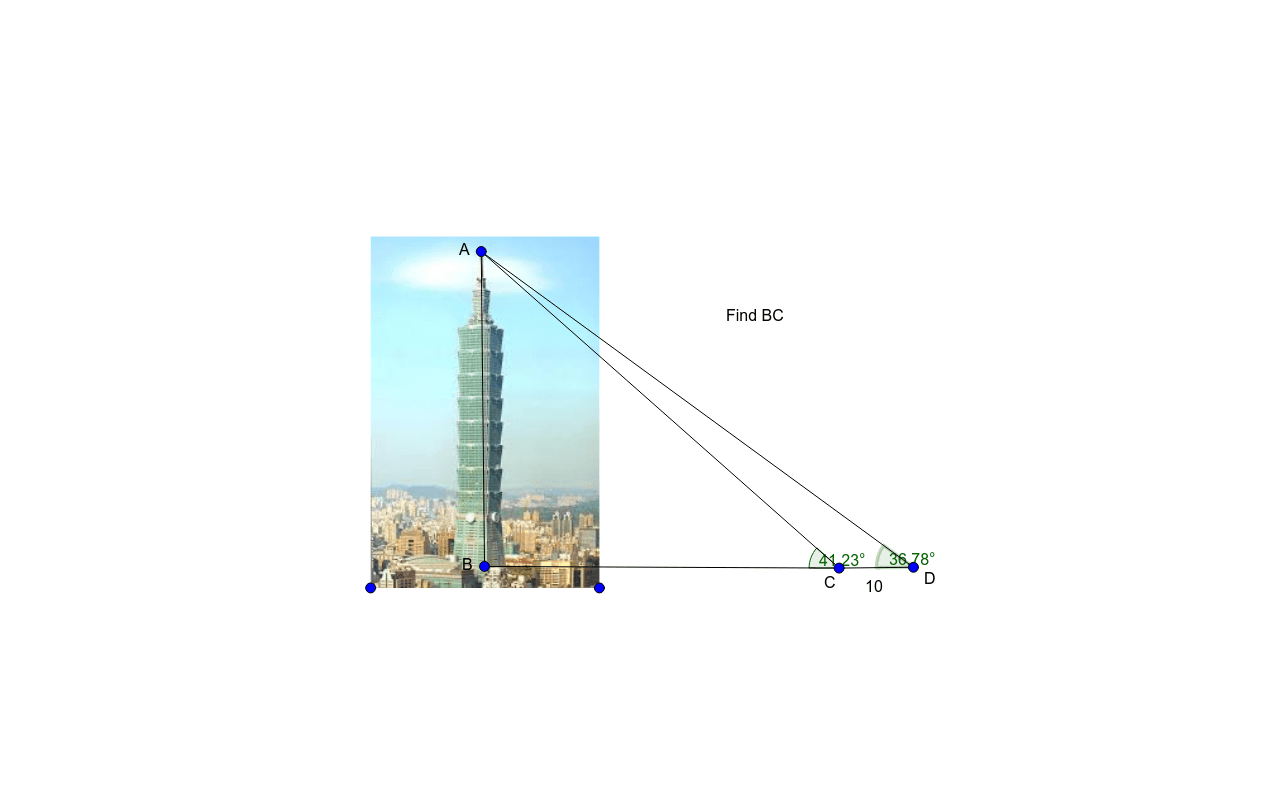
This GeoGebra example demonstrates a comprehensive application problem involving the Law of Sines and the Law of Cosines, set in a kite-shaped quadrilateral constructed via translation and similarity transformations. The core mathematical concepts include trigonometric laws, triangle angle sum, similarity transformations, and quadratic functions (likely for solving equations). The construction uses Segment and Angle commands, creating points A, B, C, D, E, F, segments f, g, h, i, j, and angles α and β. It also employs lists (list1, list2) and multiple text objects (text1 to text6) to display step-by-step calculations and results. This resource is ideal for high school students learning trigonometry, solving triangles, and geometric modeling, as well as for teachers demonstrating real-world applications in class or for student self-study.
GeoGebra Commands & Parameters
Segment(C, D) → fSegment(D, E) → gSegment(C, E) → hSegment(F, C) → iSegment(E, F) → jAngle(C, F, E) → αAngle(C, E, D) → β
AI Drawing Prompt Reference
Draw a kite-shaped quadrilateral composed of two triangles sharing a common side. Start with the base segment, then construct the upper vertex to form the left triangle. Use translation and similarity to create the right triangle, making the shape symmetric like a kite. Connect the diagonals and mark two key angles: one at the kite's tip and another at the junction of the base and side. Include three main sides and two auxiliary segments, with clear angle labels. The figure should be clean and suitable for demonstrating the Law of Sines and Cosines.
The prompt above was compiled from the original drawing commands and is for reference only.