
New Pythagorean Theorem
Loading the math board and drawing, please wait…
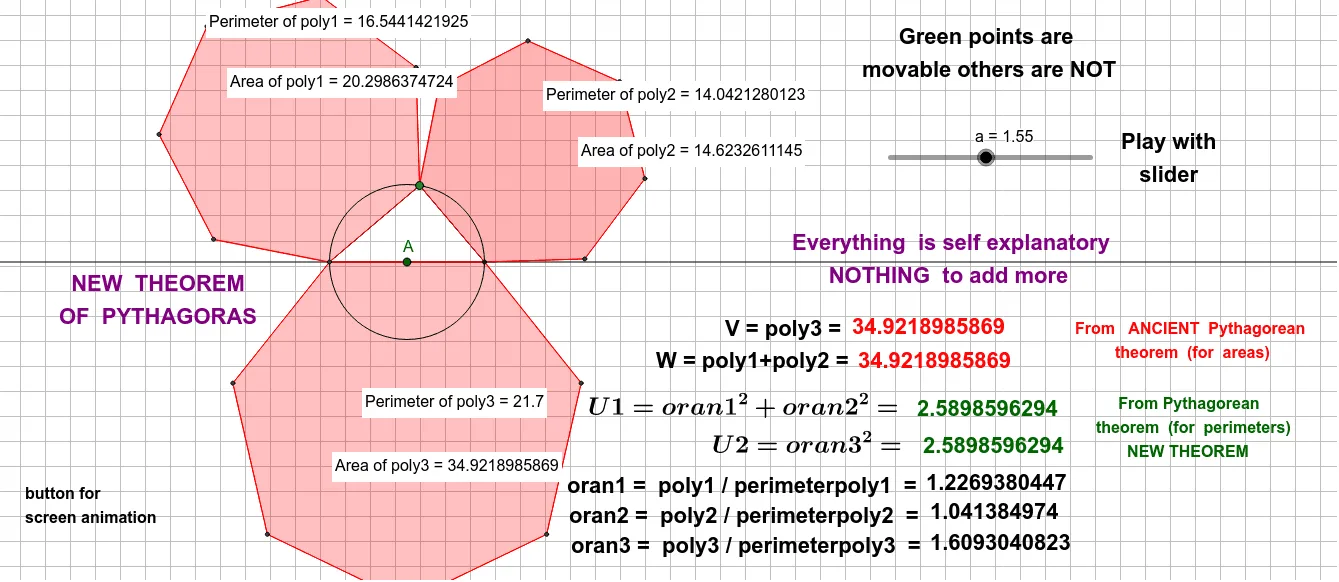
This example illustrates a new Pythagorean theorem involving geometric transformations and polygons. It demonstrates the proof process using commands such as Circle, Point, Line, Intersect, Polygon, Segment, Rotate, PointIn, and Perimeter. Suitable for middle school and above students to learn about geometric transformations and proof methods.
GeoGebra Commands & Parameters
Circle(A, a) → cPoint(c) → CLine(C, A) → fIntersect(c, f, 2) → DPolygon(C, D, 7) → poly3, f_1, S, T, U, g_1, h_1, i_1, j_1, k_1, l_1, Q, RPoint(c) → BSegment(B, C) → gPoint(f) → ERotate(E, 90°, C) → E'Point(f) → FSegment(B, D) → hPolygon(D, B, 7) → poly1, i, I, J, K, j, k, l, m, n, p, G, HPolygon(B, C, 7) → poly2, q, N, O, P, r, s, t, b, d, e, L, MPointIn(poly2) → Pointpoly2_1PointIn(poly1) → Pointpoly1_1PointIn(poly3) → Pointpoly3_1Perimeter(poly1) → perimeterpoly1PointIn(poly1) → Pointpoly1Perimeter(poly2) → perimeterpoly2PointIn(poly2) → Pointpoly2Perimeter(poly3) → perimeterpoly3PointIn(poly3) → Pointpoly3
AI Drawing Prompt Reference
Draw a circle, pick a point on it, and connect it to the center with a line that intersects the circle again at another point. Using these two points on the circle as adjacent vertices, construct a regular heptagon. Pick another point on the circle, connect it to the first circle point, and take a point on the line, rotating it 90 degrees around the first circle point. Connect the first circle point to the second intersection, and construct three regular heptagons from these three pairs of adjacent points. Place a point inside each heptagon and measure the perimeter of each heptagon.
The prompt above was compiled from the original drawing commands and is for reference only.