
New Aperiodic Monotile!
Loading the math board and drawing, please wait…
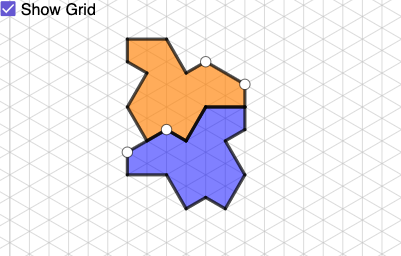
This example demonstrates a newly discovered aperiodic monotile, a special geometric shape that cannot be repeated through translation or rotation. Using transformation commands such as rotation and reflection, the construction of this unique shape is shown. Suitable for high school and above students or math enthusiasts.
GeoGebra Commands & Parameters
Point(Circle[A, 2]) → BSegment(A, B) → fCircle(B, 1) → cRotate(A, (2 * pi / 3), B) → A'Ray(B, A') → gIntersect(c, g, 1) → CSegment(B, C) → hOrthogonalLine(C, h) → iCircle(C, sqrt(3)) → dIntersect(d, i, 1) → DOrthogonalLine(D, f) → jCircle(D, sqrt(3)) → eIntersect(e, j, 1) → EOrthogonalLine(E, j) → kCircle(E, 1) → pIntersect(p, k, 2) → FRotate(E, (-2 * pi / 3), F) → E'Segment(D, E) → lSegment(E, F) → mSegment(F, E') → nOrthogonalLine(E', n) → qCircle(E', sqrt(3)) → rIntersect(r, q, 1) → GRotate(E', (2 * pi / 3), G) → E''Segment(G, E'') → sOrthogonalLine(E'', s) → tCircle(E'', 1) → c_1Intersect(c_1, t, 2) → HRotate(E'', (2 * pi / 3), H) → E'''Segment(E'', H) → aSegment(H, E''') → bOrthogonalLine(E''', b) → f_1Circle(E''', sqrt(3)) → d_1Intersect(d_1, f_1, 1) → IRotate(E''', (2 * pi / 3), I) → JPolygon(A, B, E''', I, J, C, D, E, F, E', G, E'', H) → poly1, a_1, h_1, e''', i_1, j_1, b_1, c_2, d_2, e_1, f_2, e', g_1, e''Circle(K, 2) → k_1Point(k_1) → LRotate(K, (-2 * pi / 3), L) → K'Ray(L, K') → m_1Circle(L, 1) → p_1Intersect(p_1, m_1, 1) → PSegment(K, L) → n_1Segment(L, P) → q_1OrthogonalLine(P, q_1) → r_1Circle(P, sqrt(3)) → s_1Intersect(s_1, r_1, 2) → QRotate(P, (2 * pi / 3), Q) → P'Segment(P, Q) → t_1Segment(Q, P') → g_2OrthogonalLine(P', g_2) → h_2Circle(P', 1) → e_2Intersect(e_2, h_2, 2) → RRotate(P', (2 * pi / 3), R) → P''Segment(P', R) → i_2Segment(R, P'') → j_2OrthogonalLine(P'', j_2) → k_2Circle(P'', sqrt(3)) → p_2Intersect(p_2, k_2, 2) → SRotate(P'', (-2 * pi / 3), S) → P'''Segment(P''', S) → l_2Segment(P'', S) → m_2OrthogonalLine(P''', l_2) → n_2Circle(P''', 1) → q_2Intersect(q_2, n_2, 2) → TRotate(P''', (-2 * pi / 3), T) → USegment(T, U) → r_2OrthogonalLine(U, r_2) → s_2Circle(U, sqrt(3)) → t_2Intersect(t_2, s_2, 2) → VRotate(U, (-2 * pi / 3), V) → U'Polygon(K, L, U, V, U', P, Q, P', R, P'', S, P''', T) → poly2, k_3, t_3, u, v, u', l_3, p_3, q_3, p', r_3, p'', s_3, p'''Segment(B, A) → l_1Segment(K, L) → a_2Segment(D, E) → b_2Segment(D, C) → f_3Segment(C, B) → g_3Segment(E, F) → h_3Segment(F, E') → i_3Segment(E', G) → j_3Segment(G, E'') → m_3Segment(E'', H) → n_3Segment(H, E''') → a_3Segment(E''', I) → b_3Segment(I, J) → c_3Segment(J, A) → d_3Segment(K, U') → e_3Segment(U', V) → f_4Segment(V, U) → g_4Segment(U, T) → h_4Segment(T, P''') → i_4Segment(P''', S) → j_4Segment(S, P'') → k_4Segment(P'', R) → l_4Segment(R, P') → m_4Segment(P', Q) → n_4Segment(Q, P) → p_4Segment(P, L) → q_4AperiodicMonotile(M) → poly3, N, f_5, g_5, h_5, i_5, j_5, r_4, s_4, t_4, a_4, b_4, c_4, d_4, e_4ReflectAperiodicMonotile(O) → W, poly4, t_5, a_5, b_5, c_5, d_5, k_5, l_5, m_5, n_5, p_5, q_5, r_5, s_5
AI Drawing Prompt Reference
This is a new aperiodic monotile, which cannot be repeated by translation or rotation. The figure consists of points, line segments, and circles, constructed using rotations and reflections. Key objects include points A, B, E''', I, J, C, D, E, F, E', G, E'', H, connected by line segments and circles. The construction order starts from point A, then adds points B, E''', I, J, etc., and connects them through circles and line segments to form a complex geometric shape. This figure is suitable for math enthusiasts or high school students.
The prompt above was compiled from the original drawing commands and is for reference only.