
Multiplication of Decimals and Geometric Construction
Loading the math board and drawing, please wait…
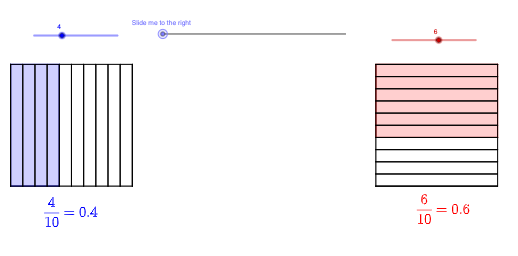
This example demonstrates the application of decimal multiplication in geometric figures. Key mathematical concepts include decimal operations, geometric construction, and coordinate geometry. Construction involves using GeoGebra commands such as Segment, Sequence, Polygon, Point, Vector, Translate, Intersect, etc. Suitable for middle school students learning the integration of geometry and mathematics.
GeoGebra Commands & Parameters
Segment(A, B) → fSegment(C, B) → gSegment(A, D) → hSegment(D, C) → iSegment(E, F) → jSegment(F, G) → kSegment(H, G) → lSegment(E, H) → mSequence(Segment[((i / d1 * 2) - 4, -1), ((i / d1 * 2) - 4, 1)], i, 0, d1, 1) → l1Sequence(Segment[(2, (i / d2 * 2) - 1), (4, (i / d2 * 2) - 1)], i, 0, d2, 1) → l2Polygon(A, n1a, n1b, B) → q1, a, n, p, bPolygon(E, n2a, n2b, H) → q2, e, q, r, h_1Segment(I, J) → sPoint(s) → KVector(I, K) → uTranslate(l1, u) → l1'Translate(l2, Vector[(-u)]) → l2'Translate(A, u) → A'Translate(n1a, u) → n1a'Translate(n1b, u) → n1b'Translate(B, u) → B'Translate(E, u) → E'Translate(H, u) → H'Translate(E, Vector[(-u)]) → E'_{1}Translate(n2a, Vector[(-u)]) → n2a'_{1}Translate(n2b, Vector[(-u)]) → n2b'_{1}Translate(H, Vector[(-u)]) → H'_{1}Polygon(E'_{1}, n2a'_{1}, n2b'_{1}, H'_{1}) → q2'_{1}, e'_{1}, g_1, i_1, h'_{1}Translate(A, u) → A'_{1}Translate(n1a, u) → n1a'_{1}Translate(n1b, u) → n1b'_{1}Translate(B, u) → B'_{1}Polygon(A'_{1}, n1a'_{1}, n1b'_{1}, B'_{1}) → q1', a'_{1}, t, c, b'_{1}Translate(A, u) → A'_{2}Translate(D, u) → D'Segment(A'_{2}, D') → h'Translate(C, u) → C'Translate(B, u) → B'_{2}Segment(C', B'_{2}) → g'Translate(E, Vector[(-u)]) → E'_{2}Translate(F, Vector[(-u)]) → F'Segment(E'_{2}, F') → j'Translate(H, Vector[(-u)]) → H'_{2}Translate(G, Vector[(-u)]) → G'Segment(H'_{2}, G') → l'Intersect(g_1, t) → LPolygon(A', n2a'_{1}, L, M) → q3, a', d, l_1, m_1GCD(n1, d1) → gcd1GCD(n2, d2) → gcd2
AI Drawing Prompt Reference
Draw a composite geometric figure consisting of two rectangles and two parallelograms, demonstrating decimal multiplication. Start with two adjacent rectangles, one on the left and one on the right, filled with grid lines. Inside the right rectangle, construct a parallelogram, and inside the left rectangle, construct another parallelogram, linked by a translation vector. Then, translate the left grid lines to the right and the right grid lines to the left, creating an interleaved effect. Finally, mark an intersection point where the two parallelograms cross, and show the side-length ratio of the rectangles to illustrate the geometric meaning of decimal multiplication.
The prompt above was compiled from the original drawing commands and is for reference only.