
Mixed and Improper Fractions Converter
Loading the math board and drawing, please wait…
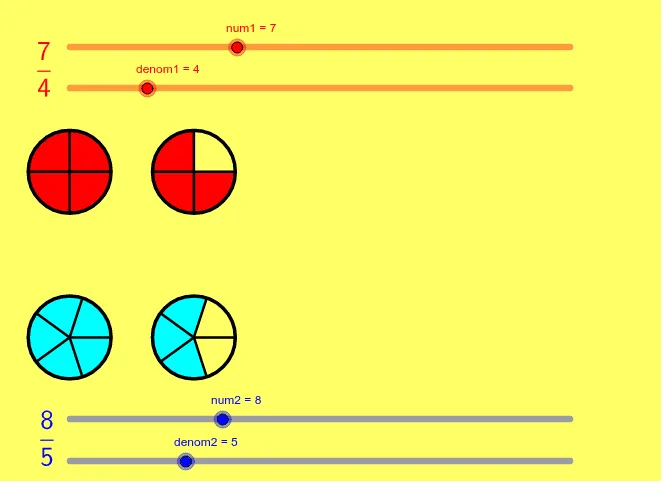
This example demonstrates the conversion between mixed numbers and improper fractions through interactive dynamic geometry. It involves core math concepts like fraction properties, operations, and visual learning. Constructed using GeoGebra commands Sequence and CircleSector, with objects like r1-r5, b1-b5, R1-R5, etc., it features slider animations for an engaging visual representation. Ideal for middle school and above students to grasp fraction conversion principles and enhance mathematical visualization skills.
GeoGebra Commands & Parameters
Sequence((cos(2 * π * i / denom1), sin(2 * π * i / denom1) + 2), i, 1, denom1) → rpts1Sequence((cos(2 * π * i / denom1) + 3, sin(2 * π * i / denom1) + 2), i, 1, denom1) → rpts2Sequence((cos(2 * π * i / denom1) + 6, sin(2 * π * i / denom1) + 2), i, 1, denom1) → rpts3Sequence((cos(2 * π * i / denom1) + 9, sin(2 * π * i / denom1) + 2), i, 1, denom1) → rpts4Sequence((cos(2 * π * i / denom1) + 12, sin(2 * π * i / denom1) + 2), i, 1, denom1) → rpts5Sequence((cos(2 * π * i / denom2), sin(2 * π * i / denom2) - 2), i, 1, denom2) → bpts1Sequence((cos(2 * π * i / denom2) + 3, sin(2 * π * i / denom2) - 2), i, 1, denom2) → bpts2Sequence((cos(2 * π * i / denom2) + 6, sin(2 * π * i / denom2) - 2), i, 1, denom2) → bpts3Sequence((cos(2 * π * i / denom2) + 9, sin(2 * π * i / denom2) - 2), i, 1, denom2) → bpts4Sequence((cos(2 * π * i / denom2) + 12, sin(2 * π * i / denom2) - 2), i, 1, denom2) → bpts5Sequence(Segment[Element[bpts1, i], B1], i, 1, denom2) → bseg1Sequence(Segment[Element[bpts2, i], B2], i, 1, denom2) → bseg2Sequence(Segment[Element[bpts3, i], B3], i, 1, denom2) → bseg3Sequence(Segment[Element[bpts4, i], B4], i, 1, denom2) → bseg4Sequence(Segment[Element[bpts5, i], B5], i, 1, denom2) → bseg5Sequence(Segment[Element[rpts1, i], R1], i, 1, denom1) → rseg1Sequence(Segment[Element[rpts2, i], R2], i, 1, denom1) → rseg2Sequence(Segment[Element[rpts3, i], R3], i, 1, denom1) → rseg3Sequence(Segment[Element[rpts4, i], R4], i, 1, denom1) → rseg4Sequence(Segment[Element[rpts5, i], R5], i, 1, denom1) → rseg5CircleSector(B1, Element[bpts1, 1], Element[bpts1, num2 - floor(num2 / denom2) + 1]) → bsec1CircleSector(B2, Element[bpts2, 1], Element[bpts2, num2 - denom2 * floor(num2 / denom2) + 1]) → bsec2CircleSector(B3, Element[bpts3, 1], Element[bpts3, num2 - denom2 * floor(num2 / denom2) + 1]) → bsec3CircleSector(B4, Element[bpts4, 1], Element[bpts4, num2 - denom2 * floor(num2 / denom2) + 1]) → bsec4CircleSector(B5, Element[bpts5, 1], Element[bpts5, num2 - denom2 * floor(num2 / denom2) + 1]) → bsec5CircleSector(R1, Element[rpts1, 1], Element[rpts1, num1 - denom1 * floor(num1 / denom1) + 1]) → rsec1CircleSector(R2, Element[rpts2, 1], Element[rpts2, num1 - denom1 * floor(num1 / denom1) + 1]) → rsec2CircleSector(R3, Element[rpts3, 1], Element[rpts3, num1 - denom1 * floor(num1 / denom1) + 1]) → rsec3CircleSector(R4, Element[rpts4, 1], Element[rpts4, num1 - denom1 * floor(num1 / denom1) + 1]) → rsec4CircleSector(R5, Element[rpts5, 1], Element[rpts5, num1 - denom1 * floor(num1 / denom1) + 1]) → rsec5