
Mechanical Flapping Bird: A 3D Linkage-Driven Animation
Loading the math board and drawing, please wait…
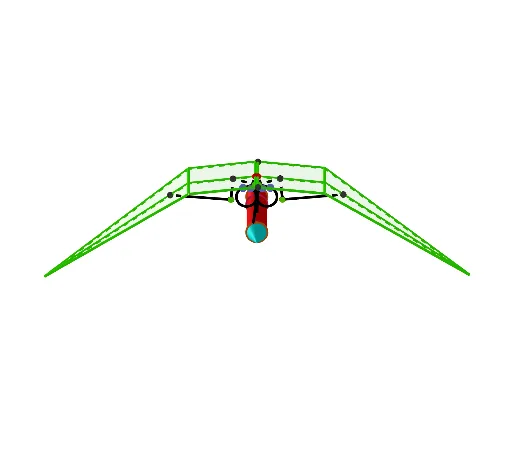
① This example demonstrates a flapping bird driven by mechanical linkages, using a 3D geometric construction with animated sliders to simulate periodic wing motion. ② Core mathematical concepts include spatial relationships among points, lines, and planes, rotation and reflection transformations, and the use of basic solids like cylinders and cones to build complex mechanical structures; it also touches on linear programming/optimization (to constrain linkage motion) and linear regression (possibly for trajectory fitting). ③ Construction highlights: from the summary, GeoGebra commands such as Circle, Point, Ray, Midpoint, Rotate, Intersect, Segment, Line, Polygon, OrthogonalLine, Cylinder, Cone, Plane, and Mirror are used, creating numerous points (A, B, C, D, E, F, G, H, I, J, K, L, M) and lines (d, e, f, g, h, i, j, k, l, m, t), with rotations and reflections to generate symmetric parts, and polygons/solids to form the bird body and wings. ④ Suitable for high school or university courses in solid geometry, 3D modeling, or mechanical principles, and for interdisciplinary math-engineering projects to understand parametric design and motion simulation.
GeoGebra Commands & Parameters
Circle(A, 2) → cPoint(c) → BPoint(c) → DRay(A, D) → fMidpoint(B, A) → CCircle(C, A) → dRotate(B, (-α), C) → B'Circle(D, 1) → eIntersect(e, f, 2) → ECircle(B', 1.2) → hCircle(E, 2.2) → gIntersect(h, g, 2) → FSegment(F, B') → iSegment(E, F) → jRotate(B', (-(45°)), C) → B''Circle(B'', 1.3) → pIntersect(g, p, 1) → HRay(H, E) → lRotate(F, (-(80°)), E) → F'Segment(E, F') → kIntersect(g, l, 2) → GCircle(G, E) → rIntersect(r, l, 2) → ICircle(F', 6) → qCircle(I, 2.2) → sIntersect(q, s, 1) → JRay(I, J) → mCircle(J, 15) → tIntersect(t, m, 1) → KSegment(I, H) → nSegment(J, F') → aSegment(B'', H) → bSegment(I, K) → f_1Point(zAxis) → LPoint(zAxis) → MLine(L, M) → g_1Line(H, g_1) → h_1Line(I, g_1) → i_1Point(i_1) → NLine(N, n) → j_1Point(i_1) → OLine(O, j_1) → k_1Intersect(j_1, h_1) → PIntersect(k_1, h_1) → QPolygon(P, N, O, Q) → q1, p_1, n_1, o, q_1Polygon(N, K, O) → t1, o_1, n_2, k_2Circle(F', 0.2) → c_1Circle(E, 0.2) → d_1Circle(H, 0.2) → e_1OrthogonalLine(F', k) → l_1OrthogonalLine(E, k) → m_1Intersect(d_1, m_1, 1) → RPoint(eq1) → SLine(S, g_1) → r_1Point(r_1) → TPoint(r_1) → UCylinder(T, U, 1) → u, s_1, t_1, vPoint(r_1) → VCone(U, V, 1) → w, c_2, a_1Segment(S, H) → b_1Point(r_1) → WSegment(W, P) → f_2Point(c_2) → ZSegment(Z, Q) → h_2Point(r_1) → A_1Point(r_1) → B_1Cone(B_1, A_1, 1) → u_1, d_2, v_1Point(eq1) → C_1Point(r_1) → D_1Point(r_1) → E_1Plane(D_1, C_1, E_1) → p_2Mirror(q1, p_2) → q1'Mirror(t1, p_2) → t1'Mirror(I, p_2) → I'Mirror(K, p_2) → K'Segment(I', K') → g_2Mirror(I, p_2) → I'_1Mirror(H, p_2) → H'Segment(I'_1, H') → n'Mirror(J, p_2) → J'Mirror(F', p_2) → F''Segment(J', F'') → a'Mirror(E, p_2) → E'Mirror(F', p_2) → F''_1Segment(E', F''_1) → k'Mirror(d, p_2) → d'Mirror(B'', eq1) → B'''Mirror(H, eq1) → H'_1Segment(B''', H'_1) → b'Mirror(F, eq1) → F'_1Mirror(B', eq1) → B''_1Segment(F'_1, B''_1) → i'Mirror(S, eq1) → S'Mirror(H, eq1) → H'_2Segment(S', H'_2) → i_2Mirror(F', eq1) → F''_2Mirror(d_1, eq1) → e_2Mirror(c_1, eq1) → q_2Mirror(E, eq1) → E'_1Mirror(F, eq1) → F'_2Segment(E'_1, F'_2) → j'