
Measuring Polygon Area
Loading the math board and drawing, please wait…
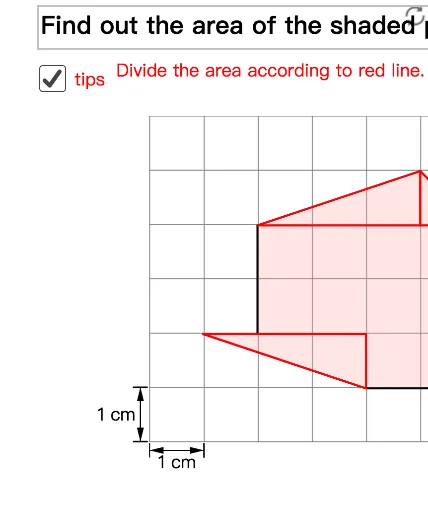
This example demonstrates how to measure the area of any polygon using GeoGebra. Key math concepts include vectors, geometric transformations, polygon construction, and coordinate geometry. Construction highlights involve commands like Segment, Vector, Point, Rotate, Polygon, Max, Min, Translate. Suitable for high school mathematics, helping students understand area calculation methods and vector applications.
GeoGebra Commands & Parameters
Segment(X0, X0 + (0, mark)) → hSegment(X0 + (1, 0), X0 + (1, mark)) → iVector(X0 + (0, mark / 2), X0 + (1, mark / 2)) → uVector(X0 + (1, mark / 2), X0 + (0, mark / 2)) → vSegment(Y0 - (mark, 0), Y0) → jSegment(Y0 - (mark, 1), Y0 - (0, 1)) → kVector(Y0 - (mark / 2, 1), Y0 - (mark / 2, 0)) → wVector(Y0 - (mark / 2, 0), Y0 - (mark / 2, 1)) → zPoint(yAxis) → APoint(xAxis) → BPoint(xAxis) → CRotate(E, (90° * t1), F) → E'Rotate(F, (90° * t1), F) → F'Rotate(L, (90° * t1), F) → L'Polygon(E', F', L') → poly1, l', e', f'Rotate(G, ((-(90°)) * t2), F) → G'Rotate(M, ((-(90°)) * t2), F) → M'Rotate(F, ((-(90°)) * t2), F) → F'_1Polygon(G', M', F'_1) → poly2, f'_1, g', m'Rotate(D, ((-(180°)) * t3), J) → D'Rotate(E, ((-(180°)) * t3), J) → E'_1Rotate(J, ((-(180°)) * t3), J) → J'Polygon(D', E'_1, J') → poly3, j', d', e'_1Rotate(J, (180° * t4), J) → J'_1Rotate(K, (180° * t4), J) → K'Rotate(C, (180° * t4), J) → C'Polygon(J'_1, K', C') → poly4, c', j'_1, k'Max(t5 - 1, 0) → s2Min(t5, 1) → s1Min(t6, 1) → w1Max(t6 - 1, 0) → w2Translate(Translate[G, Vector[(s1 * Vector[M, H])]], Vector[(s2 * Vector[M, B])]) → G''Translate(Translate[M, Vector[(s1 * Vector[M, H])]], Vector[(s2 * Vector[M, B])]) → M''Translate(Translate[H, Vector[(s1 * Vector[H, M])]], Vector[(s2 * Vector[M, B])]) → H''Polygon(G'', H'', M'') → poly5, m'', g'', h''Translate(Translate[B, Vector[(w1 * Vector[N, A])]], Vector[(w2 * Vector[B, M])]) → B'Translate(Translate[N, Vector[(w1 * Vector[N, A])]], Vector[(w2 * Vector[B, M])]) → N'Translate(Translate[A, Vector[(w1 * Vector[A, N])]], Vector[(w2 * Vector[B, M])]) → A'Polygon(A', B', N') → poly6, n', a', b'Polygon(E', F', L') → poly1', l'_1, e'_2, f'_2Polygon(G', M', F'_1) → poly2', f'_3, g'_1, m'_1Polygon(D', E'_1, J') → poly3', j'_2, d'_1, e'_3Polygon(J'_1, K', C') → poly4', c'_1, j'_3, k'_1Polygon(G'', H'', M'') → poly5', m''_1, g''_1, h''_1Polygon(A', B', N') → poly6', n'_1, a'_1, b'_1Polygon(H, I, N, B, C, K, J, L) → poly7, h_1, i_1, n, b, c, k_1, j_1, lPolygon(A, B, C, D, E, F, G, H, I) → poly8, a, b_1, c_1, d, e, f, g, h_2, i_2Polygon(E, F, L) → poly9, l_1, e_1, f_1Polygon(F, G, M) → poly10, m, f_2, g_1Polygon(G, H, M) → poly11, m_1, g_2, h_3Polygon(A, B, N) → poly12, n_1, a_1, b_2Polygon(C, K, J) → poly13, j_2, c_2, k_2Polygon(D, E, J) → poly14, j_3, d_1, e_2