
Calculating Polygon Area: Geometric Construction and Area Calculation
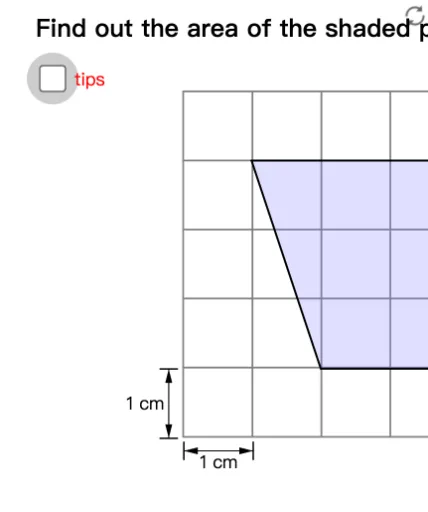
Loading the math board and drawing, please wait…
This example demonstrates how to construct a polygon and calculate its area using GeoGebra. The key mathematical concepts include polygon area formulas, geometric construction techniques, and coordinate geometry. The construction involves using commands like Segment, Vector, Point, Translate, and Polygon to create polygon objects, along with text annotations and markers for visualization. It is suitable for middle or high school mathematics courses to learn geometric area calculation and drawing methods.
GeoGebra Commands & Parameters
Segment(X0, X0 + (0, 0.25)) → gSegment(X0, X0 + (0, mark)) → hSegment(X0 + (1, 0), X0 + (1, mark)) → iVector(X0 + (0, mark / 2), X0 + (1, mark / 2)) → uVector(X0 + (1, mark / 2), X0 + (0, mark / 2)) → vSegment(Y0 - (mark, 0), Y0) → jSegment(Y0 - (mark, 1), Y0 - (0, 1)) → kVector(Y0 - (mark / 2, 1), Y0 - (mark / 2, 0)) → wVector(Y0 - (mark / 2, 0), Y0 - (mark / 2, 1)) → zPoint(yAxis) → APoint(xAxis) → BPoint(xAxis) → CPoint(xAxis) → ETranslate(A, Vector[(t1 * Vector[A, D])]) → A'Translate(B, Vector[(t1 * Vector[A, D])]) → B'Translate(F, Vector[(t1 * Vector[A, D])]) → F'Polygon(A', B', F') → poly1, f', a', b'Translate(C, Vector[(t2 * Vector[D, A])]) → C'Translate(D, Vector[(t2 * Vector[D, A])]) → D'Translate(E, Vector[(t2 * Vector[D, A])]) → E'Polygon(C', D', E') → poly2, e', c', d'Polygon(A', B', F') → poly1', f'_1, a'_1, b'_1Polygon(C', D', E') → poly2', e'_1, c'_1, d'_1Polygon(B, E, D, F) → poly3, b, e, d, fPolygon(A, B, C, D) → poly4, a, b_1, c, d_1Polygon(A, B, F) → poly5, f_1, a_1, b_2Polygon(C, D, E) → poly6, e_1, c_1, d_2