
Measuring Polygon Area with Symmetry Transformations
Loading the math board and drawing, please wait…
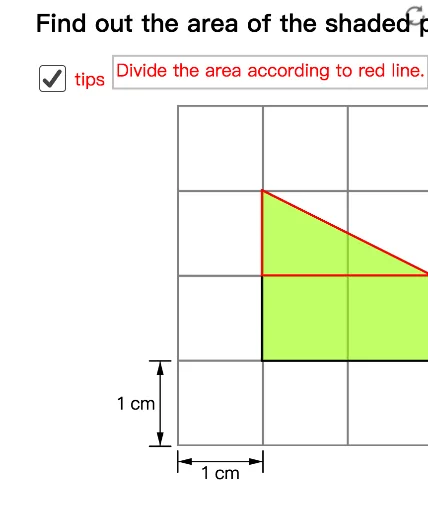
①This example demonstrates how to construct a polygon in GeoGebra, measure its area, and observe changes under symmetry transformations (rotation). ②Core mathematical concepts include polygon area calculation, axial/central symmetry, rotation, and the feasible region idea from linear programming (as indicated by original tags). ③Construction highlights: using commands such as Segment, Vector, Point, Intersect, Rotate, and Polygon, it creates multiple points (A, B, C, D, E, F) and their rotated counterparts (A', F', D'), forming polygons poly1 and poly2, with text objects displaying area measurements. ④Suitable for middle/high school geometry lessons to intuitively understand area formulas, symmetry properties, and dynamic geometric exploration, also useful as a visual aid for computing feasible region areas in linear programming.
GeoGebra Commands & Parameters
Segment(X0, X0 + (0, 0.25)) → gSegment(X0, X0 + (0, mark)) → hSegment(X0 + (1, 0), X0 + (1, mark)) → iVector(X0 + (0, mark / 2), X0 + (1, mark / 2)) → uVector(X0 + (1, mark / 2), X0 + (0, mark / 2)) → vSegment(Y0 - (mark, 0), Y0) → jSegment(Y0 - (mark, 1), Y0 - (0, 1)) → kVector(Y0 - (mark / 2, 1), Y0 - (mark / 2, 0)) → wVector(Y0 - (mark / 2, 0), Y0 - (mark / 2, 1)) → zSegment((3, -1), (3, 3)) → lPoint(yAxis) → AIntersect(xAxis, yAxis) → BPoint(xAxis) → CPoint(xAxis) → EPoint(yAxis) → FRotate(A, ((-(180°)) * t1), D) → A'Rotate(F, ((-(180°)) * t1), D) → F'Rotate(D, ((-(180°)) * t1), D) → D'Polygon(A', F', D') → poly1, d', a', f'Rotate(C, (180° * t2), D) → C'Rotate(D, (180° * t2), D) → D'_1Rotate(E, (180° * t2), D) → E'Polygon(C', D'_1, E') → poly2, e', c', d'_1Polygon(A', F', D') → poly1', d'_2, a'_1, f'_1Polygon(C', D'_1, E') → poly2', e'_1, c'_1, d'_3Polygon(B, E, D, F) → poly3, b, e, d, fPolygon(A, B, C) → poly4, c, a, b_1Polygon(A, F, D, E, C) → poly5, a_1, f_1, d_1, e_1, c_1
AI Drawing Prompt Reference
Draw a figure consisting of a pentagon and its symmetric transformations, including rotations. Start by constructing a pentagon, then generate multiple new pentagons through rotations and symmetry transformations. Display the area of each pentagon. The figure includes the original pentagon and two new pentagons obtained by rotating 180 degrees, along with other pentagons created through rotations and symmetry. All pentagons rotate around a central point, with their areas labeled to show the effect of symmetric transformations on area.
The prompt above was compiled from the original drawing commands and is for reference only.