
Dividing a Cube into Equal Parts with Equal Volume and Surface Area
Loading the math board and drawing, please wait…
In collections
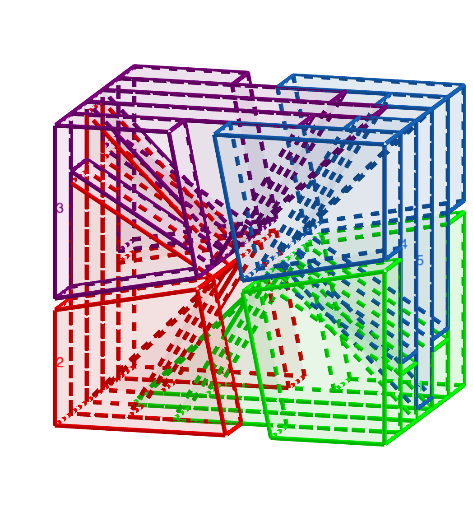
Dissecting a cube into equal parts
① This example demonstrates how to divide a cube into several parts such that each part has equal volume and equal surface area, a classic problem in solid geometry. ② Core mathematical concepts include volume and surface area calculations of a cube, symmetric spatial partitioning, and constructing cutting planes using polygons, involving geometric transformations and equality relations of area/volume. ③ Construction highlights: from the construction summary, many point objects (e.g., A, B, C, D, E, F, G, H, I, J, K, L, M, N, O, P, Q, R, S, T, U, V, W, Z) and subscripted points (e.g., A_1, B_1, C_1, D_1, F_1, I_1, J_1, O_1, P_1, Q_1, R_1, S_1, T_1) are used, and the Polygon command creates polygonal faces, with auxiliary objects (e.g., q1, j) possibly aiding the division. ④ Suitable for high school or early college solid geometry teaching, also useful for mathematical modeling or geometric intuition training, helping students understand spatial partitioning and symmetry.
GeoGebra Commands & Parameters
Polygon(J, I, O, M) → q1, j, i, o, mPolygon(A, B, G, C) → q2, a_1, b, g, cPolygon(L, J, M, P) → q3, l, j_1, m_1, pPolygon(G, B, E, H) → q4, g_1, b_1, e, hPolygon(A, B, E, D) → q5, a_2, b_2, e_1, dPolygon(J, I, K, L) → q6, j_2, i_1, k, l_1Polygon(M, P, N, O) → q7, m_2, p_1, n, o_1Polygon(C, G, H, F) → q8, c_1, g_2, h_1, fPolygon(B_1, T, R, D) → q9, q, t, r, d_1Polygon(A_1, K, Q, S) → q10, s, k_1, q_1, s_1Polygon(A_1, P, L) → t1, l_2, f_1, p_2Polygon(P, W, U, E_1) → poly1, n_1, r_1, t_1, f_2Polygon(P, E_1, N) → t2, n_2, p_3, h_2Polygon(A_1, S, W, P) → q11, i_2, s_2, w, p_4Polygon(W, Q, R, Z) → q12, w_1, q_2, r_2, z_1Polygon(C_1, D_1, Z, W) → q13, k_2, t_2, z_2, w_2Polygon(T, B_1, H, Z) → t3, c_2, d_2, e_2, f_3Polygon(Z, V, F_1, H) → q14, z_3, v, g_3, h_3Polygon(H, F, F_1) → t4, i_3, h_4, f_4Polygon(W, S, C_1) → poly2, j_3, k_3, l_3Polygon(Z, T, D_1) → t5, m_3, n_3, r_3Polygon(B_1, E, H) → t6, h_5, q_3, e_3Polygon(D_1, C_1, Q, R) → q15, s_3, t_3, q_4, r_4Polygon(W, Q, U) → t7, u, w_3, q_5Polygon(Z, V, R) → t8, r_5, z_4, v_1Polygon(K, I, O, N) → q16, k_4, i_4, o_2, n_4Polygon(K, E_1, U, Q) → t9, a_3, b_3, c_3, d_3Polygon(F, C, A, D) → q17, f_5, c_4, a_4, d_4Polygon(V, F_1, D, R) → q18, v_2, g_4, d_5, r_6Polygon(H_1, G_1, J_1, I_1) → q19, j_4, l_4, m_4, s_4Polygon(L_1, K_1, H_1, G_1) → q20, t_4, b_4, e_4, g_5Polygon(L_1, K_1, I_1, J_1) → q21, i_5, j_5, k_5, l_5Polygon(I_1, P_1, O_1, S_1) → q22, m_5, n_5, p_5, s_5Polygon(R_1, Q_1, J_1, T_1) → poly3, t_5, a_5, b_5, c_5Polygon(O_1, P_1, H_1, M_1) → q23, e_5, f_6, g_6, h_6Polygon(G_1, N_1, R_1, Q_1) → q24, i_6, j_6, k_6, l_6Polygon(A_2, Z_1, W_1, S_1) → q25, m_6, n_6, p_6, q_6Polygon(T_1, B_2, V_1, U_1) → t10, s_6, t_6, a_6, b_6Polygon(Z_1, D_2, M_1, W_1) → q26, c_6, d_6, e_6, f_7Polygon(N_1, C_2, V_1, U_1) → q27, g_7, h_7, i_7, u_1Polygon(D_2, Z_1, A_2, E_2) → q28, j_7, k_7, l_7, m_7Polygon(C_2, V_1, B_2, F_2) → q29, n_7, p_7, q_7, r_7Polygon(I_1, P_1, H_1) → t11, s_7, t_7, a_7Polygon(W_1, S_1, O_1) → t12, b_7, c_7, d_7Polygon(G_1, Q_1, J_1) → t13, e_7, f_8, g_8Polygon(T_1, U_1, R_1) → t14, h_8, i_8, j_8Polygon(E_2, A_2, S_1, G_2) → q30, k_8, l_8, m_8, n_8Polygon(F_2, H_2, T_1, B_2) → q31, p_8, q_8, r_8, s_8Polygon(S_1, I_2, J_2, I_1) → q32, t_8, a_8, b_8, c_8Polygon(K_2, L_2, T_1, J_1) → q33, d_8, e_8, f_9, g_9Polygon(I_2, G_2, S_1) → t15, h_9, i_9, j_9Polygon(K_1, J_2, I_1) → t16, k_9, l_9, m_9Polygon(L_1, K_2, J_1) → t18, r_9, s_9, t_9Polygon(F_2, C_2, N_1, H_2) → q34, a_9, b_9, c_9, d_9Polygon(L_2, K_2, G_1, N_1) → q35, e_9, f_{10}, g_{10}, h_{10}Polygon(M_1, I_2, J_2, H_1) → q37, m_{10}, n_{10}, p_{10}, q_{10}Polygon(D_2, E_2, G_2, M_1) → q36, i_{10}, j_{10}, k_{10}, l_{10}Polygon(H_3, I_3, S_2, R_2) → q38, n_9, p_9, q_9, r_{10}Polygon(Q_2, R_2, C_3, B_3) → q39, s_{10}, t_{10}, a_{10}, b_{10}Polygon(O_2, D_3, E_3, N_2) → q40, c_{10}, d_{10}, e_{10}, f_{11}Polygon(F_3, G_3, N_2, M_2) → q41, g_{11}, h_{11}, i_{11}, j_{11}Polygon(F_3, T_2, J_3, M_2) → q43, p_{11}, q_{11}, r_{11}, s_{11}Polygon(U_2, K_3, J_3, T_2) → q44, u_2, t_{11}, a_{11}, b_{11}Polygon(L_3, M_3, Z_2, A_3) → q45, c_{11}, d_{11}, e_{11}, f_{12}Polygon(Z_2, W_2, B_3, C_3) → q46, g_{12}, h_{12}, i_{12}, j_{12}Polygon(E_3, U_2, V_2, D_3) → q47, k_{12}, l_{12}, m_{12}, n_{12}Polygon(Q_2, O_2, V_2, W_2) → q48, p_{12}, q_{12}, r_{12}, s_{12}Polygon(Z_2, Q_3, P_3, W_2) → q49, t_{12}, a_{12}, b_{12}, c_{12}Polygon(V_2, O_3, N_3, U_2) → q50, d_{12}, o_3, e_{12}, f_{13}Polygon(W_2, S_3, R_3, V_2) → q51, g_{13}, h_{13}, i_{13}, j_{13}Polygon(I_3, H_3, Z_2, A_3) → q52, k_{13}, l_{13}, m_{13}, n_{13}Polygon(G_3, F_3, T_2, U_2) → q53, p_{13}, q_{13}, r_{13}, s_{13}Polygon(H_3, Z_2, C_3) → t17, t_{13}, a_{13}, b_{13}Polygon(B_3, W_2, Q_2) → t19, c_{13}, d_{13}, e_{13}Polygon(O_2, D_3, V_2) → t20, f_{14}, g_{14}, h_{14}Polygon(G_3, E_3, U_2) → t21, i_{14}, j_{14}, k_{14}Polygon(S_2, R_2, M_3, L_3) → q54, l_{14}, m_{14}, n_{14}, p_{14}Polygon(Q_3, P_3, Q_2, R_2) → q55, q_{14}, r_{14}, s_{14}, t_{14}Polygon(S_3, R_3, O_2, Q_2) → q56, a_{14}, b_{14}, c_{14}, d_{14}Polygon(N_3, N_2, O_2, O_3) → q57, e_{14}, f_{15}, g_{15}, h_{15}Polygon(N_2, K_3, J_3, M_2) → q58, i_{15}, j_{15}, k_{15}, l_{15}Polygon(U_2, N_3, K_3) → t22, m_{15}, n_{15}, p_{15}Polygon(V_2, O_3, R_3) → t23, q_{15}, r_{15}, s_{15}Polygon(W_2, S_3, P_3) → t24, t_{15}, a_{15}, b_{15}Polygon(Z_2, M_3, Q_3) → t25, c_{15}, d_{15}, e_{15}Polygon(M_4, L_4, Z_3, A_4) → q42, k_{11}, l_{11}, m_{11}, n_{11}Polygon(A_4, B_4, C_4, Z_3) → q59, f_{16}, g_{16}, h_{16}, i_{16}Polygon(N_4, O_4, T_3, U_3) → q60, j_{16}, o_4, k_{16}, u_3Polygon(U_3, D_4, E_4, T_3) → q61, l_{16}, m_{16}, n_{16}, p_{16}Polygon(G_4, F_4, W_3, V_3) → q62, q_{16}, r_{16}, s_{16}, v_3Polygon(V_3, T_4, U_4, W_3) → q63, t_{16}, a_{16}, u_4, b_{16}Polygon(T_4, V_3, R_4) → t26, c_{16}, d_{16}, e_{16}Polygon(U_4, W_3, Q_4) → t27, f_{17}, g_{17}, h_{17}Polygon(U_3, S_4, D_4) → t28, i_{17}, j_{17}, k_{17}Polygon(S_4, R_4, V_3, U_3) → q64, l_{17}, m_{17}, n_{17}, p_{17}Polygon(Q_4, P_4, Z_3, W_3) → q65, q_{17}, r_{17}, s_{17}, t_{17}Polygon(P_4, C_4, Z_3) → t29, a_{17}, b_{17}, c_{17}Polygon(H_4, K_4, Z_3, W_3) → q66, d_{17}, e_{17}, f_{18}, g_{18}Polygon(I_4, J_4, U_3, V_3) → q67, h_{18}, i_{18}, j_{18}, k_{18}Polygon(N_4, J_4, U_3) → t30, l_{18}, m_{18}, n_{18}Polygon(V_3, G_4, I_4) → t31, p_{18}, q_{18}, r_{18}Polygon(W_3, F_4, H_4) → t32, s_{18}, t_{18}, a_{18}Polygon(Z_3, K_4, L_4) → t33, b_{18}, c_{18}, d_{18}Polygon(U_4, T_4, G_4, F_4) → q68, e_{18}, f_{19}, g_{19}, h_{19}Polygon(A_5, Z_4, C_4, B_4) → q69, i_{19}, j_{19}, k_{19}, l_{19}Polygon(A_5, Z_4, L_4, M_4) → q70, m_{19}, n_{19}, p_{19}, q_{19}Polygon(O_4, N_4, W_4, V_4) → q71, r_{19}, s_{19}, w_4, v_4Polygon(T_3, O_4, V_4, E_4) → q72, t_{19}, a_{19}, b_{19}, c_{19}Polygon(E_4, D_4, W_4, V_4) → q73, d_{19}, e_{19}, f_{20}, g_{20}Polygon(B_4, A_4, M_4, A_5) → q74, h_{20}, i_{20}, j_{20}, k_{20}Polygon(S_4, R_4, G_4, W_4) → q75, l_{20}, m_{20}, n_{20}, p_{20}Polygon(G_4, W_4, J_4, I_4) → q76, q_{20}, r_{20}, s_{20}, t_{20}Polygon(Z_4, F_4, Q_4, P_4) → q78, e_{20}, f_{21}, g_{21}, h_{21}Polygon(K_4, H_4, F_4, Z_4) → q77, a_{20}, b_{20}, c_{20}, d_{20}
AI Drawing Prompt Reference
Draw a cube and divide it into several equal parts by using multiple cutting planes, so that each small polyhedron has equal volume and surface area. First establish the 8 vertices of the cube, then create polygonal cutting surfaces from the interior of the cube in various directions. These intersecting cutting planes divide the cube into multiple irregular polyhedron blocks, each defined by vertices and polygonal faces. Maintain symmetry so that each divided piece is as evenly distributed as possible in geometry.
The prompt above was compiled from the original drawing commands and is for reference only.