
Maths and Textiles: Jacquard Pattern Construction
Loading the math board and drawing, please wait…
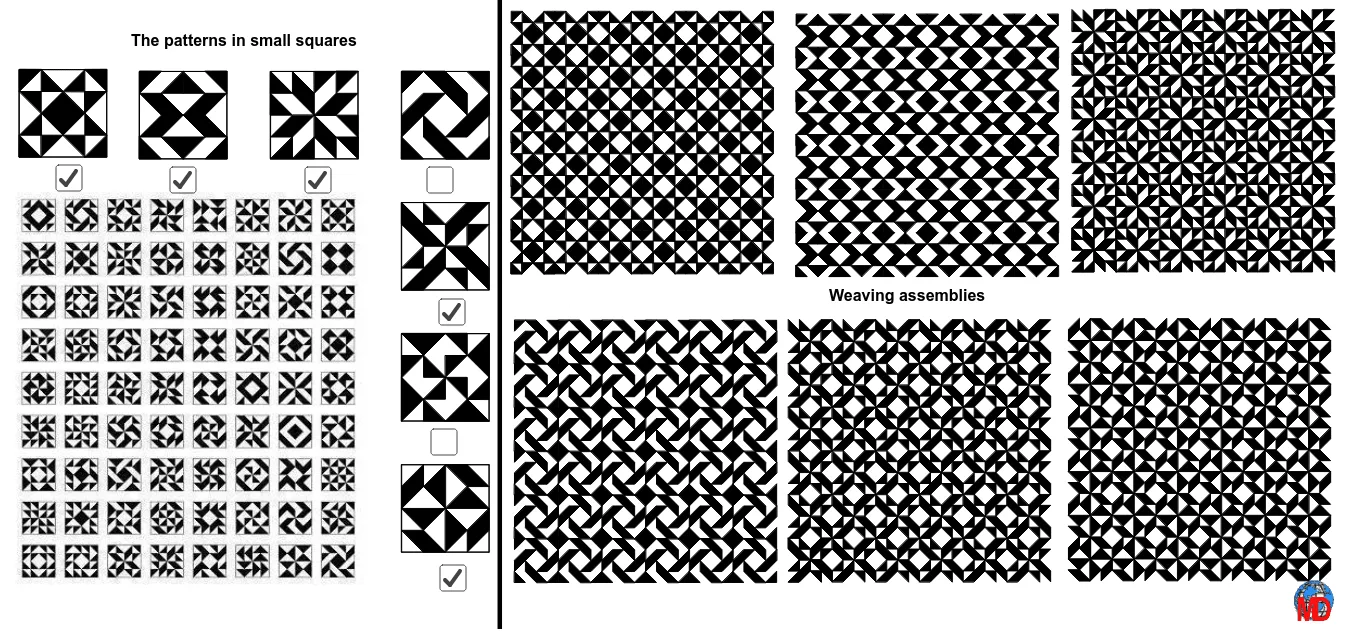
This example demonstrates how geometric transformations and function graphs are used to construct complex patterns for jacquard textiles. Core math concepts include vectors, sequences, polygon construction, transformations, and graphing functions. GeoGebra commands like Motif1, Vector, Sequence, Line, and Polygon are employed to create and combine geometric shapes. Suitable for high school and above students learning geometric constructions, function graphing, and transformation applications.
GeoGebra Commands & Parameters
Motif1(B_1, C_1) → poly15, poly16, poly25, poly26, poly27, poly17, poly18, poly19, poly20, poly21, poly22, poly23, poly24Vector(A, A + (1, 0)) → eVector(A, A + (0, 1)) → fSequence(Sequence[Translate[liste1, Vector[(s * e) + (t * f)]], s, 0, n], t, 0, n) → liste2Outil2(D_1, E_1) → poly14, poly28, poly37, poly38, poly29, poly30, poly31, poly32, poly33, poly34, poly35, poly36Sequence(Sequence[Translate[liste3, Vector[(s * e) + (t * f)]], s, 0, n], t, 0, n) → liste4Outil3(F_1, G_1) → poly39, poly40, poly49, poly50, poly41, poly42, poly43, poly44, poly45, poly46, poly47, poly48Outil3(H_1, I_1) → poly51, poly52, poly61, poly62, poly53, poly54, poly55, poly56, poly57, poly58, poly59, poly60Sequence(Sequence[Translate[liste5, Vector[(s * e) + (t * f)]], s, 0, n], t, 0, n) → liste6Outil3(C, D) → poly1, poly2, poly11, poly12, poly3, poly4, poly5, poly6, poly7, poly8, poly9, poly10Outil2(E, F) → poly13, poly63, poly72, poly73, poly64, poly65, poly66, poly67, poly68, poly69, poly70, poly71Motif1(G, H) → poly74, poly75, poly84, poly85, poly86, poly76, poly77, poly78, poly79, poly80, poly81, poly82, poly83Outil4(Q_1, R_1) → poly96, poly97, poly98, poly99, poly100, poly101, poly102, poly103Sequence(Sequence[Translate[liste7, Vector[(s * e) + (t * f)]], s, 0, n], t, 0, n) → liste8Outil4(S_1, T_1) → poly88, poly89, poly90, poly91, poly92, poly93, poly94, poly95Outil5(W_1, Z_1) → poly116, poly117, poly126, poly127, poly118, poly119, poly120, poly121, poly122, poly123, poly124, poly125Sequence(Sequence[Translate[liste9, Vector[(s * e) + (t * f)]], s, 0, n], t, 0, n) → liste10Outil5(A_2, B_2) → poly128, poly129, poly138, poly139, poly130, poly131, poly132, poly133, poly134, poly135, poly136, poly137Outil6(C_2, D_2) → poly112, poly113, poly114, poly115, poly140, poly141, poly142, poly143Sequence(Sequence[Translate[liste11, Vector[(s * e) + (t * f)]], s, 0, n], t, 0, n) → liste12Outil7(B, I) → poly87, poly104, poly105, poly106, poly107, poly108, poly109, poly110Sequence(Sequence[Translate[liste13, Vector[(s * e) + (t * f)]], s, 0, n], t, 0, n) → liste14Outil6(J, K) → poly111, poly144, poly145, poly146, poly147, poly148, poly149, poly150Outil7(L, M) → poly151, poly152, poly153, poly154, poly155, poly156, poly157, poly158Line(N, O) → jPolygon(G, H, 4) → poly159, k, l, m, p, P, QPolygon(E, F, 4) → poly160, q, r, s, t, R, SPolygon(C, D, 4) → poly161, a_1, b_1, c_1, d_1, T, UPolygon(S_1, T_1, 4) → poly162, e_1, f_1, g_1, h_1, V, WPolygon(J, K, 4) → poly163, i_1, j_1, k_1, l_1, Z, A_1Polygon(A_2, B_2, 4) → poly164, m_1, n_1, p_1, q_1, J_1, K_1Polygon(L, M, 4) → poly165, r_1, s_1, t_1, a_2, L_1, M_1
AI Drawing Prompt Reference
Create a complex geometric pattern demonstrating the use of geometric transformations and function graphs in jacquard textiles. Begin by constructing multiple quadrilaterals, then use vector transformations and sequence operations to translate and combine these shapes, forming layered patterns. The design features repeated geometric units that are rotated and translated to create a continuous texture, showcasing the application of function graphs and vectors.
The prompt above was compiled from the original drawing commands and is for reference only.