
Last Propositions of Decagon
Loading the math board and drawing, please wait…
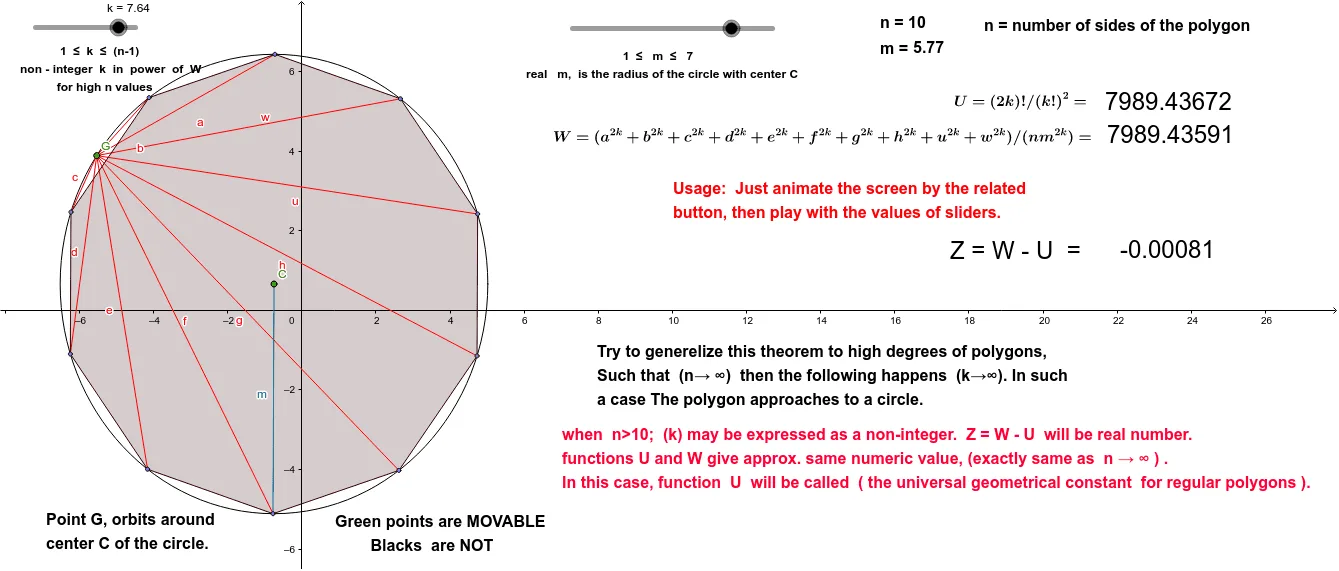
This example illustrates the last few propositions of a decagon, involving geometric transformations and vectors. Using GeoGebra commands such as Circle, Point, Segment, and Rotate, the construction of a decagon's elements is demonstrated. Suitable for high school geometry, aiding students in understanding the properties and transformations of a decagon.
GeoGebra Commands & Parameters
Circle(C, m_0) → g_1Point(g_1) → GPoint(g_1) → DSegment(G, D) → fRotate(D, 36°, C) → D'Segment(G, D') → gRotate(D', 36°, C) → D''Segment(G, D'') → hRotate(D'', 36°, C) → D'''Segment(G, D''') → uRotate(D''', 36°, C) → ESegment(G, E) → wRotate(E, 36°, C) → E'Segment(G, E') → aRotate(E', 36°, C) → E''Segment(G, E'') → bRotate(E'', 36°, C) → E'''Segment(G, E''') → cRotate(E''', 36°, C) → FSegment(G, F) → dRotate(F, 36°, C) → F'Segment(G, F') → eSegment(C, D) → mCircle(A, m_0) → hhhPoint(hhh) → BRotate(B, (-(60°)), A) → B'_1Rotate(B, 60°, A) → B'Rotate(B', 60°, A) → B''Rotate(B'', 60°, A) → B'''Rotate(B''', 60°, A) → KAttachCopyToView(PolyLine[(12.100000000000005,0.2599999999999979), (12.100000000000005,0.2599999999999979), (NaN,NaN), (12.100000000000005,0.2599999999999979), (12.080000000000004,0.19999999999999787), (12.020000000000005,0.2199999999999979), (12.020000000000005,0.29999999999999793), (12.020000000000005,0.379999999999998), (12.020000000000005,0.4599999999999981), (12.080000000000004,0.41999999999999804), (12.140000000000004,0.359999999999998), (12.160000000000004,0.29999999999999793), (12.160000000000004,0.2199999999999979), (12.140000000000004,0.15999999999999784), (12.060000000000004,0.15999999999999784), (12.000000000000004,0.17999999999999786), (11.960000000000004,0.2399999999999979), (11.960000000000004,0.31999999999999795), (11.960000000000004,0.399999999999998), (12.040000000000004,0.399999999999998), (12.140000000000004,0.399999999999998), (12.220000000000004,0.399999999999998), (12.260000000000005,0.33999999999999797), (12.280000000000005,0.2599999999999979), (12.280000000000005,0.17999999999999786), (12.220000000000004,0.2599999999999979), (12.220000000000004,0.33999999999999797), (12.200000000000005,0.4599999999999981), (12.160000000000004,0.5399999999999981), (12.120000000000005,0.5999999999999982), (12.040000000000004,0.5999999999999982), (11.960000000000004,0.5799999999999982), (11.880000000000004,0.5999999999999982), (11.880000000000004,0.6799999999999982), (11.800000000000004,0.7399999999999982), (11.880000000000004,0.6799999999999982), (11.920000000000005,0.6199999999999982), (11.940000000000005,0.5599999999999982), (12.040000000000004,0.5399999999999981), (12.160000000000004,0.49999999999999806), (12.220000000000004,0.4599999999999981), (12.180000000000005,0.399999999999998), (12.140000000000004,0.33999999999999797), (12.180000000000005,0.399999999999998), (12.240000000000004,0.41999999999999804), (12.280000000000005,0.33999999999999797), (12.280000000000005,0.2599999999999979), (12.320000000000004,0.15999999999999784), (12.340000000000005,0.2199999999999979), (12.260000000000005,0.2199999999999979), (12.180000000000005,0.2199999999999979), (12.100000000000005,0.19999999999999787), (12.000000000000004,0.19999999999999787), (11.900000000000004,0.19999999999999787), (11.860000000000005,0.2599999999999979), (11.840000000000005,0.31999999999999795), (11.800000000000004,0.379999999999998), (11.880000000000004,0.379999999999998), (11.940000000000005,0.33999999999999797), (12.000000000000004,0.29999999999999793), (12.060000000000004,0.359999999999998), (12.040000000000004,0.2799999999999979), (NaN,NaN), (7.460000000000003,-1.7000000000000035), (7.460000000000003,-1.7000000000000035), true], 1, (-5.120000000000001, -5.000000000000006), (18.720000000000006, 6.620000000000003), (0, 581), (1192, 0)) → stroke1Segment(C, D') → h_1Segment(C, D'') → iSegment(C, D''') → jSegment(C, E) → lSegment(C, E') → pSegment(C, E'') → qSegment(C, E''') → rSegment(C, F) → sSegment(F', C) → tPolygon(E', E'', E''', F, F', D, D', D'', D''', E) → poly1, e', e_2, e'', e''', f_2, f', d_1, d', d'', d'''Polygon(E', E'', E''', F, F', D, D', D'', D''', E) → poly2, e'_1, e_3, e''_1, e'''_1, f_3, f'_1, d_2, d'_1, d''_1, d'''_1
AI Drawing Prompt Reference
Draw a decagon starting from point C, rotating 36 degrees each time to generate points D, D', D'', D''', E, E', E'', E''', F, and connect these points to form the decagon. Additionally, rotate 60 degrees from point C to generate points B, B', B'', B''', and connect these points to form a hexagon. Finally, connect point C to all generated points to form polygons.
The prompt above was compiled from the original drawing commands and is for reference only.