
Koch Snowflake 3D Fractal
Loading the math board and drawing, please wait…
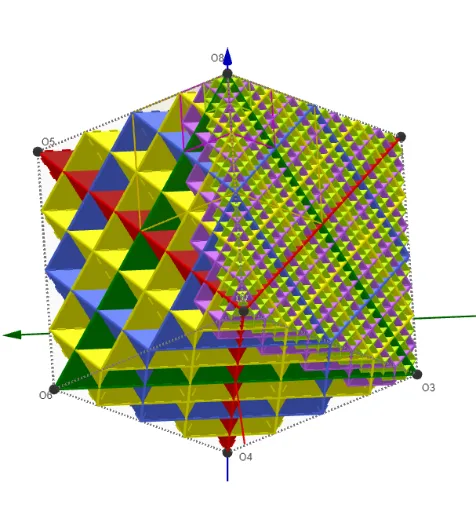
This example demonstrates the 3D construction of the Koch snowflake fractal, a concept in fractal geometry. The key mathematical concepts involved include fractal geometry, geometric transformations, and solid geometry. The construction uses GeoGebra commands such as Polygon, Cube, Tetrahedron, Sequence, Mirror, and Translate to build a tetrahedral cube structure. It is suitable for high school students or college freshmen to learn about geometric transformations and fractal concepts.
GeoGebra Commands & Parameters
Polygon(Take[T0, 1, 3]) → G00Cube(T0(4), (T0(1) + T0(2) - T0(3) + T0(4)) / 2, O) → Cubus, O2, faceAEDO, faceBCDE, edge3, edge2, edge1, edgeAO, edge4, edgeAE, edgeBE, edgeBC, O7, edge5, edgeCD_{1}, edgeDO, edgeDE, O6, O4, O3, face1, face4, face3, face2Tetrahedron(G00, true) → P0, A, face6, face5, face7, edge6, edge8, edge7Polygon(Take[T1, 1, 3]) → G10Tetrahedron(G10, true) → P1, B, face9, face8, face10, edge9, edge11, edge10Sequence(Polygon[Element[T2, j]], j, 1, 8) → G20Sequence(Tetrahedron[Element[G20, j], ¬(j ≟ 7 ∨ j ≟ 2)], j, 1, 8) → P2Sequence(Polygon[Element[T31, j]], j, 1, Length[T31]) → G31Sequence(Tetrahedron[Element[G31, j], j ≟ 4 ∨ j ≟ 5], j, 1, 8) → P31Mirror(P31, Plane[O6, O, O2]) → P32Mirror(P31, Plane[O6, O3, O5]) → P33Mirror(P31, Plane[O, O3, O5]) → P34Mirror(P31, Plane[(O5 + O6) / 2, (O8 + O7) / 2, (O2 + O3) / 2]) → P35Mirror(P31, Plane[(O3 + O7) / 2, (O8 + O2) / 2, (O5 + O) / 2]) → P36Mirror(P31, Plane[(O + O2) / 2, (O8 + O5) / 2, (O7 + O6) / 2]) → P37Sequence(Polygon[Element[T41, j]], j, 1, Length[T41]) → G51Sequence(Tetrahedron[Element[G51, j], j ≟ 4 ∨ j ≟ 5], j, 1, 8) → P41Translate(P41, Vector[(O2 - O8) / 4]) → P42Translate(P41, Vector[(O2 - O8) / 2]) → P43Translate(P41, Vector[((O2 - O8) * 3 / 4)]) → P44Translate(P41, Vector[(O7 - O8) / 4]) → P45Translate(P45, Vector[(O2 - O8) / 4]) → P46Translate(P45, Vector[(O2 - O8) / 2]) → P47Translate(P45, Vector[((O2 - O8) * 3 / 4)]) → P48Translate(P41, Vector[(O7 - O8) / 2]) → P49Translate(P49, Vector[(O2 - O8) / 4]) → P4ATranslate(P49, Vector[(O2 - O8) / 2]) → P4BTranslate(P49, Vector[((O2 - O8) * 3 / 4)]) → P4CTranslate(P41, Vector[((O7 - O8) * 3 / 4)]) → P4DTranslate(P4D, Vector[(O2 - O8) / 4]) → P4ETranslate(P4D, Vector[(O2 - O8) / 2]) → P4FTranslate(P4D, Vector[((O2 - O8) * 3 / 4)]) → P4GCube(O8, (O8 + O2) / 2, Vector[O - O2]) → Cubus_3, C, face13, faceCDHG, faceEFGH, edgeDO8, edge12, edge13, edgeCD, edgeEO8, edgeDH, edgeEH, D, edgeEF, edge14, edgeFG, edgeCG, edgeGH, E, F, G, H, face11, faceDHEO8, face12Cube(O8, O8 + (O2 - O8) / 4, Vector[O - O2]) → Cubus_4, I, face16, faceIJNM, faceKLMN, edgeJO8, edge15, edge16, edgeIJ, edgeKO8, edgeJN, edgeKN, J, edgeKL, edge17, edgeLM, edgeIM, edgeMN, K, L, M, N, face14, faceJNKO8, face15Cube(O8, O8 + (O2 - O8) / 8, Vector[O - O2]) → Cubus_5, P, face19, facePQUT, faceRSTU, edgeO8Q, edge18, edge19, edgePQ, edgeO8R, edgeQU, edgeRU, Q, edgeRS, edge20, edgeST, edgePT, edgeTU, R, S, T, U, face17, faceO8QUR, face18Sequence(Polygon[Element[T51, j]], j, 1, Length[T51]) → G61Sequence(Tetrahedron[Element[G61, j], j ≟ 4 ∨ j ≟ 5], j, 1, 8) → P50Sequence(Translate[Translate[P50, Vector[(O7 - O8) / 8]], Vector[((O2 - O8) * j / 8)]], j, 0, 7) → P52Sequence(Translate[Translate[P50, Vector[((O7 - O8) * 2 / 8)]], Vector[((O2 - O8) * j / 8)]], j, 0, 7) → P53Sequence(Translate[Translate[P50, Vector[((O7 - O8) * 3 / 8)]], Vector[((O2 - O8) * j / 8)]], j, 0, 7) → P54Sequence(Translate[Translate[P50, Vector[((O7 - O8) * 4 / 8)]], Vector[((O2 - O8) * j / 8)]], j, 0, 7) → P55Sequence(Translate[Translate[P50, Vector[((O7 - O8) * 5 / 8)]], Vector[((O2 - O8) * j / 8)]], j, 0, 7) → P56Sequence(Translate[Translate[P50, Vector[((O7 - O8) * 6 / 8)]], Vector[((O2 - O8) * j / 8)]], j, 0, 7) → P57Sequence(Translate[Translate[P50, Vector[((O7 - O8) * 7 / 8)]], Vector[((O2 - O8) * j / 8)]], j, 0, 7) → P58Sequence(Translate[P50, Vector[((O2 - O8) * j / 8)]], j, 0, 7) → P51Translate(P31, Vector[(O4 - O8) / 2]) → P38
AI Drawing Prompt Reference
Construct a 3D Koch snowflake fractal as a solid geometry model. Start from a polygon base, build a cube structure, then form a tetrahedron from the base element. Generate multiple segments by creating sequences of polygons and tetrahedra so the structure branches into several parts at increasing indices. Produce additional symmetric copies by mirroring the same set of polygons/tetrahedra across several planes, arranging them in different spatial directions. Finally, use translations with stepwise fractional vectors to repeat the mirrored segments and stack them at finer scales, yielding a multi-level 3D fractal snowflake composed of many tetrahedral and polygonal parts.
The prompt above was compiled from the original drawing commands and is for reference only.