
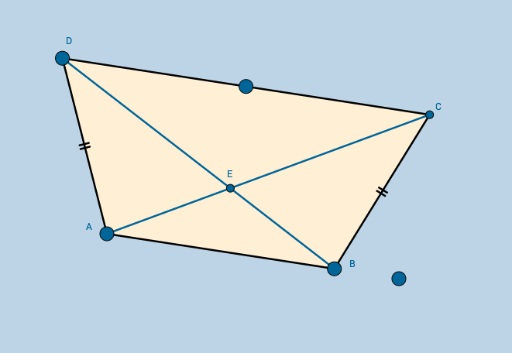
Isosceles Trapezoid Template by Tim Brzezinski
Loading the math board and drawing, please wait…
In collections
Congruence (CO) Cluster
Congruence (Vol 2)
CCSS High School: Geometry (Congruence) Volume 2
CCSS High School: Geometry (Congruence) Volume 2
CCSS High School: Geometry (Congruence) Volume 2
Geometry (Congruence) Volume 2
CCSS High School: Geometry (Congruence) Volume 2
CCSS High School: Geometry (Congruence) Volume 2
CCSS High School: Geometry (Congruence) Volume 2
CCSS High School: Geometry (Congruence) Volume 2
CCSS High School: Geometry (Congruence) Volume 2
CCSS High School: Geometry (Congruence) Volume 2
Gail LeBlancCCSS High School: Geometry (Congruence) Volume 2
CCSS High School: Geometry (Congruence) Volume 2
CCSS High School: Geometry (Congruence) Volume 2
Unit 7: Polygons and Quadrilaterals
Quadrilaterals
This example demonstrates the geometric construction and properties of an isosceles trapezoid. It involves core mathematical concepts such as polygons, angles, vectors, and geometric transformations. The construction utilizes GeoGebra commands and objects like Line, Point, Midpoint, Slope, OrthogonalLine, Mirror, Dilate, Segment, Circle, Intersect, Vector, Translate, Angle, Rotate, Polygon, and Distance. It is suitable for high school mathematics teaching or geometric construction practice, helping to understand the symmetry and transformation properties of isosceles trapezoids.
GeoGebra Commands & Parameters
Line(A, B_1) → aRay(A, B_1) → bPoint(b) → BMidpoint(A, B) → D_1Line(A, B) → cSlope(c) → dOrthogonalLine(D_1, c) → gPoint(g) → E_1Ray(D_1, E_1) → hPoint(h) → FSlope(h) → iLine(F, c) → lPoint(l) → GPoint(l) → HRay(F, G) → mRay(F, H) → nPoint(m) → DMirror(D, h) → I'Dilate(A, If[0 < o ≤ 1, 1 - o, 0], B) → A'Segment(A, A') → pDilate(A, If[1 < o ≤ 2, 2 - o, 0], D) → A'_1Segment(A, A'_1) → qSegment(A, B) → rSegment(B, I') → sSegment(I', D) → tSegment(D, A) → a_1Circle(A, (0.2 * Min[a_1, r])) → c_1Circle(D, (0.2 * Min[a_1, r])) → d_1Intersect(d_1, a_1, 1) → JIntersect(d_1, t, 1) → KIntersect(c_1, r, 1) → LIntersect(c_1, a_1, 1) → MDilate(D, If[2 < o ≤ 3, 3 - o, 0], I') → CSegment(D, C) → b_1Dilate(A, If[3 < o ≤ 4, 4 - o, 0], B) → A'_2Vector(A, A'_2) → uTranslate(A, u) → A'_3Translate(A'_1, u) → NSegment(A'_3, N) → q'OrthogonalLine(A, r) → g_1Point(g_1) → OAngle(D, A, O) → αAngle(I', B, A) → βRotate(A'_3, If[4 < o ≤ 5, (((o - 4) * 2) * α), (2 * α)], B) → PRotate(N, If[4 < o ≤ 5, (((o - 4) * 2) * α), (2 * α)], B) → C_1Dilate(A, If[5 < o ≤ 6, 6 - o, 0], B) → A'_4Vector(A, A'_4) → vDilate(D, If[7 < o ≤ 8, 8 - o, 0], I') → I'_2Vector(D, I'_2) → wDilate(A, If[9 < o ≤ 10, 10 - o, 0], I') → A'_5Segment(A, A'_5) → i_1Dilate(A, If[10 < o ≤ 11, 11 - o, 0], D) → A'_6Vector(A, A'_6) → u_1Translate(A, u_1) → A'_7Translate(A'_5, u_1) → QSegment(A'_7, Q) → j_1Segment(D, B) → l_1Angle(L, A, I') → γRotate(A'_7, If[11 < o ≤ 12, ((-(o - 11)) * (2 * γ)), (-2 * γ)], D) → RRotate(Q, If[11 < o ≤ 12, ((-(o - 11)) * (2 * γ)), (-2 * γ)], D) → Q'Segment(R, Q') → m_1Polygon(A, B, I', D) → poly1, a_2, c_2, i', i_2Intersect(i_1, m_1) → EDistance(A, E) → distanceASDistance(E, C_1) → distanceSN'Distance(E, B) → distanceSCDistance(E, D) → distanceSISegment(B, I') → q''